


Last Updated on January 10, 2026 by Nurseslab.in Editorial Team
Gram-positive bacilli are rod-shaped bacteria with thick cell walls that retain Gram stain. Pathogens like Bacillus, Clostridium, and Listeria species cause diverse infections—from foodborne illness to wound and neurological diseases—critical in microbiology and nursing care.
Introduction
Gram positive bacilli constitute a diverse group of bacteria, distinguished by their rod-shaped morphology and the ability to retain the crystal violet stain during Gram staining due to their thick peptidoglycan cell wall. These organisms are of significant clinical relevance, responsible for a spectrum of infections ranging from mild to life-threatening conditions. Their ubiquity in the environment and human microbiota, coupled with potent virulence factors, make them important pathogens in both community and healthcare settings.
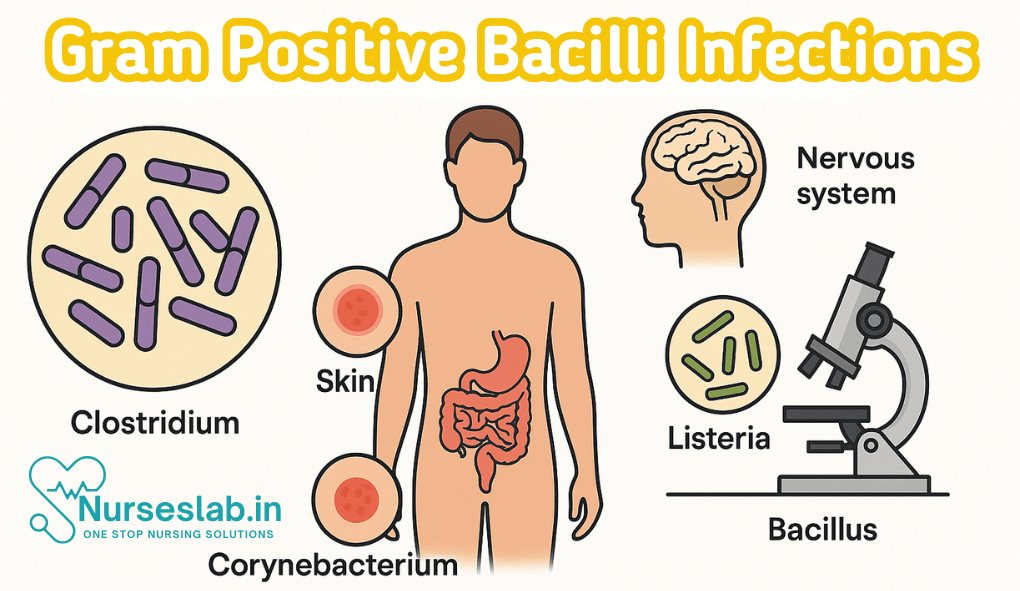
Classification of Gram Positive Bacilli
Major Genera and Distinguishing Features
Gram positive bacilli are classified into several major genera, each with unique characteristics and clinical significance. The principal genera include Bacillus, Clostridium, Corynebacterium, Listeria, and others such as Actinomyces and Propionibacterium. The distinguishing features of these genera are outlined below:
- Bacillus: Aerobic or facultatively anaerobic, spore-forming rods commonly found in soil. Notable species include Bacillus anthracis (anthrax) and Bacillus cereus (food poisoning).
- Clostridium: Obligate anaerobes, spore-forming rods, widely distributed in soil and intestinal tract. Key species are Clostridium tetani (tetanus), Clostridium botulinum (botulism), Clostridium perfringens (gas gangrene), and Clostridium difficile (antibiotic-associated diarrhoea).
- Corynebacterium: Non-spore-forming, aerobic rods. The most clinically relevant is Corynebacterium diphtheriae, the causative agent of diphtheria.
- Listeria: Small, non-spore-forming, facultatively anaerobic rods. Listeria monocytogenes is notable for causing listeriosis, especially in immunocompromised individuals, pregnant women, and neonates.
- Others: Actinomyces species are filamentous, anaerobic rods causing actinomycosis; Propionibacterium (now Cutibacterium) are implicated in acne and device-related infections.
Key Gram Positive Bacilli
| Genus | Spore Formation | Oxygen Requirement | Notable Species | Clinical Significance |
| Bacillus | Yes | Aerobic/Facultative | B. anthracis, B. cereus | Anthrax, Food poisoning |
| Clostridium | Yes | Anaerobic | C. tetani, C. botulinum, C. perfringens, C. difficile | Tetanus, Botulism, Gas gangrene, Diarrhoea |
| Corynebacterium | No | Aerobic | C. diphtheriae | Diphtheria |
| Listeria | No | Facultative Anaerobic | L. monocytogenes | Listeriosis |
| Actinomyces | No | Anaerobic | A. israelii | Actinomycosis |
Epidemiology
The prevalence and impact of Gram positive bacilli infections vary globally, influenced by geographic, environmental, and host factors. Key epidemiological aspects include:
- Anthrax: Endemic in agricultural regions; occupational exposure for farmers, veterinarians, and wool workers.
- Tetanus: More common in areas with poor immunisation coverage and inadequate wound care practices.
- Botulism: Associated with consumption of improperly preserved foods and, in infants, honey or environmental exposure.
- Gas Gangrene: Frequently arises in trauma or surgical wounds contaminated with soil or faeces.
- Diphtheria: Resurgent in regions with declining vaccine coverage.
- Listeriosis: Linked to consumption of contaminated dairy products, ready-to-eat meats, and vegetables; high-risk populations include pregnant women, neonates, elderly, and immunocompromised individuals.
Risk factors encompass advanced age, immunosuppression (e.g., HIV/AIDS, chemotherapy), chronic illnesses (diabetes, renal failure), and invasive healthcare interventions (surgery, indwelling devices). Susceptible populations include neonates, elderly, and those with impaired immunity.
Pathogenesis
Mechanisms of Infection
Gram positive bacilli employ diverse strategies to establish infection in the human host. The pathogenesis involves several steps:
- Colonisation: Initial attachment to host tissues, often mediated by adhesins and surface proteins.
- Invasion: Breaching of epithelial barriers, either via toxins or direct invasion.
- Multiplication: Proliferation within host tissues, sometimes facilitated by evasion of immune responses.
- Toxin Production: Many species produce potent exotoxins that mediate tissue damage and systemic effects.
- Host Response: Activation of innate and adaptive immunity, which may contribute to tissue pathology (e.g., inflammation, necrosis).
Virulence Factors
- Bacillus anthracis: Capsule (poly-D-glutamic acid), anthrax toxin (protective antigen, lethal factor, oedema factor).
- Clostridium tetani: Tetanospasmin (neurotoxin) interferes with inhibitory neurotransmitter release.
- Clostridium botulinum: Botulinum toxin blocks acetylcholine release, causing flaccid paralysis.
- Clostridium perfringens: Alpha toxin (phospholipase C), collagenase, hyaluronidase facilitate tissue destruction.
- Corynebacterium diphtheriae: Diphtheria toxin inhibits protein synthesis (ADP-ribosylation of EF-2).
- Listeria monocytogenes: Listeriolysin O enables escape from phagosomes; internalins promote cell invasion.
Host Response
The host mounts both innate and adaptive immune responses against Gram positive bacilli. Neutrophils and macrophages play key roles in phagocytosis and containment, while humoral immunity (antibodies) neutralises toxins. However, excessive inflammation and immune-mediated tissue damage may exacerbate disease severity, as seen in gas gangrene and diphtheria.
Clinical Manifestations
Disease Presentations by Pathogen
Anthrax (Bacillus anthracis):
- Cutaneous: Painless ulcer with black eschar, local oedema.
- Inhalational: Severe respiratory distress, mediastinal widening, high mortality.
- Gastrointestinal: Abdominal pain, vomiting, bloody diarrhoea, sepsis.
Food Poisoning (Bacillus cereus):
- Emetic type: Rapid-onset vomiting, linked to rice dishes.
- Diarrhoeal type: Watery diarrhoea, abdominal cramps.
Tetanus (Clostridium tetani):
- Generalised muscle rigidity, spasms, trismus (“lockjaw”), opisthotonos, autonomic dysfunction.
Botulism (Clostridium botulinum):
- Descending symmetric flaccid paralysis, cranial nerve involvement (diplopia, dysphagia), respiratory failure.
Gas Gangrene (Clostridium perfringens):
- Rapidly progressive muscle necrosis, severe pain, crepitus (gas in tissues), systemic toxicity, shock.
Diphtheria (Corynebacterium diphtheriae):
- Sore throat, low-grade fever, pseudomembrane formation in pharynx, cervical lymphadenopathy (“bull neck”), myocarditis, neuropathy.
Listeriosis (Listeria monocytogenes):
- Febrile gastroenteritis, bacteraemia, meningitis (especially neonates, elderly), granulomatosis infantiseptica (in utero infection).
Actinomycosis (Actinomyces israelii):
- Chronic suppurative infection, sinus tract formation, “sulphur granules” in pus.
Clinical Syndromes
| Pathogen | Common Clinical Syndromes | At-Risk Populations |
| B. anthracis | Cutaneous, inhalational, gastrointestinal anthrax | Farmers, veterinarians, textile workers |
| B. cereus | Emetic and diarrhoeal food poisoning | General population (contaminated food) |
| C. tetani | Tetanus (muscle rigidity, spasms) | Unvaccinated, trauma patients |
| C. botulinum | Botulism (flaccid paralysis) | Infants, foodborne outbreaks |
| C. perfringens | Gas gangrene, food poisoning | Trauma, surgical patients |
| C. diphtheriae | Diphtheria (respiratory, cutaneous) | Unimmunised children, adults |
| L. monocytogenes | Listeriosis (meningitis, sepsis) | Pregnant women, neonates, elderly, immunocompromised |
| A. israelii | Actinomycosis (chronic abscesses) | Individuals with poor oral hygiene, immunocompromised |
Diagnosis
Laboratory Identification
Accurate diagnosis of Gram positive bacilli infections relies on a combination of clinical suspicion and laboratory confirmation. Key steps include:
- Microscopy: Gram stain reveals purple rod-shaped bacteria; presence of spores or characteristic arrangements (e.g., “Chinese letter” for Corynebacterium).
- Culture: Use of selective and differential media (e.g., blood agar, Robertson’s cooked meat medium for anaerobes).
- Biochemical Tests: Identification based on catalase, motility, sugar fermentation, and toxin production.
- Toxin Detection: ELISA, PCR, or bioassays for diphtheria, tetanus, and botulinum toxins.
- Molecular Methods: PCR and nucleic acid amplification for rapid and specific identification.
- Imaging: Radiographs for gas gangrene (gas in soft tissues), echocardiography for diphtheritic myocarditis.
Clinical Criteria and Differential Diagnosis
Diagnosis requires integration of laboratory findings with clinical features. Differential diagnosis may include other bacterial, viral, or non-infectious conditions presenting with similar symptoms (e.g., viral pharyngitis vs. diphtheria, stroke vs. botulism). A thorough history, including exposure risks and immunisation status, is essential.
Treatment Options
Antimicrobial Therapy
The mainstay of therapy for Gram positive bacilli infections is timely administration of appropriate antimicrobials. The choice of agent depends on the pathogen, site of infection, and local resistance patterns.
- Anthrax: Ciprofloxacin, doxycycline, or penicillin G; adjunctive antitoxin for systemic disease.
- Tetanus: Metronidazole or penicillin; human tetanus immunoglobulin (HTIG) for toxin neutralisation.
- Botulism: Equine-derived antitoxin; supportive care (mechanical ventilation), antibiotics for wound botulism (penicillin, metronidazole).
- Gas Gangrene: High-dose penicillin G, clindamycin; surgical debridement is crucial.
- Diphtheria: Erythromycin or penicillin; diphtheria antitoxin for toxin neutralisation.
- Listeriosis: Ampicillin (with or without gentamicin); trimethoprim-sulfamethoxazole for penicillin-allergic patients.
- Actinomycosis: Prolonged high-dose penicillin; surgical drainage for abscesses.
Supportive Care and Resistance Issues
Supportive measures (airway management, fluid resuscitation, wound care) are often lifesaving. Increasing antimicrobial resistance, particularly among Bacillus cereus, Listeria, and Clostridium difficile, necessitates judicious use of antibiotics and consideration of local susceptibility data. Multidisciplinary care, including infectious disease specialists and surgeons, improves outcomes in severe infections.
Prevention and Control
Vaccines
- Tetanus: Tetanus toxoid vaccine (part of DPT, DT, Td, Tdap schedules) provides effective protection; booster every 10 years.
- Diphtheria: Diphtheria toxoid vaccine (DPT, Td, Tdap) is highly effective; routine childhood immunisation is essential.
- Anthrax: Vaccine available for high-risk occupational groups; not part of routine immunisation.
Infection Control Measures
- Strict aseptic techniques in healthcare settings.
- Proper wound care and hygiene to prevent tetanus and gas gangrene.
- Safe food handling (adequate cooking, refrigeration) to prevent botulism, listeriosis, and B. cereus food poisoning.
- Surveillance and prompt isolation of diphtheria cases.
- Education and awareness campaigns for at-risk populations.
Public Health Strategies
Comprehensive public health interventions include:
- Universal immunisation programmes (DPT).
- Outbreak investigation and reporting (especially diphtheria, anthrax).
- Food safety regulations and monitoring.
- Occupational health measures for high-risk groups (farmers, laboratory workers).
Recent Advances
Emerging Pathogens and New Therapies
Recent trends highlight the emergence of multidrug-resistant strains, especially among Clostridium difficile, Bacillus cereus, and Listeria monocytogenes. Novel diagnostic modalities, such as multiplex PCR and mass spectrometry (MALDI-TOF), have enhanced rapid identification. Research into monoclonal antibodies, bacteriophage therapy, and vaccine development is ongoing, offering hope for improved management and prevention.
Research Trends
- Genomic studies elucidating virulence mechanisms and resistance determinants.
- Development of next-generation vaccines (e.g., recombinant anthrax, diphtheria).
- Investigations into host-pathogen interactions for targeted therapies.
- Global surveillance to track emerging strains and outbreaks.
Conclusion
Gram positive bacilli are a major cause of diverse and often severe infections, challenging clinicians and public health systems worldwide. Their clinical impact is shaped by potent virulence factors, environmental ubiquity, and the vulnerability of certain populations. Effective management requires a multidisciplinary approach encompassing prompt diagnosis, appropriate antimicrobial therapy, supportive care, and robust prevention strategies such as vaccination and infection control.
Ongoing research into pathogen biology, resistance mechanisms, and innovative treatments will continue to shape the future of Gram positive bacilli infection control. Medical professionals and students must remain vigilant, updating their knowledge and practices to address these evolving threats.
REFERENCES
- Apurba S Sastry, Essential Applied Microbiology for Nurses including Infection Control and Safety, First Edition 2022, Jaypee Publishers, ISBN: 978-9354659386
- Joanne Willey, Prescott’s Microbiology, 11th Edition, 2019, Innox Publishers, ASIN- B0FM8CVYL4.
- Anju Dhir, Textbook of Applied Microbiology including Infection Control and Safety, 2nd Edition, December 2022, CBS Publishers and Distributors, ISBN: 978-9390619450
- Gerard J. Tortora, Microbiology: An Introduction 13th Edition, 2019, Published by Pearson, ISBN: 978-0134688640
- Durrant RJ, Doig AK, Buxton RL, Fenn JP. Microbiology Education in Nursing Practice. J Microbiol Biol Educ. 2017 Sep 1;18(2):18.2.43. https://pmc.ncbi.nlm.nih.gov/articles/PMC5577971/
Stories are the threads that bind us; through them, we understand each other, grow, and heal.
JOHN NOORD
Connect with “Nurses Lab Editorial Team”
I hope you found this information helpful. Do you have any questions or comments? Kindly write in comments section. Subscribe the Blog with your email so you can stay updated on upcoming events and the latest articles.


