


Last Updated on January 11, 2026 by Nurseslab.in Editorial Team
Glycolysis is the first step in cellular respiration, breaking down glucose into pyruvate while producing ATP and NADH. This process occurs in the cytoplasm and provides quick energy for cells, essential in physiology, nursing, and medical education.
Introduction
Glycolysis is directly linked to conditions such as diabetes, sepsis, and shock, where energy supply and glucose utilisation are critical. Understanding this pathway helps nurses anticipate and respond to metabolic changes, recognise early warning signs, and effectively communicate with other healthcare professionals.
Overview of Glycolysis
Definition of Glycolysis
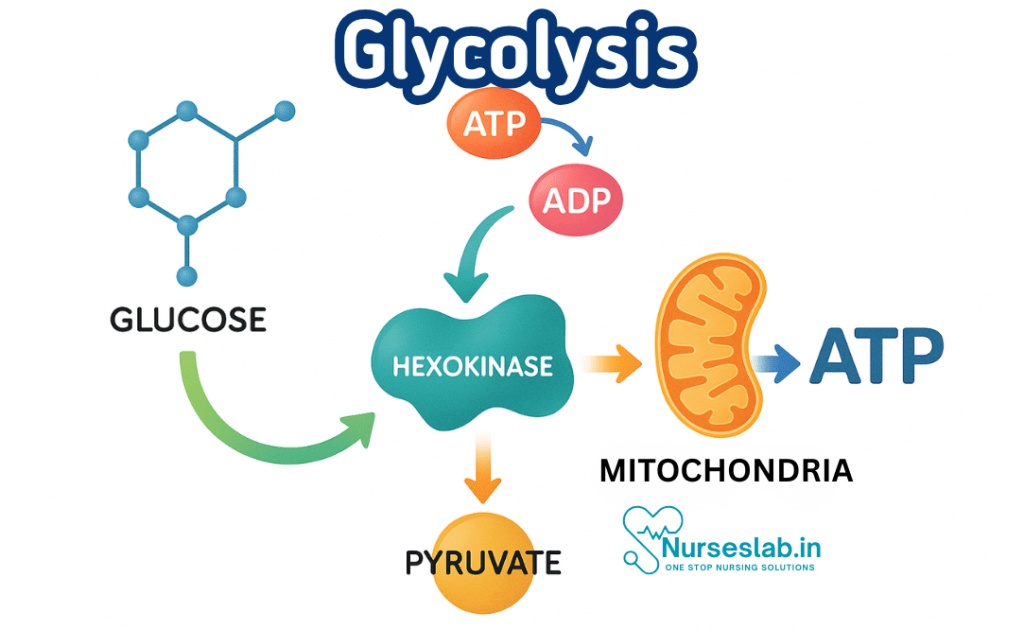
Glycolysis is a series of ten enzyme-catalysed reactions that break down one molecule of glucose (a six-carbon sugar) into two molecules of pyruvate (a three-carbon compound). In the process, glycolysis generates energy in the form of adenosine triphosphate (ATP) and provides intermediates for other metabolic pathways.
Historical Background
The discovery of glycolysis dates back to the late 19th and early 20th centuries. Pioneering work by scientists such as Gustav Embden, Otto Meyerhof, and Jakub Parnas led to the elucidation of the pathway, often referred to as the Embden-Meyerhof-Parnas (EMP) pathway. Their research laid the foundation for modern metabolic biochemistry.
Role of Glycolysis in Metabolism
Glycolysis is central to energy production, particularly in tissues with high or fluctuating energy demands. It operates in the cytoplasm of all cells and does not require oxygen, making it essential for anaerobic energy production. Glycolysis also supplies intermediates for other metabolic processes, such as the synthesis of amino acids, nucleotides, and lipids.
Key Features of Glycolysis:
- Universal: Present in virtually all cells.
- Anaerobic: Can operate without oxygen.
- Initial step in glucose metabolism.
- Provides precursors for other metabolic pathways.
Detailed Steps of Glycolysis
Glycolysis consists of two main phases: the energy investment phase and the energy payoff phase. Each phase comprises a series of specific enzymatic reactions. Understanding these steps equips nurses with insights into how glucose is metabolised and how energy is produced at the cellular level.
Phase 1: Energy Investment Phase
1.Glucose to Glucose-6-Phosphate (G6P)
- Enzyme: Hexokinase (or Glucokinase in the liver)
- Process: A phosphate group from ATP is transferred to glucose, forming G6P. This step is irreversible and traps glucose inside the cell.
- Significance: Begins the commitment of glucose to metabolism within the cell.
2.Glucose-6-Phosphate to Fructose-6-Phosphate (F6P)
- Enzyme: Phosphoglucose isomerase
- Process: G6P is rearranged to form F6P, an isomer.
- Significance: Prepares the molecule for further phosphorylation.
3.Fructose-6-Phosphate to Fructose-1,6-Bisphosphate (F1,6BP)
- Enzyme: Phosphofructokinase-1 (PFK-1)
- Process: Another phosphate group from ATP is added, producing F1,6BP. This is a key regulatory and irreversible step.
- Significance: PFK-1 is a major control point, sensitive to the cell’s energy status.
4.Fructose-1,6-Bisphosphate to Glyceraldehyde-3-Phosphate (G3P) and Dihydroxyacetone Phosphate (DHAP)
- Enzyme: Aldolase
- Process: F1,6BP is split into two three-carbon sugars: G3P and DHAP.
- Significance: Only G3P continues directly through glycolysis; DHAP is converted to G3P in the next step.
5.Dihydroxyacetone Phosphate to Glyceraldehyde-3-Phosphate
- Enzyme: Triose phosphate isomerase
- Process: DHAP is converted into G3P, ensuring that two molecules proceed through the subsequent steps.
- Significance: Doubles the products formed in the next phase.
Phase 2: Energy Payoff Phase
a.Glyceraldehyde-3-Phosphate to 1,3-Bisphosphoglycerate (1,3-BPG)
- Enzyme: Glyceraldehyde-3-phosphate dehydrogenase
- Process: G3P is oxidised and phosphorylated, producing 1,3-BPG and reducing NAD+ to NADH.
- Significance: Generates reducing equivalents (NADH) for further energy production.
b. 1,3-Bisphosphoglycerate to 3-Phosphoglycerate
- Enzyme: Phosphoglycerate kinase
- Process: A phosphate group is transferred from 1,3-BPG to ADP, forming ATP and 3-phosphoglycerate.
- Significance: This is an example of substrate-level phosphorylation, producing ATP directly.
c.3-Phosphoglycerate to 2-Phosphoglycerate
- Enzyme: Phosphoglycerate mutase
- Process: The phosphate group is shifted from the third to the second carbon.
- Significance: Prepares the molecule for dehydration in the next step.
d.2-Phosphoglycerate to Phosphoenolpyruvate (PEP)
- Enzyme: Enolase
- Process: Water is removed, producing PEP, a high-energy compound.
- Significance: PEP is primed to generate ATP in the final step.
e.Phosphoenolpyruvate to Pyruvate
- Enzyme: Pyruvate kinase
- Process: PEP donates its phosphate to ADP, forming ATP and pyruvate.
- Significance: Another substrate-level phosphorylation. This step is irreversible and tightly regulated.
Energy Yield of Glycolysis
For every molecule of glucose metabolised, glycolysis produces:
- 2 molecules of ATP (net gain; 4 produced, 2 consumed)
- 2 molecules of NADH (used in further energy production, depending on oxygen availability)
- 2 molecules of pyruvate (which can enter the citric acid cycle or be converted to lactate)
Summary Table: Steps, Enzymes, and Products
| Step | Enzyme | Substrate | Product | ATP/NADH |
| 1 | Hexokinase | Glucose | Glucose-6-phosphate | -1 ATP |
| 2 | Phosphoglucose isomerase | Glucose-6-phosphate | Fructose-6-phosphate | |
| 3 | Phosphofructokinase-1 | Fructose-6-phosphate | Fructose-1,6-bisphosphate | -1 ATP |
| 4 | Aldolase | Fructose-1,6-bisphosphate | G3P & DHAP | |
| 5 | Triose phosphate isomerase | DHAP | G3P | |
| 6 | G3P dehydrogenase | G3P | 1,3BPG | +2 NADH |
| 7 | Phosphoglycerate kinase | 1,3BPG | 3PG | +2 ATP |
| 8 | Phosphoglycerate mutase | 3PG | 2PG | |
| 9 | Enolase | 2PG | PEP | |
| 10 | Pyruvate kinase | PEP | Pyruvate | +2 ATP |
Regulation of Glycolysis
The body finely tunes glycolysis to balance energy supply and demand. Three main enzymes regulate the pathway:
- Hexokinase/Glucokinase: Inhibited by its product (G6P), preventing excessive glucose phosphorylation.
- Phosphofructokinase-1 (PFK-1): The primary regulatory enzyme, sensitive to ATP (inhibits when energy is high) and AMP (activates when energy is low). Also regulated by citrate and fructose 2,6-bisphosphate.
- Pyruvate kinase: Activated by F1,6BP (feed-forward activation), inhibited by ATP and alanine.
Hormonal Control
Hormones modulate glycolysis to suit the body’s metabolic state:
- Insulin: Stimulates glycolysis by upregulating key enzymes, especially after meals when blood glucose is high.
- Glucagon: Inhibits glycolysis in the liver during fasting, favouring glucose production (gluconeogenesis) instead.
- Adrenaline: Increases glycolysis in muscle during stress or exercise to provide rapid energy.
Physiological Conditions Affecting Glycolysis
Several physiological states influence glycolytic activity:
- Exercise: Increases glycolysis in muscles to meet energy demands.
- Hypoxia (low oxygen): Shifts metabolism towards anaerobic glycolysis, increasing lactate production.
- Fasting: Reduces glycolysis in the liver, conserving glucose for critical organs such as the brain and red blood cells.
Clinical Significance of Glycolysis
A thorough understanding of glycolysis is essential in clinical practice, as many diseases and diagnostic tests involve this pathway.
Disorders Related to Glycolysis
- Diabetes Mellitus: Impaired glucose uptake and metabolism lead to altered glycolytic activity, affecting energy balance and producing complications such as lactic acidosis.
- Pyruvate Kinase Deficiency: A genetic disorder affecting red blood cells, causing haemolytic anaemia due to impaired ATP production.
- Lactic Acidosis: Excessive anaerobic glycolysis (as seen in sepsis, shock, or hypoxia) leads to lactate accumulation, lowering blood pH and causing metabolic acidosis.
- Cancer: Many tumours exhibit increased glycolysis (the ‘Warburg effect’), even in the presence of oxygen, to support rapid cell growth and division.
Diagnostic Markers and Laboratory Tests
Common tests related to glycolysis include:
- Blood Glucose: Reflects the availability of substrate for glycolysis; critical in diabetes management.
- Lactate Levels: Elevated in hypoxia, sepsis, or metabolic disorders; a key marker of tissue perfusion and oxygenation.
- Pyruvate and Enzyme Assays: Used in diagnosing rare metabolic disorders affecting glycolytic enzymes.
Implications for Patient Care
Nurses must recognise abnormal glycolytic activity and respond appropriately. For example, monitoring for signs of hypoglycaemia or hyperglycaemia, recognising lactic acidosis, and understanding the metabolic needs of critically ill patients.
Glycolysis in Different Tissues
While glycolysis is a universal pathway, its role and regulation vary across tissues:
- Muscle: During exercise, muscles rely heavily on glycolysis for rapid ATP production, especially when oxygen is limited.
- Brain: The brain depends almost entirely on glucose and glycolysis for energy, as it cannot use fatty acids efficiently.
- Red Blood Cells: Lacking mitochondria, red blood cells rely exclusively on glycolysis for ATP generation.
- Liver: The liver modulates glycolysis and gluconeogenesis to maintain blood glucose homeostasis, responding to hormonal signals.
Nursing Implications
Glycolysis is more than a theoretical concept; its understanding has practical applications in daily nursing practice.
Monitoring Metabolic Status
Nurses are often the first to notice changes in a patient’s metabolic state. Knowledge of glycolysis informs the interpretation of vital signs, laboratory results, and clinical symptoms. For example, rapid breathing, confusion, and hypotension in a septic patient may indicate lactic acidosis due to increased anaerobic glycolysis.
Understanding Laboratory Results
Laboratory data such as blood glucose and lactate levels are central to patient assessment and management. Nurses who understand the underlying metabolic pathways can more effectively interpret these results, anticipate complications, and advocate for timely interventions.
Patient Education
Nurses play a key role in educating patients about metabolic health. Explaining how the body uses glucose, the impact of diet and exercise, and the importance of medication adherence empowers patients to take an active role in managing their conditions, especially in chronic illnesses such as diabetes.
Summary and Key Takeaways
- Glycolysis is a central metabolic pathway converting glucose to pyruvate, generating ATP and NADH.
- The pathway consists of ten enzyme-catalyzed steps, divided into energy investment and energy payoff phases.
- Regulation of glycolysis ensures energy balance, controlled by key enzymes and hormones.
- Disorders of glycolysis have significant clinical repercussions, including anemia and lactic acidosis.
- Nurses play a crucial role in monitoring metabolic status, interpreting lab values, and educating patients.
- Understanding glycolysis enhances nursing practice and patient outcomes across diverse clinical settings.
REFERENCES
- Harbans Lal, Textbook of Applied Biochemistry and Nutrition& Dietetics 2nd Edition ,November 2024, CBS Publishers and Distributors, ISBN: 978-9394525757
- Suresh K Sharma, Textbook of Biochemistry and Biophysics for Nurses, 2nd Edition, September 2022, Jaypee Publishers, ISBN: 978-9354655760
- Peter J Kennelly, Harpers Illustrated Biochemistry Standard Edition, September 2022, McGraw Hill Lange Publishers, ISBN: 978-1264795673
- Denise R Ferrier, Ritu Singh, Lippincott Illustrated Reviews Biochemistry, Second Edition, June 2024, ISBN- 978-8197055973
- Yadav, Tapeshwar & Bhadeshwar, Sushma. (2022). Essential Textbook of Biochemistry for Nursing.
- Applied Sciences, Importance of Biochemistry for Nursing Practice, November 2, 2023, https://bns.institute/applied-sciences/importance-biochemistry-nursing-practice/
Stories are the threads that bind us; through them, we understand each other, grow, and heal.
JOHN NOORD
Connect with “Nurses Lab Editorial Team”
I hope you found this information helpful. Do you have any questions or comments? Kindly write in comments section. Subscribe the Blog with your email so you can stay updated on upcoming events and the latest articles.


