


Last Updated on January 14, 2026 by Nurseslab.in Editorial Team
Virginia Henderson’s Nursing Need Theory is a cornerstone of modern nursing practice, emphasizing the nurse’s role in helping patients achieve independence in meeting their basic needs. Often called the “First Lady of Nursing,” Henderson redefined nursing as more than just task execution—it’s about empowering individuals to regain control over their health.
Life Story of Virginia Henderson
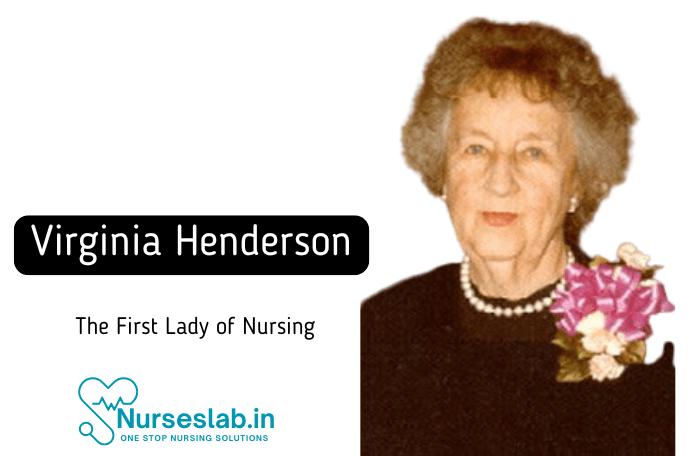
Virginia Avenel Henderson (1897–1996) was a pioneering nurse theorist, educator, and researcher whose work laid the foundation for modern nursing practice. Her definition of nursing and her Need Theory continue to shape nursing education and patient care worldwide.
Early Life & Education
- Born November 30, 1897, in Kansas City, Missouri, and raised in Bedford County, Virginia.
- Received early education at her grandfather’s boys’ school and later at home with her aunts.
- Graduated from the U.S. Army School of Nursing in Washington, D.C., in 1921.
- Earned her Bachelor’s (1932) and Master’s (1934) degrees from Teachers College, Columbia University.
Career & Contributions
- Began as a public health nurse in New York and Washington, D.C.
- Became the first full-time nursing instructor in Virginia at Norfolk Presbyterian Hospital (1924–1929).
- Taught at Teachers College, Columbia University for 14 years, influencing generations of nurses.
- Joined Yale School of Nursing in 1953 as a research associate, continuing until her death3.
The Need Theory
- Defined nursing as:
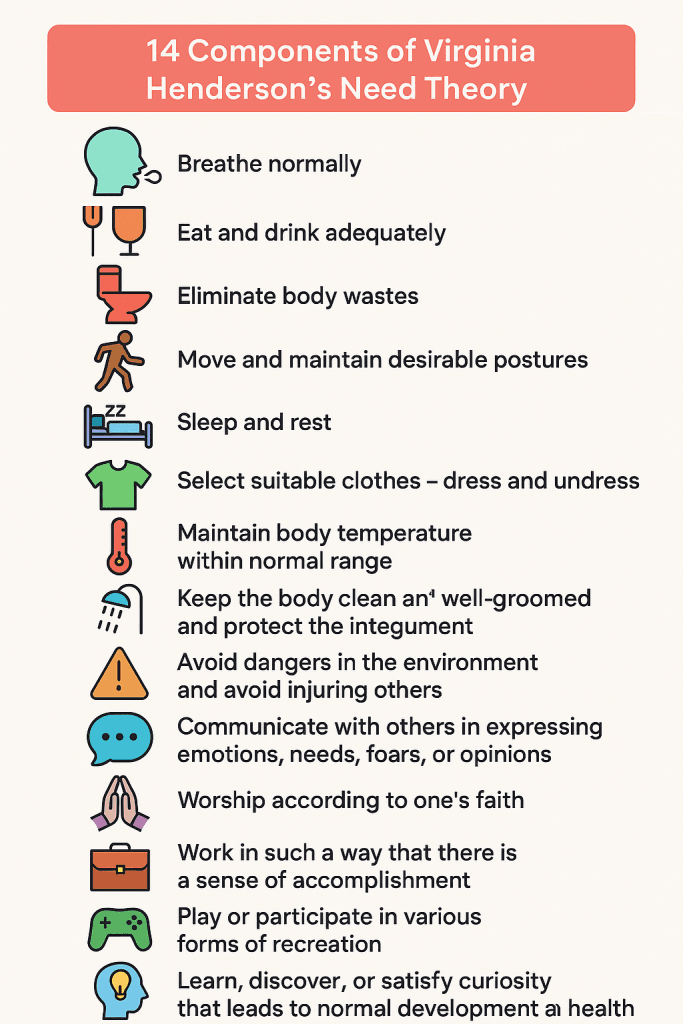
- Identified 14 fundamental needs of patients, ranging from breathing and nutrition to communication and spirituality.
- Emphasized patient independence, holistic care, and the nurse’s role as substitutive, supplementary, or complementary.
Legacy & Honors
- Called the “First Lady of Nursing”, “Modern-Day Mother of Nursing”, and “20th Century Florence Nightingale”.
- Authored and revised key nursing texts, including Principles and Practice of Nursing and Basic Principles of Nursing Care.
- Directed the Nursing Studies Index, a 12-year project cataloging nursing research from 1900 to 1960.
- Received 13 honorary doctorates, the Christiane Reimann Prize, and was inducted into the ANA-Hall of Fame.
- The Virginia Henderson Global Nursing e-Repository was named in her honor.
Final Years
- Buried in her family’s plot in Bedford County, Virginia.
- Passed away on March 19, 1996, at age 98, in Branford, Connecticut.
“Nurses assisted individuals, sick or well, in the performance of those activities contributing to health, its recovery (or to a peaceful death), that they would perform unaided if they had the requisite strength, will or knowledge.”
Need Theory of Virginia Henderson
Nursing Need Theory is one of the most crucial theories since it laid the foundation for other nursing care approaches in the 20th century. Henderson’s nursing theory focuses on the nursing staff’s attention to the physiological, psychological, and social needs met through nursing care. One of the prerequisites and assumptions of this model is the patient’s participation in the planning and implementation of care.
Background of the Need Theory
- She called her definition of nursing her “concept” (Henderson1991)
- She emphasized the importance of increasing the patient’s independence so that progress after hospitalization would not be delayed (Henderson,1991)
- “assisting individuals to gain independence in relation to the performance of activities contributing to health or its recovery” (Henderson, 1966).
- She categorized nursing activities into 14 components, based on human needs.
- She described the nurse’s role as substitutive (doing for the person), supplementary (helping the person), complementary (working with the person), with the goal of helping the person become as independent as possible.
- Her definition of nursing was:
“The unique function of the nurse is to assist the individual, sick or well, in the performance of those activities contributing to health or its recovery (or to peaceful death) that he would perform unaided if he had the necessary strength, will or knowledge. And to do this in such a way as to help him gain independence as rapidly as possible” (Henderson, 1966)
Physiological Components
- breathe normally
- eat and drink adequately
- eliminate waste
- movement and maintain posture
- sleep and rest
- Choose clothing and dress
- maintenance of body temperature
- cleaning and grooming of the body
- avoidance of environmental dangers and injury
Psychological Aspects of Communicating and Learning
- express emotion and needs by communication
- learning and discovery
Spiritual and Moral
- worship under one’s faith
Sociologically Oriented to Occupation and Recreation
- accomplish work
- play and participate in recreation
Nursing can be evaluated as a profession on the basis of the extent to which it enables the individual to achieve each of these functions autonomously.
The role and functions of professional nursing vary with the situation. If the total health care team could be seen as a pie graph in health care situations, in some situations no role exists for certain health care workers.
Henderson’s theory & the four major concepts
Virginia Henderson is known as the “First Lady of Nursing” and developed the Need Theory, which defines nursing as:
“Assisting the individual, sick or well, in the performance of those activities contributing to health, recovery, or a peaceful death that he would perform unaided if he had the necessary strength, will, or knowledge.”
Concepts of the Theory
- Nurse’s Role: Act as a substitute (doing for the patient), helper (assisting the patient), or partner (working with the patient).
- Goal of Nursing: Help the patient gain independence as quickly as possible.
- Four Components:
- Individual – A patient with 14 fundamental needs
- Environment – Conditions affecting health and independence
- Health – Ability to function independently
- Nursing – Assisting the individual to achieve independence
1. Individual
- Have basic needs that are component of health.
- Requiring assistance to achieve health and independence or a peaceful death.
- Mind and body are inseparable and interrelated.
- Considers the biological, psychological, sociological, and spiritual components.
- The theory presents the patient as a sum of parts with biopsychosocial needs.
2. Environment
- Settings in which an individual learns unique pattern for living.
- All external conditions and influences that affect life and development.
- Individuals in relation to families
- Minimally discusses the impact of the community on the individual and family.
- Basic nursing care involves providing conditions under which the patient can perform the 14 activities unaided
3. Health
- Definition based on individual’s ability to function independently as outlined in the 14 components.
- Nurses need to stress promotion of health and prevention and cure of disease.
- Good health is a challenge -affected by age, cultural background, physical, and intellectual capacities, and emotional balance Is the individual’s ability to meet these needs independently.
4. Nursing
- Temporarily assisting an individual who lacks the necessary strength, will and knowledge to satisfy 1 or more of 14 basic needs.
- Assists and supports the individual in life activities and the attainment of independence.
- Nurse serves to make patient “complete” “whole”, or “independent.”
- The nurse is expected to carry out physician’s therapeutic plan Individualized care is the result of the nurse’s creativity in planning for care.
- “Nurse should have knowledge to practice individualized and human care and should be a scientific problem solver.”
- In the Nature of Nursing Nurse role is,” to get inside the patient’s skin and supplement his strength will or knowledge according to his needs.”
14 Fundamental Needs of Henderson
- Breathe normally
- Eat and drink adequately
- Eliminate body wastes
- Move and maintain desirable posture
- Sleep and rest
- Select suitable clothes (dress/undress)
- Maintain body temperature (adjust clothing/environment)
- Keep body clean and well-groomed, protect the skin
- Avoid environmental dangers and injuring others
- Communicate with others to express emotions and needs
- Worship according to one’s faith
- Work in a way that provides accomplishment
- Play or participate in recreation
- Learn, discover, or satisfy curiosity for normal development and health
Comparison with Maslow’s Hierarchy of Human Needs
| Maslow’s | Henderson |
|---|---|
| Physiological needs | Breathe normallyEat and drink adequately Eliminate by all avenues of elimination Move and maintain desirable posture Sleep and rest Select suitable clothing Maintain body temperature Keep body clean and well groomed and protect the integument |
| Safety Needs | Avoid environmental dangers and avoid injuring other |
| Belongingness and love needs | Communicate with others worship according to one’s faith |
| Esteem needs | Work at something providing a sense of accomplishment Play or participate in various forms of recreation Learn, discover, or satisfy curiosity |
Characteristics of Henderson’s Theory
- There is interrelation of concepts.
- Concepts of fundamental human needs, biophysiology, culture, and interaction, communication are borrowed from other discipline.Eg.. Maslow’s theory.
- Her definition and components are logical and the 14 components are a guide for the individual and nurse in reaching the chosen goal.
- Relatively simple yet generalizable.
- Applicable to the health of individuals of all ages.
- can be the bases for hypotheses that can be tested.
- assist in increasing the general body of knowledge within the discipline.
- Her ideas of nursing practice are well accepted.
- can be utilized by practitioners to guide and improve their practice.
Application in Nursing Practice
1. Assessment
- Assess the patient’s ability to perform the 14 needs independently.
- Identify deficits that require nursing assistance.
2. Nursing Diagnosis
- Identify actual or potential problems based on unmet needs.
- Example: Impaired mobility related to postoperative pain
3. Planning and Intervention
- Assist the patient based on the type of nursing role:
- Substitute: Nurse performs for the patient (e.g., feeding a post-stroke patient)
- Helper: Nurse assists the patient in partial independence (e.g., helping with ambulation)
- Partner: Nurse works alongside the patient (e.g., teaching wound care for home management)
4. Evaluation
- Determine if patient independence has improved in fulfilling the 14 needs.
- Goal: Patient regains self-care abilities as much as possible.
Case Scenario 1: Post-Stroke Patient with Limited Mobility
Scenario:
Mr. A, 70 years old, suffered a stroke that caused right-sided weakness (hemiparesis). He is bedridden, unable to walk, and needs help with daily activities.
Application of Henderson’s Need Theory:
- Unmet Needs:
- Move and maintain desirable posture
- Eliminate body wastes
- Keep body clean and well-groomed
- Communicate (if speech is impaired)
Nursing Diagnosis:
- Impaired physical mobility related to neuromuscular weakness.
- Self-care deficit (bathing, toileting, feeding) related to impaired motor function.
Nursing Interventions:
- Assist with bed mobility, turning, and range-of-motion exercises to prevent complications. (Helper role)
- Provide bedside commode or bedpan and assist with toileting. (Substitute role)
- Perform bed bath and grooming while gradually encouraging participation. (Partner role)
- Collaborate with physical therapy to improve ambulation. (Helper role)
- Evaluate progress and encourage independence in ADLs as strength improves.
Case Scenario 2: Postoperative Abdominal Surgery Patient
Scenario:
Mrs. B, 45 years old, underwent abdominal surgery. She is on bed rest for 24 hours, experiences pain on movement and is dependent on nurses for care.
Application of Henderson’s Need Theory:
- Unmet Needs:
- Eat and drink adequately
- Move and maintain posture
- Eliminate wastes
- Sleep and rest
Nursing Diagnosis:
- Acute pain related to surgical incision.
- Self-care deficit related to postoperative discomfort and restricted mobility.
Nursing Interventions:
- Administer analgesics as prescribed and use positioning for comfort. (Substitute role)
- Assist with feeding and oral care until the patient can sit up. (Helper role)
- Encourage early ambulation with support after 24 hours to prevent complications. (Partner role)
- Provide bedpan and assist with elimination, maintaining privacy and hygiene. (Substitute role)
- Educate on deep breathing and coughing exercises to promote recovery. (Partner role)
REFERENCES
- Henderson, V. (1964). The Nature of Nursing. The American Journal of Nursing, 64(8), 62–68.
- Fulton, J. S. (1987). Virginia Henderson: theorist, prophet, poet. ANS. Advances in Nursing Science, 10, 1–9.
- Bishop, A. H., & Scudder, J. R. (1996). “And Gina Sews”: A Tribute to Virginia Henderson, 1898-1996. ANS. Advances in Nursing Science, 19(1), 1–2.
- Henderson’s nursing need theory. (n.d.). Nursing Theory. Web.
- Chinn, P. L., & Kramer, M. (2018). Knowledge Development in Nursing: Theory and Process (10th ed.). St Louis: Elsevier.
- Halloran, Edward (1995) A Virginia Henderson reader; excellence in nursing. Springer Publishing Co.: New York,.
- Henderson, Virginia; Nite, Gladys. (1978) Principles and practice of nursing sixth edition Macmillan: New York and London.
Stories are the threads that bind us; through them, we understand each other, grow, and heal.
JOHN NOORD
Connect with “Nurses Lab Editorial Team”
I hope you found this information helpful. Do you have any questions or comments? Kindly write in comments section. Subscribe the Blog with your email so you can stay updated on upcoming events and the latest articles.


