

The spinal cord transmits nerve signals from the brain to the rest of the body. It is enclosed and safeguarded by layers of tissue known as the meninges and a column of vertebrae (spinal bones). Damage to the spinal cord is called spinal cord injury (SCI).
SCI may be permanent and life-threatening. Depending on the level of injury, motor and sensory functions may be lost. The most common cause of spinal cord injury is an abrupt, severe impact on the spinal cord caused by trauma or from compression of the vertebra, masses, or abscesses. Less commonly, the spinal cord can suffer damage from impaired blood flow, inflammatory reactions, abnormal metabolic processes, or toxins.
The nerve fibers and neurons in the spinal cord can be partially or completely destroyed by trauma. The most frequently involved parts of the vertebrae are the following:
- Cervical—C5, C6, and C7
- Thoracic—T12
- Lumbar—L1
The severity is divided into the following categories:
Complete:
- A spinal cord contusion, bruising, or disruption of blood flow to the affected spinal cord area results in complete loss of function
- The body is affected bilaterally
- It may cause paralysis of the lower body (paraplegia) or all four limbs (quadriplegia)
Incomplete:
- Some function below the primary level of the injury is still present
- There is still some transmission between the body and the brain
- The individual might be able to move one arm or leg more than the other or function better on one side of the body than the other
A clinical examination that includes a comprehensive and precise evaluation of the motor and sensory nerves is necessary for classification. The American Spinal Injury Association (ASIA) Impairment Scale is used to grade SCI.
To correctly diagnose the injuries, imaging is essential. CT scan can identify fractures, and MRI can accurately assess the level of injury.
Nursing Process
A thorough physical examination and clinical assessment of the spinal cord injury are required immediately. Recognizing the signs and symptoms determines the exact location and kind of injury that was sustained.
Immobilization by witnesses or emergency personnel is vital to prevent further injury. Nurses play an essential role in stabilizing and preserving the airway and circulation. Patients will often be monitored in the neurological ICU setting.
Rehabilitation is a crucial component of healing, and for some patients, intensive rehabilitation therapy may be necessary. Once the patient is prepared to leave the inpatient rehabilitation hospital, rehabilitation must continue outpatient.
Spinal cord injury can be life-changing and psychologically distressing for the patient and their family. Counsel the patient regarding prognosis, complications, and outcomes as necessary. Management of problems like anxiety, frustration, loneliness, and depression can be aided by referring to mental health services and support groups.
Nursing Assessment
The initial evaluation of a patient with suspected SCI involves a thorough medical history and physical examination. Key aspects to assess include:

- Medical History: Gather comprehensive information about the mechanism of injury, the time elapsed since the injury, and any pre-existing medical conditions that may affect treatment and prognosis. Assess for symptoms such as movement loss, sensory deficits, and autonomic dysfunction.
- Physical Examination: Conduct a detailed neurological examination to determine the level of injury and its completeness. Evaluate motor and sensory functions using standardized scales such as the American Spinal Injury Association (ASIA) Impairment Scale. Assess reflexes, muscle strength, and skin integrity.
- Laboratory and Imaging Studies: Obtain baseline laboratory tests, including complete blood count, electrolytes, and renal function tests. Imaging studies such as X-rays, CT scans, and MRIs are critical for confirming the diagnosis and determining the extent of the injury.
Nursing Interventions
Effective nursing intervention is paramount in managing SCI to prevent complications, promote recovery, and enhance the quality of life for patients.
Immediate Interventions
Immediate interventions focus on stabilizing the patient and preventing further injury. These include:
- Immobilization: Immobilize the spine using cervical collars, backboards, or other devices to prevent additional damage to the spinal cord.
- Airway Management: Ensure a patent airway and provide adequate ventilation, particularly in cases of high cervical injuries that may impair respiratory function.
- Hemodynamic Support: Monitor and maintain blood pressure to ensure adequate perfusion of the spinal cord. Administer intravenous fluids and vasopressors as needed.
- Pharmacological Treatment: Administer corticosteroids or other medications as prescribed to reduce inflammation and limit secondary damage to the spinal cord.
Long-Term Interventions
Long-term interventions aim to optimize recovery, prevent complications, and support the patient’s overall well-being. These include:
- Rehabilitation: Develop a comprehensive rehabilitation program that includes physical therapy, occupational therapy, and speech therapy to improve functional abilities and independence.
- Skin Care: Implement measures to prevent pressure ulcers, such as regular repositioning, specialized mattresses, and meticulous skin care.
- Bowel and Bladder Management: Establish a routine for bowel and bladder care to prevent complications such as urinary tract infections and constipation.
- Psychological Support: Provide emotional support and counseling to help patients cope with the psychological impact of SCI. Encourage participation in support groups and mental health services.
Patient Education
Educate patients and their families about the importance of adherence to prescribed treatments and lifestyle modifications to optimize recovery. Teach patients to recognize early warning signs of complications and to seek prompt medical attention. Provide information on assistive devices, home modifications, and community resources available to support patients with SCI.
Nursing Care Plans
Once the nurse identifies nursing diagnoses for spinal cord injuries, nursing care plans help prioritize assessments and interventions for both short and long-term goals of care. In the following section, you will find nursing care plan examples for spinal cord injuries.
Ineffective Breathing Pattern
Ineffective breathing patterns associated with spinal cord injury can be related to weakness or paralysis of respiratory muscles and impaired coughing reflexes.
Nursing Diagnosis: Ineffective Breathing Pattern
Related to:
- Cervical spinal cord injury
- Thoracic spinal cord injury
- Decreased lung volumes
- Weak cough reflex
- Diaphragm muscle weakness
- Impaired diaphragm function
- Respiratory muscle paralysis
As evidenced by:
- Paradoxical or unequal chest wall movement
- Irregular breathing pattern
- Shallow rapid breaths
- Breathlessness
- Alterations in oxygen saturation
- Alterations in respiratory rate
- Alterations in respiratory rhythm
- Alterations in respiratory depth
- Changes in arterial blood gas
- Use of accessory muscles
Expected outcomes:
- Patient will demonstrate a respiratory rate and rhythm within expected limits
- Patient will maintain an oxygen saturation of 95-100%
- Patient will demonstrate clear breath sounds
- Patient will demonstrate effective coughing
Assessment:
1. Determine the causative factors.
Spinal cord injury can develop due to non-traumatic conditions like vascular abnormalities, tumors, or infections.
2. Assess for respiratory symptoms.
The priority of an SCI is to maintain the airway and breathing. Symptoms of an inefficient breathing pattern include irregular breathing, unequal chest wall movement, shallow rapid breaths, diminished breath sounds upon auscultation, and breathlessness which can signify a need for emergency actions.
3. Assess spirometry.
Spirometry can be performed routinely at the bedside and offers actual results on the vital capacity and any airflow blockage to determine the patient’s lung function.
4. Check the patient’s muscle strength.
Take muscle strength measurements at the bedside. Maximal inspiratory pressure (MIP) and nasal inspiratory pressure are the most accurate noninvasive indicator of functional respiratory muscle strength.
5. Assess the patient’s coughing abilities.
Peak cough flow can be regularly measured using a peak flow meter to evaluate the ability to cough.
6. Consider the patient’s spinal cord injury level.
Depending on the involvement of the phrenic nerve and the diaphragmatic function, injuries at cervical 5 (C5) can cause varying degrees of loss of respiratory function. However, they often result in decreased vital capacity and inspiratory effort.
Interventions:
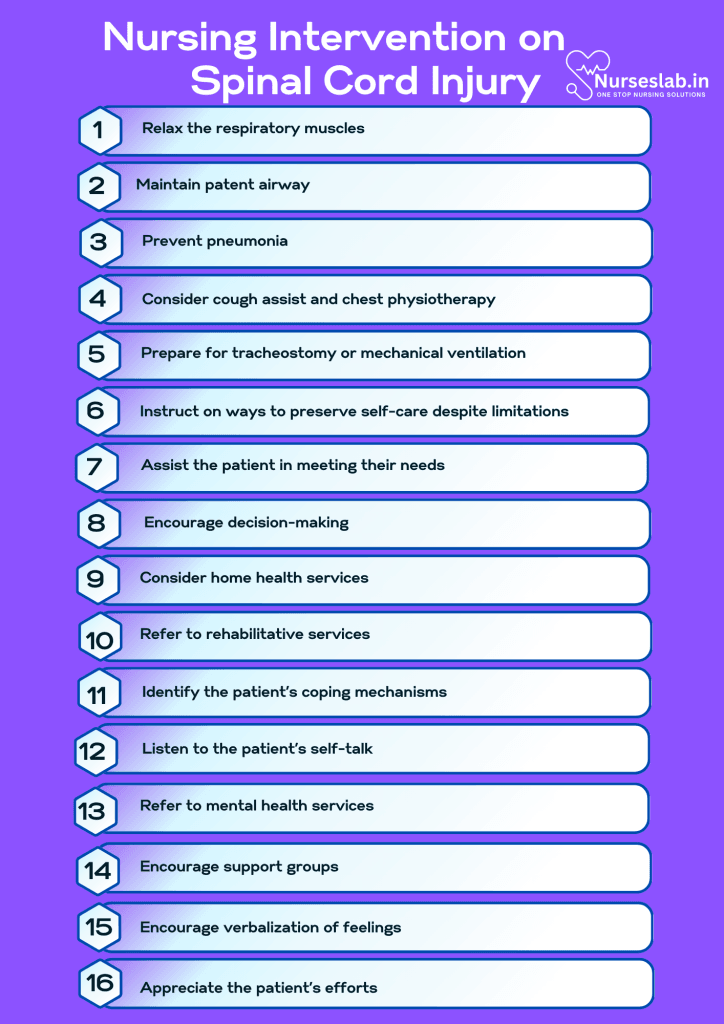
1. Relax the respiratory muscles.
Help the patient deal with the physiological side effects of hypoxia, which might include anxiety and terror.
2. Maintain patent airway.
Keep the head in a neutral posture, raise the head of the bed a little if it is safe to do so, and use an airway device if needed.
3. Prevent pneumonia.
Pneumonia and related complications are common causes of death in SCI. Preventing the development of respiratory conditions by suctioning, instructing on deep breathing, and respiratory muscle training can reduce the risk.
4. Consider cough assist and chest physiotherapy.
A weak cough is a common finding and can lead to a build-up of secretions. A mechanical cough assist device can apply pressure to stimulate a cough. Chest PT can also assist in clearing the airways.
5. Prepare for tracheostomy or mechanical ventilation.
SCI that affects the phrenic nerve at the cervical level causes an impairment in respiration. Long-term tracheostomy and mechanical ventilation may be required.
Self-Care Deficit
Self-care deficit associated with spinal cord injury can be caused by impaired muscles of the extremity, paralysis, and muscle weakness.
Nursing Diagnosis: Self-Care Deficit
Related to:
- Muscle weakness
- Paralysis
- Impaired peripheral nerve transmission
- Impaired mobility
As evidenced by:
- Inability to perform self-care tasks
- Unable to bathe independently
- Unable to dress independently
- Unable to eat independently
- Unable to use the toilet independently
Expected outcomes:
- Patient will be able to identify the activities in which they need assistance
- Patient will be able to verbalize independence in doing an activity
- Patient will be able to perform self-care activities within their capability
Assessment:
1. Determine the patient’s capabilities and limits.
Self-care deficits are common among those with an SCI, but rehabilitation and equipment can help them overcome barriers.
2. Assess the patient’s health perception.
Perceptions of health are highly influenced by other self-care elements such as health habits, agency, and health literacy. Patients unable to perform self-care tasks are considerably more likely to have poor perceptions of their health.
3. Assess barriers to participation in activities.
Barriers to participation include lack of information, psychological or personal issues, family/ carer problems, fear of appearing dependent, social or economic limitations, depression, and work or home environment problems.
Interventions:
1. Instruct on ways to preserve self-care despite limitations.
Dependence on others for basic care can feel dehumanizing. At the very least, implement ways for the patient to communicate their needs. Recommend devices and equipment that allow the patient to participate.
2. Assist the patient in meeting their needs.
While encouraging and integrating self-care independence, assisting with personal care is a necessary component of nursing care.
4. Encourage decision-making.
Allow the patient to make any decisions they can, such as choosing what to eat or wear, to encourage independence and participation.
5. Consider home health services.
The patient and family may need additional help in the home with ADLs. Refer to case management for assistance with referrals.
6. Refer to rehabilitative services.
Rehabilitation will help the patient optimize their ability to perform at their highest capacity. Adaptive services such as wheelchair fitting or creating handicap-accessible transportation can improve the patient’s access to the environment.
Situational Low Self-Esteem
Situational low self-esteem associated with spinal cord injury can be caused by loss of body functions, change in physical abilities, and perceived loss of self/identity.
Nursing Diagnosis: Situational Low Self-Esteem
Related to:
- Alteration in body image
- Functional impairment
- Role change
- Helplessness
- Decreased control over the environment
As evidenced by:
- Poor perception about own body or self
- Feelings of helplessness/uselessness
- Loss of interest in care or outcomes
- Change in social involvement
Expected outcomes:
- Patient will openly discuss their feelings about their situation
- Patient will be able to demonstrate self-confidence through goal planning and active participation in care
- Patient will be able to express positive self-appraisal
Assessment:
1. Assess the patient’s self-esteem.
Identify the patient’s sense of self-worth and self-image, as this affects how the patient can handle the current scenario or crisis and overcome barriers.
2. Determine the patient’s sense of control.
It is crucial to assess if the patient feels they have control over their circumstances or if they are at the hands of luck or fate.
3. Assess the support system.
Navigating an SCI will require support from family and friends, possibly for a lifetime. Assess how strong and willing the patient’s support system is, as this can influence how they feel about themselves and their future.
4. Assess cultural and religious beliefs.
Throughout a person’s life, cultural and religious influences impact their self-perception, sense of value, and crisis management skills.
5. Note if there are any suicidal thoughts.
The high stress and devastation of an SCI can result in suicidal thoughts and may indicate the need for additional assessment and recommendations for mental health services.
Interventions:
1. Identify the patient’s coping mechanisms.
Coping mechanisms boost resilience because they teach how to deal effectively with unpleasant emotions and other adverse circumstances.
2. Listen to the patient’s self-talk.
Unconsciously, someone who feels unimportant, incompetent, or out of control frequently speaks negatively about themselves, contributing to a loss of self-esteem.
3. Refer to mental health services.
Spinal cord injuries cause loss not only of physical abilities but the potential loss of achievements and future plans. Realization of this can cause immense depression that requires expert mental health support.
4. Encourage support groups.
Meeting and developing relationships with others who have experienced an SCI can improve the patient’s self-esteem and remind them that they are not alone.
5. Encourage verbalization of feelings.
Expression of one’s own feelings aids in the process of loss and grief.
6. Promote patient involvement.
Patients involved in their care are more likely to adhere to treatment regimens, are more knowledgeable about their conditions, and report higher levels of satisfaction with their care.
7. Appreciate the patient’s efforts.
Recognize improvement by acknowledging it. Encouragement from others in a positive way encourages perseverance and continued growth.
Nursing Diagnoses and Rationales for Spinal Cord Injury
1. Impaired Physical Mobility
Rationale: Spinal cord injury (SCI) often leads to partial or complete loss of motor function, resulting in impaired physical mobility. Assessing the patient’s level of mobility, providing physical therapy, and developing an individualized exercise plan can promote muscle strength and prevent complications such as muscle atrophy and contractures. Encouraging the use of assistive devices and ensuring a safe environment can also help enhance mobility.
2. Risk for Skin Breakdown
Rationale: Patients with SCI are at high risk for pressure ulcers due to immobility and loss of sensation. Regularly assessing skin integrity, implementing a repositioning schedule, and using pressure-relieving devices can help prevent skin breakdown. Educating the patient and caregivers about proper skin care and early signs of pressure ulcers is also crucial.
3. Ineffective Breathing Pattern
Rationale: Depending on the level of the spinal cord injury, respiratory muscles may be affected, leading to an ineffective breathing pattern. Monitoring respiratory function, providing respiratory therapy, and ensuring proper positioning can improve ventilation. In severe cases, mechanical ventilation may be necessary.
4. Risk for Infection
Rationale: SCI patients are at an increased risk for infections, particularly urinary tract infections (UTIs) and respiratory infections, due to immobility and potential use of indwelling catheters. Regularly monitoring for signs of infection, providing appropriate hygiene care, and educating the patient on infection prevention strategies can help mitigate this risk.
5. Altered Bowel and Bladder Function
Rationale: Loss of autonomic function in SCI patients can lead to altered bowel and bladder control. Establishing a bowel and bladder management program, providing patient education, and using assistive devices such as catheters or bowel stimulants can help manage these issues and prevent complications such as constipation and urinary retention.
6. Chronic Pain
Rationale: Persistent pain is a common issue for SCI patients, often due to nerve damage, muscle spasms, and pressure sores. Assessing the patient’s pain level, providing pharmacological and non-pharmacological pain management strategies, and engaging in regular follow-ups can help manage chronic pain effectively.
7. Risk for Autonomic Dysreflexia
Rationale: Patients with injuries at or above the T6 level are at risk for autonomic dysreflexia, a potentially life-threatening condition characterized by sudden hypertension and other autonomic responses. Educating the patient about triggers, monitoring for signs and symptoms, and providing immediate intervention are essential to prevent and manage autonomic dysreflexia.
8. Ineffective Coping
Rationale: The sudden and life-altering nature of SCI can lead to emotional distress and ineffective coping mechanisms. Assessing the patient’s emotional state, providing psychological support, and involving mental health professionals can help address these issues. Encouraging participation in support groups and promoting adaptive coping strategies are also important.
9. Risk for Depression
Rationale: The chronic and debilitating effects of SCI can contribute to feelings of sadness, hopelessness, and depression. Monitoring for signs of depression, providing emotional support, and referring to mental health professionals as needed can help address this risk. Encouraging participation in enjoyable activities and fostering a positive outlook are also important strategies.
10. Risk for Social Isolation
Rationale: Social isolation is a common issue for SCI patients due to mobility limitations and potential stigma. Assessing the patient’s social network, providing opportunities for social interactions, and involving them in community activities can help reduce isolation. Educating the patient and their family about the condition can also improve social support and decrease stigma.
REFERENCES
- American Association of Neurological Surgeons. (2022). Spinal cord injury – Types of injury, diagnosis and treatment. https://www.aans.org/en/Patients/Neurosurgical-Conditions-and-Treatments/Spinal-Cord-Injury
- Cleveland Clinic. (2022). Spinal cord injury: Types, symptoms, causes & treatment. https://my.clevelandclinic.org/health/diseases/12098-spinal-cord-injury
- Doenges, M. E., Moorhouse, M. F., & Murr, A. C. (2019). Nurse’s pocket guide: Diagnoses, interventions, and rationales (15th ed.). F A Davis Company.
- Joe Bennett, J., Das, J. M., & Emmady., P. D. (2022). Spinal cord injuries – StatPearls – NCBI bookshelf. National Center for Biotechnology Information. https://www.ncbi.nlm.nih.gov/books/NBK560721/
- Johns Hopkins Medicine. (2021). Acute spinal cord injury. Johns Hopkins Medicine Baltimore, Maryland. https://www.hopkinsmedicine.org/health/conditions-and-diseases/acute-spinal-cord-injury
- Ackley, B. J., Ladwig, G. B., Makic, M. B., Martinez-Kratz, M. R., & Zanotti, M. (2023). Nursing diagnoses handbook: An evidence-based guide to planning care. St. Louis, MO: Elsevier.
- Biering-Sørensen F, Bickenbach JE, El Masry WS, Officer A, von Groote PM. ISCoS-WHO collaboration. International Perspectives of Spinal Cord Injury (IPSCI) report. Spinal Cord. 2011 Jun;49(6):679-83. doi: 10.1038/sc.2011.12. Epub 2011 Mar 22. PMID: 21423254.
- Consortium for Spinal Cord Medicine. Early acute management in adults with spinal cord injury: a clinical practice guideline for health-care professionals. J Spinal Cord Med. 2008;31(4):403-79. doi: 10.1043/1079-0268-31.4.408. PMID: 18959359; PMCID: PMC2582434.
- Harding, M. M., Kwong, J., & Hagler, D. (2022). Lewis’s Medical-Surgical Nursing: Assessment and Management of Clinical Problems, Single Volume. Elsevier.
- Herdman, T. H., Kamitsuru, S., & Lopes, C. (2024). NANDA International Nursing Diagnoses – Definitions and Classification, 2024-2026.
- Ignatavicius, D. D., Rebar, C., & Heimgartner, N. M. (2023). Medical-Surgical Nursing: Concepts for Clinical Judgment and Collaborative Care. Elsevier.
- Silvestri, L. A. (2023). Saunders comprehensive review for the NCLEX-RN examination. St. Louis, MO: Elsevier.
- Snider BA, Eren F, Reeves RK, Rupp R, Kirshblum SC. The International Standards for Neurological Classification of Spinal Cord Injury: Classification Accuracy and Challenges. Top Spinal Cord Inj Rehabil. 2023 Winter;29(1):1-15. doi: 10.46292/sci22-00036. Epub 2023 Feb 15. PMID: 36819931; PMCID: PMC9936898.
- Mayo Clinic. (2021). Spinal cord injury – Symptoms and causes. https://www.mayoclinic.org/diseases-conditions/spinal-cord-injury/symptoms-causes/syc-20377890
- Silvestri, L. A., & Silvestri, A. E. (2022). Saunders comprehensive review for the NCLEX-RN examination (9th ed.). Elsevier Inc.
- World Health Organization (WHO). (2013). Spinal cord injury. https://www.who.int/news-room/fact-sheets/detail/spinal-cord-injury
Stories are the threads that bind us; through them, we understand each other, grow, and heal.
JOHN NOORD
Connect with “Nurses Lab Editorial Team”
I hope you found this information helpful. Do you have any questions or comments? Kindly write in comments section. Subscribe the Blog with your email so you can stay updated on upcoming events and the latest articles.


