

Last Updated on January 15, 2026 by Nurseslab.in Editorial Team
A transient ischemic attack (TIA) is a short episode of symptoms resembling a stroke. Since a TIA or “mini-stroke” only lasts a few minutes and doesn’t harm the brain permanently, it is frequently disregarded. However, this is a mistake, as a TIA may be a warning sign of a future stroke.
With a TIA, blood flow to the brain is temporarily obstructed and only causes a temporary blockage with no lasting effects. Symptoms of a TIA are similar to that of a stroke but resolve within 24 hours.
Atherosclerosis, the accumulation of cholesterol-containing fatty deposits in an artery, is the underlying cause of a transient ischemic attack. Plaques of cholesterol can cause a clot to form or reduce the blood flow through an artery. A TIA may occur from a blood clot traveling from another body part to an artery that supplies the brain. Smoking, cardiovascular disease, diabetes, and blood clots are known risk factors.
The following are common warning signs of a TIA:
- Unilateral weakness, numbness, or paralysis
- Altered balance and coordination
- Slurred speech
- Difficulty swallowing (dysphagia)
- Double vision or vision loss
- Dizziness or vertigo
The 2009 AHA/ASA guidelines stated the importance of neuroimaging within 24 hours of the start of symptoms. It is recommended to get an MRI, or if an MRI cannot be conducted, a head CT to distinguish a TIA from a stroke.
Further assessments can locate potential causes of a TIA:
- Carotid ultrasonography or transcranial Doppler ultrasonography
- Magnetic resonance angiography, or CT angiography
- Electrocardiogram (ECG)
- Echocardiogram/TEE
- Routine blood tests (CBC, PT/INR, CMP, FBS, lipid panel, urine drug screen, and ESR)
The primary goal of TIA therapy is to reduce the risk of another TIA or stroke and may include medications such as antiplatelet or anticoagulant drugs. Preventative surgery may be considered for arteries narrowed by plaque formation.
Nursing Process
Transient Ischemic Attack (TIA), often referred to as a mini-stroke, is a temporary period of symptoms similar to those of a stroke. A TIA doesn’t cause permanent damage and is often a warning sign of a future stroke. Effective nursing assessment and intervention are crucial in managing TIA to prevent complications and promote patient well-being.
Nursing Assessment
Medical History: Review the patient’s history for risk factors such as hypertension, diabetes, smoking, hyperlipidaemia, and previous cardiovascular events. Also, inquire about symptoms such as sudden weakness, numbness, difficulty speaking, dizziness, and loss of coordination, which are common in TIA.
Physical Examination: Perform a comprehensive physical examination focusing on neurological deficits, such as unilateral weakness, speech difficulties, and visual disturbances. Also, assess vital signs including blood pressure, heart rate, and respiratory rate.
Laboratory Tests and Imaging: Obtain baseline laboratory tests, including blood glucose, complete blood count, and cholesterol levels. Imaging studies, such as CT scans or MRIs, are essential to rule out an actual stroke and identify any underlying conditions.
Nursing Interventions
Nursing interventions are integral to the effective management of Transient Ischemic Attack. By conducting thorough assessments, administering appropriate treatments, and offering continuous support, nurses play a pivotal role in improving health outcomes and quality of life for patients.

Acute Care
Stabilization: Ensure the patient is stable, administer oxygen if needed, and maintain an open airway. Monitor vital signs continuously and prepare for urgent interventions if symptoms worsen.
Medication Management: Administer prescribed medications such as antiplatelets or anticoagulants to prevent blood clots. Monitor for any side effects or adverse reactions.
Patient Education and Support
Risk Factor Modification: Educate the patient on lifestyle changes to reduce the risk of future TIAs or strokes. This includes smoking cessation, adopting a healthy diet, regular exercise, and managing chronic conditions such as diabetes and hypertension.
Follow-Up Care: Emphasize the importance of follow-up appointments with healthcare providers to monitor the patient’s progress and adjust treatment plans as necessary.
Self-Management Strategies
Recognizing Symptoms: Teach the patient and their family members to recognize the signs and symptoms of a TIA and stroke. Encourage them to seek immediate medical attention if symptoms reoccur.
Medication Adherence: Stress the importance of taking prescribed medications regularly and as directed to prevent further episodes.
Support Resources
Community Programs: Connect the patient with local support resources such as stroke support groups, rehabilitation services, and community programs that offer educational materials and assistance.
Emotional and Psychological Support: Encourage the patient to seek support from mental health professionals and peers to cope with the emotional and psychological impact of a TIA.
Nursing Care Plans
Once the nurse identifies nursing diagnoses for a transient ischemic attack, nursing care plans help prioritize assessments and interventions for both short and long-term goals of care. In the following section, you will find nursing care plan examples for a transient ischemic attack.
Deficient Knowledge
Deficient knowledge associated with a transient ischemic attack can result in delayed recognition of symptoms and the development of a future stroke.
Nursing Diagnosis: Deficient Knowledge
Related to:
- Unfamiliarity with TIA symptoms
- Lack of information about when to seek medical attention when having a TIA
- Misunderstanding how lifestyle factors affect the risk for a TIA
- Misconceptions about TIA treatments
- A sudden change in health status
- Poor health literacy
- Anxiety
As evidenced by:
- Questions about TIA symptoms and treatments
- Ineffective lifestyle modification
- Recurrence of a TIA
- Development of major stroke
- Nonadherence with prevention and management recommendations
Expected outcomes:
- Patient will be able to verbalize the differences between a TIA and a stroke
- Patient will be able to describe “F.A.S.T” symptoms
- Patient will implement two strategies to prevent a future TIA or stroke
Assessment:
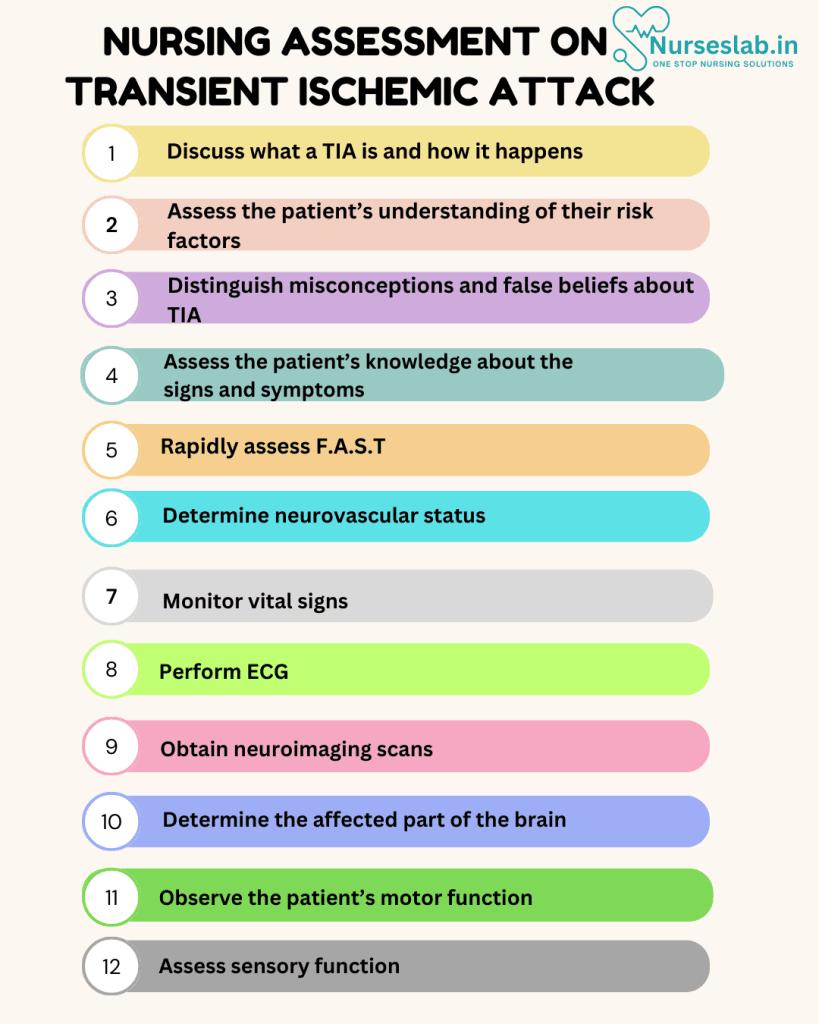
1. Discuss what a TIA is and how it happens.
The nurse must first assess what the patient knows about TIA—having this baseline data can help the nurse focus on what is unknown or misunderstood.
2. Assess the patient’s understanding of their risk factors.
The patient may not realize that their chronic health conditions or lifestyle choices influence the risk of a TIA.
3. Distinguish misconceptions and false beliefs about TIA.
The nurse must assess the patient’s beliefs to distinguish between facts and myths. The nurse must stress that a TIA is not “just” a small or minor stroke but a warning sign of an impending full stroke.
4. Assess the patient’s knowledge about the signs and symptoms.
Symptom-free strokes are much more prevalent than those with symptoms. Emphasize that not all strokes exhibit symptoms. Silent strokes can be observed when patients get MRI scans for other reasons. Silent strokes are more likely to develop into dementia, cognitive impairment, and subsequent symptomatic strokes.
Interventions:
1. Ask the patient to describe F.A.S.T.
Remembering the acronym F.A.S.T.—for face, arms, speech, and time—will help the patient recognize the signs of a TIA and a stroke. Explain to the patient that “time is tissue” when dealing with a TIA or stroke.
2. Ask the patient to differentiate between a TIA and a stroke.
A TIA often called a “mini-stroke,” differs from other forms of stroke in that blood supply to the brain is interrupted for a brief period, typically no longer than five minutes.
3. Teach the patient about cholesterol numbers.
Since atherosclerosis is a significant cause of TIA and is heavily influenced by cholesterol in the arteries, the nurse can explain and teach patients what their cholesterol numbers should be.
4. Have the patient verbalize the preventive measures of a TIA/stroke.
The nurse can evaluate if the patient is learning effectively by having them list preventative steps to decrease the risk of a TIA/stroke. These include not smoking, limiting fatty foods and sodium, exercising, and controlling their weight.
5. Advise the patient to wear a medical alert bracelet.
Patients should be advised to carry identification or wear a medical alert bracelet when taking anticoagulants following a TIA, due to the risk of bleeding.
Ineffective Cerebral Tissue Perfusion
Ineffective cerebral tissue perfusion associated with a transient ischemic attack (TIA) can be caused by blood flow cessation and vasospasm, resulting in a lack of oxygen to the brain.
Nursing Diagnosis: Ineffective Tissue Perfusion (Cerebral)
Related to:
- Blood clot
- Lack of blood supply
- Atherosclerosis
- Sickle cell disease
- Vasospasm
As evidenced by:
- Change in mental status
- Alteration in behavior
- Speech difficulty
- Inability to communicate
- Motor weakness
- Change in sensory response
Expected outcomes:
- Patient will remain alert with orientation to person, place, and time
- Patient will not experience lasting motor weakness or paralysis
- Patient will not experience a cerebrovascular accident (CVA)
Assessment:
1. Rapidly assess F.A.S.T.
F.A.S.T. stands for “face, arm, speech, and time.” The symptoms of a TIA include facial drooping, weakness in one arm, and slurred speech. The last known time of wellness is crucial as this can limit interventions.
2. Determine neurovascular status.
Lack of blood flow due to a TIA causes the brain to receive insufficient oxygen. It will affect vision, speech and language, and motor and sensory function.
3. Monitor vital signs.
Vital signs should be evaluated, including blood pressure in both arms, to rule out subclavian artery stenosis. This will show a significant difference in the readings of both arms.
4. Auscultate the heart and neck.
Auscultation of the heart and neck should be performed. Carotid artery stenosis in TIA may present as positive carotid bruits.
5. Perform ECG.
Atrial fibrillation (AFib), an abnormal ECG rhythm, may develop after a TIA. This can cause a blood clot that originates in the heart and travels to the brain.
6. Obtain neuroimaging scans.
Within 24 hours of the initiation of the symptoms, neuroimaging scans (MRI and diffusion-weighted MR imaging) are advised. A head CT with CT angiography is performed as a backup if an MRI is not possible.
Interventions:
1. Keep the blood pressure manageable.
Elevated blood pressure (BP) can damage arteries. Maintain the desired BP parameters as ordered by the healthcare provider to preserve brain perfusion.
2. Activate the Rapid Response Team (RRT).
Patients at risk of developing fatal conditions (like TIA developing into full-blown stroke) will benefit from the Rapid Response System (RRS). Activation of RRT provides immediate professional assistance and monitoring to decrease the mortality rate.
3. Administer antiplatelet medications as prescribed
Antiplatelet medications stop platelets from adhering to one another and reduce the risk of developing a clot that obstructs blood flow to the brain. Aspirin and clopidogrel may be prescribed following a TIA.
4. Provide anticoagulants as ordered.
A clot causing a TIA or stroke can be fatal. Anticoagulants cannot dissolve a clot but can prevent it from getting bigger or prevent more from developing. A client with AFib may be prescribed an anticoagulant for long-term use.
5. Control cholesterol levels.
One of the causes of TIA is hypercholesterolemia—lower cholesterol with statin medications and diet and exercise modifications.
6. Advise the patient about following the recommended diet.
A poor diet can increase the chance of developing a TIA through hypertension and high cholesterol. Advise following a low-fat, low-sodium, high-fiber diet with daily fruit, vegetables, and whole grains.
7. Prepare for possible surgery.
A carotid endarterectomy procedure creates an incision in the carotid artery to remove plaque. Carotid angioplasty places a stent into the artery to keep the artery open.
Risk for Injury
Safety issues can cause risk for injury associated with a transient ischemic attack due to altered cognitive, sensory, and motor function.
Nursing Diagnosis: Risk for Injury
Related to:
- Altered sensations
- Motor weakness
- Poor decision-making
- Uncoordinated movements
- Paralysis
- Disorientation to person, place, and time
- Inability to communicate
- Impaired swallowing
- Poor concentration
As evidenced by:
A risk for diagnosis is not evidenced by signs and symptoms as the problem has not yet occurred, and nursing interventions are directed at prevention.
Expected outcomes:
- Patient will utilize assistive devices as needed.
- Patient will remain free from any injury, wound, or fall.
- Caregivers will create a safe environment and assist the patient as needed.
Assessment:
1. Determine the affected part of the brain.
The patient may manifest symptoms that can affect the patient’s safety depending on the part of the brain involved in the TIA. Right-sided brain affectation can cause spatial-perceptual issues leading to poor decision-making and concentration in activities such as walking and driving. In comparison, left-sided brain affectation can cause problems with speech, communication, and vision.
2. Observe the patient’s motor function.
Impaired motor functions such as gait disturbances, limb paralysis, lack of coordination, and unilateral motor weakness can lead to falls that injure the patient.
3. Assess sensory function.
The patient is more likely to sustain skin damage and breakdown if they cannot distinguish between pain, heat, or sharp sensations.
4. Check the communication capabilities of the patient.
The inability to communicate pain or symptoms can place the patient at risk for injuries.
Interventions:
1. Orient the patient to their surroundings.
To avoid injuries, the patient must be familiar with their surroundings. The nurse can reduce the risk of injuries by keeping frequently used items and the call bell within the patient’s reach.
2. Prevent aspiration.
Patients with dysphagia may need pureed meals and thickened beverages. Assess their chewing and swallowing capabilities and monitor for signs of difficulty swallowing, like gagging, coughing, and pocketing food.
3. Advise scanning with vision changes.
The patient with hemianopia, often caused by a cerebral infarct, experiences a loss of vision in one-half of their visual field. Instructing them to scan the environment by moving their head from left to right or right to left can ensure they are aware of furniture, stairs, and hazards, such as vehicles in their path before ambulating.
4. Protect the skin.
The nurse must protect the patient’s skin integrity if there is paralysis and loss of sensation. Maintain appropriate alignment of the extremities, turn the patient every two hours, assess water temperature before bathing, and ensure devices and tubes are not pressing into the patient’s skin.
Nursing Diagnoses and Rationales for Transient Ischemic Attack (TIA)
1. Risk for Ineffective Cerebral Tissue Perfusion
Rationale: Transient Ischemic Attack (TIA) is characterized by temporary episodes of neurological dysfunction caused by a reduction in blood flow to the brain. Patients are at risk for inadequate cerebral tissue perfusion, which could lead to permanent stroke if not promptly managed. Regular monitoring of neurological signs and symptoms, ensuring optimal blood pressure control, and promoting lifestyle modifications are crucial to prevent recurrent episodes.
2. Knowledge Deficit
Rationale: Patients and their families may lack understanding about the causes, symptoms, and management of TIA. Educating patients on recognizing early warning signs, identifying risk factors, and adhering to prescribed medications and lifestyle changes can empower them to take preventive measures and seek timely medical intervention.
3. Risk for Injury
Rationale: Patients who experience TIA are at risk for falls and other injuries due to temporary loss of motor coordination, dizziness, or confusion. Implementing fall prevention strategies, ensuring a safe environment, and providing assistance with activities of daily living can reduce the risk of injury and enhance patient safety.
4. Anxiety
Rationale: The unpredictability and severity of TIA episodes can lead to significant anxiety and fear in patients. Providing emotional support, offering information about the condition, and teaching relaxation techniques can help alleviate anxiety and improve the patient’s quality of life.
5. Impaired Physical Mobility
Rationale: Patients may experience limitations in their physical mobility due to weakness, coordination issues, or fear of recurrent TIA episodes. Assessing mobility levels, developing a tailored exercise plan, and providing education on safe mobility practices can enhance physical endurance and confidence.
6. Ineffective Health Maintenance
Rationale: Patients might struggle with adhering to treatment regimens, lifestyle modifications, and follow-up appointments essential for managing TIA. Offering comprehensive education, ensuring follow-up care coordination, and addressing barriers to compliance can improve health maintenance and reduce the risk of future TIAs.
REFERENCES
- American Stroke Association. (n.d.). TIA (Transient ischemic attack). www.stroke.org. Retrieved from https://www.stroke.org/en/about-stroke/types-of-stroke/tia-transient-ischemic-attack
- Centers for Disease Control and Prevention. (2022, November 2). About stroke. Retrieved from https://www.cdc.gov/stroke/about.htm
- Doenges, M. E., Moorhouse, M. F., & Murr, A. C. (2019). Nurse’s pocket guide: Diagnoses, interventions, and rationales (15th ed.). F A Davis Company.
- American Heart Association. (2023). Guidelines for the Prevention of Stroke in Patients With Stroke and Transient Ischemic Attack. Stroke, 54(5), e97-e164.
- Johnston, S. C., et al. (2023). Clinical Practice Guidelines for the Management of Transient Ischemic Attack. New England Journal of Medicine, 388(12), 1129-1140.
- National Stroke Association. (2023). Nursing Care Guidelines for Transient Ischemic Attack Management. Journal of Neuroscience Nursing, 55(4), 213-225.
- Oostema JA, Brown MD, Reeves M. Emergency Department Management of Transient Ischemic Attack: A Survey of Emergency Physicians. J Stroke Cerebrovasc Dis. 2016 Jun;25(6):1517-23. doi: 10.1016/j.jstrokecerebrovasdis.2016.02.028. Epub 2016 Mar 31. PMID: 27041082.
- Smith, E. E., et al. (2023). Emergency Nursing Care for Patients with Transient Ischemic Attack. Journal of Emergency Nursing, 49(3), 285-297.
- Williams, L. S., & Bruno, A. (2023). Comprehensive Nursing Management of TIA Patients. American Journal of Nursing, 123(6), 34-42.
- Zhang, C., et al. (2023). Evidence-Based Nursing Interventions for TIA Prevention. International Journal of Nursing Studies, 139, 104355.
- Mayo Clinic. (2022, March 26). Transient ischemic attack (TIA) – Symptoms and causes. Retrieved from https://www.mayoclinic.org/diseases-conditions/transient-ischemic-attack/symptoms-causes/syc-20355679
- National Center for Biotechnology Information. (2022, July 18). Transient ischemic attack – StatPearls – NCBI bookshelf. Retrieved from https://www.ncbi.nlm.nih.gov/books/NBK459143/
- NHS UK. (2017, October 24). Transient ischaemic attack (TIA). nhs.uk. Retrieved from https://www.nhs.uk/conditions/transient-ischaemic-attack-tia/
- Silvestri, L. A., & Silvestri, A. E. (2022). Saunders comprehensive review for the NCLEX-RN examination (9th ed.). Elsevier Inc.
Stories are the threads that bind us; through them, we understand each other, grow, and heal.
JOHN NOORD
Connect with “Nurses Lab Editorial Team”
I hope you found this information helpful. Do you have any questions or comments? Kindly write in comments section. Subscribe the Blog with your email so you can stay updated on upcoming events and the latest articles.


