


Last Updated on August 29, 2026 by Nurseslab.in Editorial Team
Discover how continuous learning helps nurses and human services teams improve safety, quality, equity, teamwork, staff wellbeing, and outcomes for the people they serve.
Why learning from everyday practice is essential for safer, more responsive, and more person-centred services
Introduction
Human services exist to support people through some of the most important and difficult moments of their lives. The term includes healthcare, social care, mental-health services, disability support, public health, safeguarding, homelessness services, rehabilitation, education, and community programmes. These systems are complex because human needs are complex. They operate across organisational boundaries, rely on many professions, and must respond to changing evidence, technology, population needs, and social conditions.
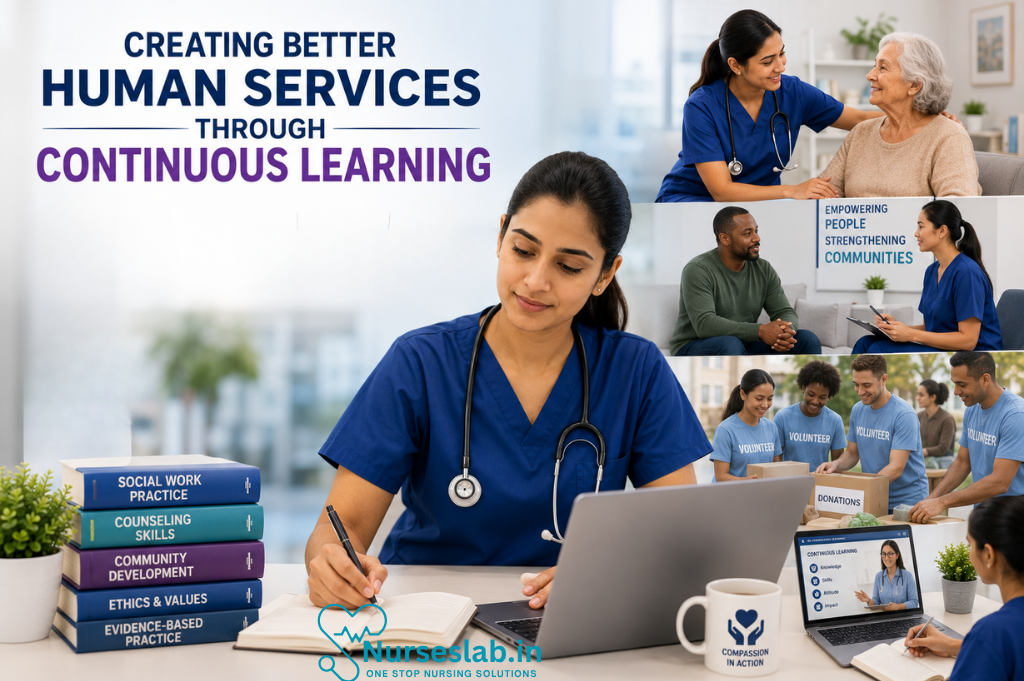
In this environment, past success does not guarantee future quality. Services must be able to learn continuously: from patients and families, frontline work, outcomes, complaints, incidents, research, audits, community knowledge, and examples of excellent care. Continuous learning turns experience into insight, insight into change, and change into better outcomes. For nurses, it connects professional development with the daily work of improving safety, dignity, equity, and coordination.
What Is a Learning Culture?
A learning culture is an environment in which people are expected and supported to ask questions, share knowledge, examine outcomes, report risk, test improvements, and reflect honestly. Learning is not restricted to mandatory courses. It is embedded in handovers, supervision, team meetings, debriefs, audits, incident responses, improvement work, patient conversations, and everyday decisions.
A learning organisation investigates how its systems influence outcomes rather than assuming every failure reflects one careless individual. It understands that people remain accountable, but also that workload, staffing, equipment, design, communication, policy, environment, and hierarchy shape behaviour. The goal is neither blame nor excuse; it is understanding followed by proportionate action.
Why Continuous Learning Matters to Nurses
Nurses often see the whole pathway. They notice repeated delays, confusing instructions, near misses, missing equipment, avoidable distress, and gaps between policy and reality. They also see what works: a communication technique that calms a frightened patient, a handover structure that prevents omissions, or a workflow that gives staff more time for care.
Continuous learning gives these observations a route into improvement. It helps nurses remain clinically current, build judgement, adapt to new roles, and contribute to service design. It also supports professional reflection: not merely asking what happened, but why, what was learned, how practice should change, and whether the change improved care.
Learning from What Goes Well
Many organisations study failure more closely than success. Yet safe, compassionate care happens every day despite complexity and pressure. Learning from excellence asks why a team succeeded. Did someone anticipate deterioration? Was equipment easy to find? Did a coordinator reduce interruptions? Did a patient’s relative provide essential information? Understanding these conditions helps services reproduce them.
Positive feedback, appreciative inquiry, peer recognition, and review of high-performing pathways can reveal practical strengths. Celebrating success is not about ignoring risk. It expands the evidence available for improvement and helps staff see that learning is relevant to ordinary practice, not only serious incidents.
Learning from Incidents Without Creating Fear
Patient-safety incidents require compassionate engagement, proportionate review, and meaningful improvement. A blame-dominated response discourages reporting and hides hazards. At the other extreme, an organisation that labels every event a “system issue” may fail to address reckless or deliberately unsafe behaviour. A just approach distinguishes human error, risky choices, capability gaps, and unacceptable conduct while examining the system around each event.
For nurses involved in an incident, learning processes should include immediate patient care, open communication according to policy, psychological support, suitable review methods, feedback, and visible action. Staff are more likely to report when they see that concerns are treated respectfully and lead to change.
Psychological Safety: The Foundation of Learning
Psychological safety means people can raise concerns, ask for help, admit uncertainty, offer ideas, and challenge decisions without humiliation or retaliation. It does not mean avoiding high standards or difficult conversations. Instead, it creates the conditions for honest information to reach the right people before harm occurs.
Leaders build psychological safety by inviting input, responding calmly to bad news, thanking staff who speak up, explaining decisions, and acting on repeated concerns. Teams undermine it through ridicule, exclusion, unpredictable reactions, intimidation, or punishing the messenger. Nurses at every level influence this climate through their response to questions and mistakes.
Reflection: Turning Experience into Development
Reflection links experience with future action. It can happen during practice, when a nurse adjusts care in response to feedback, or after an event, when there is time for structured analysis. Useful reflection goes beyond description. It explores assumptions, emotions, evidence, ethics, teamwork, context, and patient impact.
- What happened, and what evidence supports my account?
- What was I trying to achieve?
- What influenced my decisions?
- What went well, and why?
- What could have been safer or more person-centred?
- What did the patient, family, or team experience?
- What will I do differently?
- How will I know the change helped?
Reflection must preserve confidentiality. It should lead to action rather than become a paperwork exercise. Collective reflection is especially valuable because colleagues can identify system influences that one person may not see.
Continuous Professional Development with Purpose
Continuing professional development is strongest when it addresses a real practice need. Courses, conferences, simulation, reading, coaching, shadowing, case review, quality improvement, and participatory learning can all contribute. The crucial questions are whether learning is relevant, applied, assessed appropriately, and shared.
Organisations should provide protected time, equitable access, skilled educators, supervision, and practical follow-up. Completion data are not enough. A safer medicine round, clearer conversation, earlier escalation, or more reliable pathway is better evidence that education changed practice.
Using Data as a Tool for Learning
Human services generate large amounts of information: outcomes, waiting times, staffing levels, complaints, observations, experience surveys, safeguarding concerns, incidents, readmissions, and equality measures. Data become useful only when people can understand them, connect them to lived experience, test explanations, and act.
Nurses need access to timely local data and support to interpret variation. A single monthly percentage may conceal important differences between shifts, wards, locations, or patient groups. Combining quantitative trends with patient stories, observation, and staff knowledge creates a fuller picture. Data should support inquiry, not merely performance judgement.
Quality Improvement: Converting Learning into Change
Quality improvement uses systematic methods to close the gap between current and desired performance. Teams define a clear aim, understand the process, select measures, develop a change idea, test it on a small scale, learn, and adapt. Small tests make uncertainty manageable and reveal unintended effects before wider implementation.
For example, a team seeking to improve discharge understanding might co-design a plain-language medicine summary, test it with five patients, collect teach-back results and feedback, revise it, then expand cautiously. Successful improvement depends on frontline ownership, patient partnership, reliable measurement, leadership support, and time to learn.
Patients, Families, and Communities as Learning Partners
Services cannot learn fully without the people who use them. Patients and carers see transitions, repetition, accessibility barriers, cultural assumptions, and emotional impacts that staff may miss. Their role should extend beyond surveys after decisions have already been made.
Partnership can include co-design groups, patient representatives on improvement teams, accessible feedback, community advisory forums, peer researchers, and involvement in incident learning. Participation must be inclusive, supported, compensated where appropriate, and transparent about influence. Organisations should report what changed and explain when a suggestion could not be adopted.
Learning Across Professional and Organisational Boundaries
People experience one life, not separate organisational charts. Poor transitions between hospital, primary care, social care, mental-health services, housing, voluntary organisations, and families can cause duplication, delay, and risk. Continuous learning must therefore cross professional and organisational boundaries.
Interdisciplinary simulation, shared case review, joint induction, cross-sector learning networks, and pathway-level measurement help teams understand each other’s constraints. Effective collaboration requires clear information governance, role clarity, common aims, and respect for different kinds of expertise—including community and lived-experience knowledge.
The Role of Leadership
Learning culture is shaped by what leaders notice, reward, fund, and tolerate. Leaders demonstrate commitment when they allocate protected learning time, respond to concerns, remove barriers, share data openly, recognise improvement, and explain how feedback influenced decisions. They also align learning priorities with the organisation’s purpose rather than launching disconnected projects.
Leadership exists at every level. A nurse who pauses a procedure to clarify identity is leading for safety. A preceptor who welcomes questions is leading for learning. A ward manager who changes a process after repeated near misses is leading for improvement. Senior leadership remains essential because frontline commitment cannot compensate for chronic understaffing, poor systems, or lack of resources.
Equity Must Be Part of Every Learning Cycle
Average outcomes can hide unequal care. Services should examine who benefits, who waits, who is excluded, who experiences restraint or readmission, whose pain is undertreated, and whose feedback is absent. Data should be segmented carefully and interpreted with affected communities while protecting confidentiality.
Learning activities must also be accessible to staff. Shift pattern, disability, digital access, language, employment status, and caring responsibilities can affect participation. Equitable development requires flexible formats, accessible materials, protected time, fair selection, and monitoring of who receives opportunities.
Technology Can Accelerate Learning—If Used Carefully
Digital dashboards, electronic records, online learning, virtual simulation, collaboration platforms, and artificial intelligence can make evidence and feedback more timely. Technology may help identify patterns, connect dispersed teams, personalise education, and spread successful changes.
Technology must remain governed, secure, accessible, and clinically credible. Poor data quality can mislead. Algorithms may reproduce bias. Excessive alerts can create fatigue. Digital learning can exclude staff without devices or protected time. Nurses should be involved in selection, design, testing, implementation, and evaluation because they understand how technology changes real work.
Staff Wellbeing and Learning Are Connected
Exhausted staff have less capacity to reflect, attend education, absorb feedback, or participate in improvement. Organisations that value learning must also address workload, breaks, staffing, violence, discrimination, occupational health, and post-incident support. Wellbeing cannot be reduced to individual resilience training.
Learning can support wellbeing when it increases competence, control, connection, and meaning. It can damage wellbeing when imposed as unpaid work, used punitively, or disconnected from clinical reality. Protected time and relevant content communicate respect for staff and patients.
Practical Ways Nurses Can Strengthen Learning Culture
- Ask one curious question. Replace “Who caused this?” with “What made this outcome more likely?”
- Share a useful lesson. Bring a short case, guideline update, or patient insight to the team.
- Report near misses. Describe hazards before they harm someone.
- Use structured reflection. Identify a specific action and review whether it worked.
- Invite patient feedback. Ask what was clear, difficult, or missing.
- Seek observed feedback. Request comments on a handover, assessment, or procedure.
- Test small changes. Agree an aim and simple measure before changing a process.
- Thank people who speak up. A supportive response influences future reporting.
- Include quieter voices. Invite students, support workers, patients, and community partners into discussion.
- Close the loop. Tell colleagues what changed because of their concern or suggestion.
A Framework for Continuous Learning
- Notice: identify a concern, variation, success, or question.
- Understand: gather data, experiences, evidence, and system context.
- Design: co-create a practical change with staff and service users.
- Test: start small, measure, and watch for unintended effects.
- Reflect: compare the result with the aim and explain what was learned.
- Adapt: improve, stop, or expand the change based on evidence.
- Share: communicate the lesson in a usable format.
- Sustain: embed ownership, training, resources, monitoring, and review.
Common Barriers—and How to Address Them
- “There is no time.” Integrate short learning into existing handovers, huddles, supervision, and pathway reviews while protecting deeper learning time.
- “Nothing changes.” Select issues with clear ownership, provide updates, and show the effect of staff input.
- “People are afraid to report.” Improve psychological safety, confidentiality, support, and fairness.
- “Training does not fit practice.” Co-design content with frontline staff and patients, then assess practical transfer.
- “Data are unavailable or distrusted.” Improve definitions, timeliness, visibility, and data literacy.
- “Projects disappear when a champion leaves.” Build team ownership, standard work, induction, review dates, and executive support.
- “Only senior staff are heard.” Use inclusive facilitation, anonymous channels, and deliberate invitations to diverse contributors.
How to Measure Whether the Culture Is Improving
No single metric proves that a learning culture exists. Useful indicators include staff confidence to speak up, response to concerns, participation in learning, time from insight to action, sustained completion of improvements, patient involvement, learning shared across teams, access to development, staff retention, experience measures, and relevant safety or quality outcomes.
Reporting may rise when trust improves because staff feel safer to identify incidents. That rise should not automatically be interpreted as worsening care. Leaders must interpret quantitative trends with qualitative evidence and remain alert to under-reporting, unequal participation, and unintended consequences.
A Clinical Example
A community nursing team notices several people returning to hospital because they misunderstood changes to medicines after discharge. Instead of arranging another generic training session, the team reviews cases with patients, pharmacists, ward staff, and carers. They map the pathway and find inconsistent summaries, inaccessible language, and uncertainty about who confirms understanding.
The group tests a plain-language summary, a named contact, and teach-back for high-risk changes. It tracks follow-up calls, patient understanding, readmissions, and workload. Early results show better understanding but longer discharge conversations, so the process is adapted to identify who needs additional support. The team shares the learning across services and continues monitoring. This is continuous learning in practice: collaborative, evidence-informed, iterative, and centred on the person’s experience.
Conclusion
Creating better human services requires more than occasional training or a new improvement project. It requires a culture in which learning is woven into daily work: people speak honestly, evidence is usable, patients are partners, teams reflect, leaders respond, and changes are tested and evaluated.
Nurses are essential to this culture because they connect direct care, coordination, safety, advocacy, and service improvement. When they have psychological safety, time, data, education, and authority to act, everyday observations become powerful sources of progress. Continuous learning does not promise perfection. It creates something more useful: services that recognise reality, adapt intelligently, and keep becoming safer, fairer, and more responsive to the people they serve.
REFERENCES
- Mlambo M, Silén C, McGrath C. Lifelong learning and nurses’ continuing professional development, a metasynthesis of the literature. BMC Nurs. 2021 Apr 14;20(1):62. doi: 10.1186/s12912-021-00579-2. PMID: 33853599; PMCID: PMC8045269.
- Sthapit, PhD, Arhan. (2023). Strategic HRD Measures on Continuous Learning and Upskilling of Employees to Achieve Organisational Effectiveness. 90. 171-178.https://www.researchgate.net/publication/374171317_Strategic_HRD_Measures_on_Continuous_Learning_and_Upskilling_of_Employees_to_Achieve_Organisational_Effectiveness/citation/download
Stories are the threads that bind us; through them, we understand each other, grow, and heal.
JOHN NOORD
Connect with “Nurses Lab Editorial Team”
I hope you found this information helpful. Do you have any questions or comments? Kindly write in comments section. Subscribe the Blog with your email so you can stay updated on upcoming events and the latest articles.


