


Last Updated on January 10, 2026 by Nurseslab.in Editorial Team
The Five Moments for Hand Hygiene—before patient contact, before aseptic tasks, after body fluid exposure, after patient contact, and after touching patient surroundings—are critical for preventing healthcare-associated infections and ensuring safe care.
Introduction
Hand hygiene is the cornerstone of infection prevention and control in healthcare. Nurses, being at the forefront of patient care, shoulder a critical responsibility in maintaining high standards of cleanliness and safety. Inadequate hand hygiene can lead to the spread of pathogens, resulting in healthcare-associated infections (HAIs) that not only endanger patient health but also increase the burden on healthcare systems. The World Health Organization (WHO) has established the “Five Moments for Hand Hygiene” rule, a globally recognised framework that guides healthcare professionals on when hand hygiene should be performed to minimise cross-contamination.
The Importance of Hand Hygiene in Nursing
Nurses interact with patients, surfaces, and medical equipment throughout their shifts, making them pivotal in the battle against infection transmission. Hand hygiene refers to practices such as hand washing with soap and water or using alcohol-based hand rubs to remove or kill microorganisms present on the hands. In nursing, proper hand hygiene:
- Reduces the risk of transmitting infectious agents between patients, staff, and the environment.
- Protects healthcare workers from contracting infections themselves.
- Enhances patient safety and quality of care.
- Contributes to the control of outbreaks, including those caused by multidrug-resistant organisms.
In healthcare context, with its high patient loads, diverse clinical environments, and challenges such as limited resources in rural areas, makes adherence to hand hygiene even more crucial.
The Burden of Healthcare-Associated Infections (HAIs)
Healthcare-associated infections are a major public health concern globally. Internationally, the prevalence of HAIs in hospitals is estimated to be higher than in many developed countries, owing to factors such as overcrowding, limited infection control infrastructure, and variable adherence to hand hygiene protocols. Common HAIs include:
- Urinary tract infections
- Surgical site infections
- Pneumonia
- Bloodstream infections
These infections lead to increased morbidity and mortality, prolonged hospital stays, and higher healthcare costs. Studies have shown that effective hand hygiene can reduce the incidence of HAIs by up to 50%, underscoring its vital role in patient safety.
WHO’s Five Moments for Hand Hygiene: An Overview
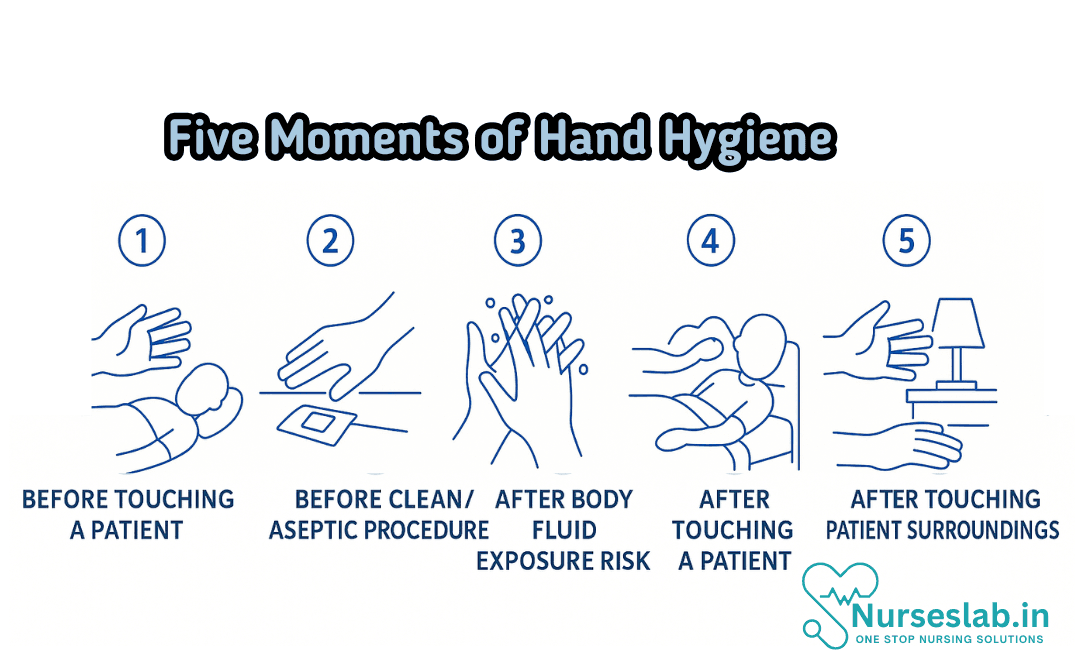
Recognising the need for clear and actionable guidance, the World Health Organization introduced the “Five Moments for Hand Hygiene” rule in 2009. This rule identifies critical times during patient care when hand hygiene should be performed to prevent cross-contamination. The Five Moments are:
- Before touching a patient: To protect the patient from harmful germs carried on the hands.
- Before clean/aseptic procedures: To prevent patient exposure to infectious agents during procedures such as inserting catheters, preparing injections, or dressing wounds.
- After body fluid exposure risk: To protect oneself and the healthcare environment from contamination after exposure to blood, urine, or other bodily fluids.
- After touching a patient: To remove germs acquired from the patient and prevent their spread to oneself or others.
- After touching patient surroundings: To remove germs picked up from surfaces or objects in the patient’s immediate environment, such as bed rails, medical equipment, or curtains.

These moments are designed to be intuitive and easily incorporated into daily nursing routines, regardless of the healthcare setting.
Why the Five Moments Rule Matters
The Five Moments rule bridges the gap between knowledge and practice. It provides nurses with a simple yet comprehensive approach to hand hygiene, ensuring that critical opportunities for infection prevention are not missed. By following this rule, nurses can:
- Reduce the risk of cross-transmission of pathogens.
- Promote a culture of safety in healthcare environments.
- Demonstrate compliance with global standards, including those set by the WHO and the CDC.
Implementing the Five Moments Rule in Nursing Practice
Successful implementation of the WHO Five Moments rule requires a multifaceted approach involving education, facility design, leadership support, and ongoing evaluation. The following sections outline practical steps for nurses and healthcare administrators.
Education and Training
Continuous education is essential for embedding hand hygiene practices into nursing culture. Training programmes should include:
- Demonstrations of proper hand washing and use of alcohol-based hand rubs.
- Role-playing scenarios illustrating the Five Moments.
- Discussions on the consequences of poor hand hygiene, using real-life examples from Indian hospitals.
- Regular refresher courses and competency assessments.
In India, many nursing schools and hospitals have begun integrating WHO guidelines into their curricula, with positive results in infection reduction.
Infrastructure and Accessibility
Physical infrastructure plays a significant role in facilitating good hand hygiene. Key measures include:
- Ensuring that sinks with running water, soap, and disposable towels are readily available.
- Placing alcohol-based hand rub dispensers at strategic locations, such as entrances to wards, near patient beds, and in procedure rooms.
- Maintaining supplies and ensuring prompt replenishment.
- Providing visual reminders, such as posters and stickers, highlighting the Five Moments rule.
In resource-limited settings, innovative approaches—such as locally produced hand rubs and community engagement—can help overcome barriers.
Leadership and Role Modelling
Nursing leaders and senior staff must set an example by consistently practising and advocating for hand hygiene. Their commitment encourages others to follow suit. Strategies include:
- Leading hand hygiene audits and feedback sessions.
- Recognising and rewarding compliance among staff.
- Addressing non-compliance in a supportive, educational manner.
Monitoring and Evaluation
Regular monitoring is crucial to sustaining high standards. Hospitals should:
- Conduct periodic audits using checklists based on the Five Moments rule.
- Collect and analyse data on hand hygiene compliance rates and HAI incidence.
- Share results transparently with staff and use findings to guide improvement.
Technology, such as electronic monitoring systems and mobile apps, is increasingly being used in Indian hospitals to track compliance and provide instant feedback.
Challenges in Hand Hygiene Compliance
Despite its proven effectiveness, hand hygiene compliance remains suboptimal in many healthcare settings. Common barriers include:
- High patient-to-nurse ratios and workload pressures.
- Limited access to hand hygiene supplies.
- Skin irritation and dryness from repeated hand washing.
- Lack of awareness or understanding of the Five Moments rule.
- Complacency or resistance to change among staff.
Addressing these challenges requires a combination of education, resource allocation, and cultural change.
Strategies to Overcome Barriers
Practical solutions include:
- Introducing hand care products, such as moisturisers, to reduce skin irritation.
- Streamlining workflows to make hand hygiene more convenient.
- Engaging patients and families in promoting hand hygiene by encouraging them to remind staff politely.
- Fostering a non-punitive environment that encourages reporting and discussion of challenges.
Hand Hygiene in Special Contexts
In diverse healthcare landscape there presents unique challenges and opportunities for hand hygiene. In high-volume government hospitals, resource constraints may impede optimal practices, while private hospitals may have better infrastructure but face issues of complacency. Rural health centres may lack basic supplies but can benefit from community-driven initiatives.
Recent outbreaks of infectious diseases such as COVID-19 have highlighted the importance of hand hygiene beyond hospitals, including in community settings and primary care. The WHO Five Moments rule is adaptable and can be applied wherever patient care is delivered.
Cultural Considerations and Patient Engagement
Cultural beliefs and practices influence attitudes towards hand hygiene. In India, where traditional healing and familial involvement in care are common, educating patients and families about the benefits of hand hygiene is crucial. Hospitals can:
- Use multilingual educational materials.
- Incorporate hand hygiene messages into hospital orientation programmes.
- Encourage patients to observe and remind staff about hand hygiene.
Global Standards and Indian Guidelines
The WHO guidelines are universally applicable but must be contextualised for Indian settings. The Ministry of Health and Family Welfare has developed national infection control standards that incorporate the Five Moments rule and emphasise hand hygiene as a key performance indicator. Accreditation bodies such as the National Accreditation Board for Hospitals & Healthcare Providers (NABH) also require compliance with hand hygiene protocols.
International partnerships, such as the WHO’s “SAVE LIVES: Clean Your Hands” campaign, have supported Indian hospitals in improving hand hygiene infrastructure and training.
The Role of Technology and Innovation
Emerging technologies are transforming hand hygiene practices. Examples include:
- Electronic monitoring systems that track hand hygiene events.
- Mobile apps that provide reminders and record compliance.
- Automated dispensers with usage tracking.
- Online training modules and virtual reality simulations.
Indian start-ups and innovators are developing cost-effective solutions tailored to local needs, such as affordable hand rub formulations and solar-powered dispensers for rural clinics.
Conclusion
Hand hygiene remains the most effective and affordable strategy for preventing infections in healthcare settings. The WHO Five Moments rule provides nurses with clear, actionable guidance to reduce cross-contamination and safeguard patient health. By embracing education, infrastructure improvements, leadership, monitoring, and innovation, Indian hospitals and nursing professionals can achieve global standards in infection prevention. The path to safer healthcare begins with clean hands—every moment, every patient, everywhere.
In summary, nurses must internalise the Five Moments rule and champion hand hygiene as a non-negotiable aspect of care. Through collective commitment and continuous improvement, the goal of reducing healthcare-associated infections and promoting patient safety is attainable across India and the world.
REFERENCES
- CDC, Clinical Safety: Hand Hygiene for Healthcare Workers, February 27, 2024, https://www.cdc.gov/clean-hands/hcp/clinical-safety/index.html
- Shehzad Zafar, 5 Moments of Hand Hygiene: Step By Step Guide, September 13, 2023 , https://www.hseblog.com/5-moments-of-hand-hygiene/
- TrishulHomeCare,The Ultimate Guide to the 5 Moments of Hand Hygiene With Examples, June 26, 2025, https://www.trishulhomecare.com/blog/5-moments-of-hand-hygiene/
- Bogaert, C. (2025). Hand Hygiene: A Comprehensive Approach for Nurses. In: Oomen, B., Gastaldi, S. (eds) Principles of Nursing Infection Prevention Control. Principles of Specialty Nursing. Springer, Cham. https://doi.org/10.1007/978-3-031-84469-0_12
- WHO, Hand Hygiene, https://www.who.int/teams/integrated-health-services/infection-prevention-control/hand-hygiene
Stories are the threads that bind us; through them, we understand each other, grow, and heal.
JOHN NOORD
Connect with “Nurses Lab Editorial Team”
I hope you found this information helpful. Do you have any questions or comments? Kindly write in comments section. Subscribe the Blog with your email so you can stay updated on upcoming events and the latest articles.


