


Last Updated on January 21, 2026 by Nurseslab.in Editorial Team
Coronavirus refers to a group of RNA viruses that cause respiratory illnesses, including COVID-19. Transmitted via droplets, these viruses can lead to mild to severe disease. Prevention, vaccination, and public health measures are essential in controlling outbreaks.
Introduction
Coronaviruses are a large family of enveloped, single-stranded RNA viruses known for causing diseases ranging from the common cold to severe respiratory syndromes in humans and animals. The term “coronavirus” is derived from the Latin “corona”, meaning crown, owing to the crown-like spikes seen on their surface under electron microscopy. The emergence of the novel coronavirus (SARS-CoV-2) in late 2019 led to the Covid-19 pandemic, which has profoundly impacted global health, economies, and societies.
Epidemiology
Global and Regional Spread
The initial outbreak of Covid-19 was traced to Wuhan, Hubei Province, China, in December 2019. Rapid human-to-human transmission facilitated global spread, with the World Health Organization (WHO) declaring Covid-19 a pandemic on 11/03/2020. By mid-2025, Covid-19 has affected every continent, with varying infection rates influenced by population density, public health measures, and socioeconomic factors. Countries such as India, the United States, Brazil, and the United Kingdom have experienced significant case burdens, though regional variations in incidence and mortality persist.
Transmission Dynamics
Covid-19 is primarily transmitted via respiratory droplets produced when an infected person coughs, sneezes, or talks. Aerosol transmission, though less common, can occur in enclosed or poorly ventilated spaces. Fomite transmission via contaminated surfaces is possible but less significant. The basic reproductive number (R0) for SARS-CoV-2 has been estimated between 2 and 3, indicating high transmissibility. Asymptomatic and pre-symptomatic carriers contribute substantially to community spread.
Risk Factors
Several risk factors increase susceptibility to Covid-19 infection and severe disease. These include advanced age (especially above 60 years), pre-existing medical conditions such as diabetes, hypertension, cardiovascular disease, chronic respiratory disease, and immunosuppression. Socioeconomic determinants, including occupation, housing density, and access to healthcare, further influence risk. Healthcare workers, due to frequent exposure, are at elevated risk.
1. SARS-CoV (Severe Acute Respiratory Syndrome Coronavirus)
- Outbreak Year: 2002–2003
- Origin: Believed to have originated in bats and transmitted to humans via civet cats
- Transmission: Respiratory droplets, close contact
- Symptoms: High fever, dry cough, shortness of breath, pneumonia
- Fatality Rate: ~9.6%
- Global Impact: Over 8,000 cases and 774 deaths across 29 countries
- Containment: Controlled through isolation, travel restrictions, and public health measures
2. MERS-CoV (Middle East Respiratory Syndrome Coronavirus)
- Outbreak Year: First identified in 2012
- Origin: Camels are the primary reservoir; virus likely originated in bats
- Transmission: Close contact with infected individuals or camels; limited human-to-human spread
- Symptoms: Fever, cough, gastrointestinal symptoms, severe pneumonia, kidney failure
- Fatality Rate: ~34%
- Global Impact: Primarily in the Middle East, with sporadic cases worldwide
- Containment: Surveillance, camel exposure reduction, hospital infection control
3. SARS-CoV-2 (Coronavirus Disease 2019 / COVID-19)
- Outbreak Year: 2019–present
- Origin: Likely originated in bats; possible intermediate host (e.g., pangolins)
- Transmission: Highly contagious via droplets, aerosols, surfaces
- Symptoms: Fever, cough, fatigue, anosmia, dyspnea, GI symptoms, thrombotic events
- Fatality Rate: Varies by region, age, and comorbidities (~1–2% globally)
- Global Impact: Over 770 million cases and 7 million deaths worldwide
- Containment: Vaccination, masking, social distancing, testing, quarantine
Morphology
Structure of Coronaviruses
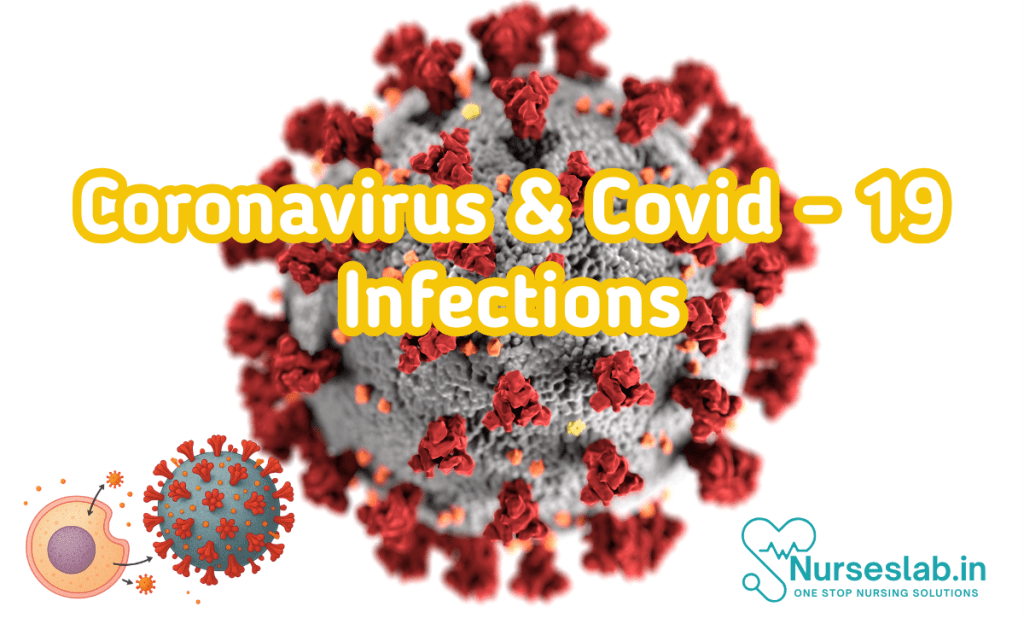
Coronaviruses possess a spherical to pleomorphic shape, measuring 60-140 nm in diameter. The viral envelope contains three major proteins: spike (S), envelope (E), and membrane (M). The spike protein is critical for host cell attachment and entry, mediating binding to the angiotensin-converting enzyme 2 (ACE2) receptor in humans. The nucleocapsid (N) protein associates with the RNA genome, providing structural stability. Under electron microscopy, the characteristic surface projections (spikes) give the virus its “corona” appearance.
Genetic Features
Coronaviruses have a positive-sense, single-stranded RNA genome ranging from 26 to 32 kilobases the largest among RNA viruses. The SARS-CoV-2 genome encodes structural proteins (S, E, M, N), non-structural proteins (such as RNA-dependent RNA polymerase), and accessory proteins that modulate host response. High mutation rates, typical of RNA viruses, facilitate genetic diversity and adaptation.
Variants
The ongoing evolution of SARS-CoV-2 has led to the emergence of multiple variants. Notable variants include Alpha (B.1.1.7), Beta (B.1.351), Gamma (P.1), Delta (B.1.617.2), and Omicron (B.1.1.529), each distinguished by mutations in the spike protein and other genomic regions. These variants differ in transmissibility, immune evasion, and disease severity, influencing public health strategies and vaccine efficacy.
Pathogenesis
Mechanisms of Infection
The pathogenesis of Covid-19 begins with viral entry into host cells via the ACE2 receptor, predominantly expressed in respiratory tract epithelial cells. The S protein, after priming by host proteases such as TMPRSS2, mediates fusion of the viral and cellular membranes. Following entry, viral RNA is released, replicated, and translated, leading to the production of new virions and cell damage.
Immune Response
The innate immune system recognises viral components via pattern recognition receptors, triggering interferon production and inflammatory cytokines. The adaptive immune response involves activation of T lymphocytes and B lymphocytes, with the latter producing neutralising antibodies targeting the spike protein. In some individuals, dysregulated immune activation leads to a “cytokine storm”, causing widespread inflammation, tissue damage, and multi-organ failure.
Disease Progression
Covid-19 exhibits a wide spectrum of disease severity, from asymptomatic infection to critical illness. Mild cases are limited to upper respiratory symptoms, whereas severe cases involve pneumonia, acute respiratory distress syndrome (ARDS), thromboembolic events, and multi-organ dysfunction. Disease progression correlates with viral load, host immune response, and underlying comorbidities.
Clinical Manifestations
Symptoms
The clinical presentation of Covid-19 ranges from asymptomatic to severe. Common symptoms include fever, dry cough, fatigue, myalgia, headache, sore throat, anosmia (loss of smell), ageusia (loss of taste), and gastrointestinal complaints such as diarrhoea and nausea. Less frequent symptoms include skin manifestations, conjunctivitis, and neurological features.
Severity Spectrum
Based on clinical severity, Covid-19 cases can be classified as mild, moderate, severe, or critical:
- Mild: Upper respiratory symptoms without pneumonia or hypoxia.
- Moderate: Pneumonia without signs of severe disease.
- Severe: Dyspnoea, respiratory rate ≥30/min, oxygen saturation ≤93%, or lung infiltrates >50% within 24–48 hours.
- Critical: Respiratory failure, septic shock, or multi-organ dysfunction.
Children and young adults are more likely to experience mild or asymptomatic infection, whereas older adults and those with comorbidities are at higher risk for severe disease.
Complications
Major complications of Covid-19 include ARDS, acute cardiac injury, thromboembolic events (deep vein thrombosis, pulmonary embolism), acute kidney injury, secondary bacterial infections, and long Covid (persistent symptoms beyond 12 weeks). Neurological complications such as encephalopathy, stroke, and Guillain-Barré syndrome have also been reported.
Laboratory Diagnosis
Testing Methods
Laboratory diagnosis of Covid-19 relies on detection of viral RNA, antigens, or antibodies. The gold standard is the reverse transcription polymerase chain reaction (RT-PCR), which detects SARS-CoV-2 RNA from respiratory samples. Other nucleic acid amplification tests (NAATs), such as loop-mediated isothermal amplification (LAMP), are also used. Rapid antigen tests offer point-of-care diagnosis but with lower sensitivity. Serological assays detect antibodies to SARS-CoV-2, useful for epidemiological studies and assessing immune response.
Sample Collection
The preferred specimens for RT-PCR include nasopharyngeal and oropharyngeal swabs, though lower respiratory tract samples (sputum, bronchoalveolar lavage) may be collected in severe cases. Proper technique and timing are crucial for accurate detection, as viral load peaks in the first week of illness.
Interpretation
A positive RT-PCR confirms active infection, whereas negative results may occur due to improper sampling, low viral load, or testing late in the disease course. Antigen tests are most reliable during early symptomatic infection. Serological tests indicate previous exposure or vaccination but do not confirm active infection. Cycle threshold (Ct) values in RT-PCR may provide indirect information on viral load but should be interpreted cautiously.
Vaccines
Development
The unprecedented scale and speed of Covid-19 vaccine development have been a hallmark of the pandemic response. Multiple platforms were utilised, including mRNA, viral vector, protein subunit, and inactivated virus vaccines. Rigorous clinical trials were conducted to evaluate safety, immunogenicity, and efficacy, followed by emergency use authorisations and mass rollouts globally.
Types of Vaccines
- mRNA Vaccines: These deliver genetic instructions for the spike protein via lipid nanoparticles. Examples include Pfizer-BioNTech and Moderna vaccines.
- Viral Vector Vaccines: Replication-deficient adenoviruses are used to deliver the spike protein gene. Examples are Oxford-AstraZeneca and Sputnik V.
- Protein Subunit Vaccines: These contain purified viral proteins, often with adjuvants. Covovax is an example.
- Inactivated Virus Vaccines: Whole virus particles are chemically inactivated. Covaxin and Sinopharm are examples.
Efficacy
Vaccine efficacy varies by type, population, and circulating variants. mRNA vaccines have demonstrated efficacy rates above 90% against symptomatic infection, though protection against severe disease remains high for all major vaccines. Breakthrough infections may occur, particularly with immune-evading variants such as Omicron, but vaccines substantially reduce hospitalisation and mortality.
Challenges
Key challenges in vaccine deployment include manufacturing scale-up, cold chain requirements, vaccine hesitancy, and equitable distribution, especially in low- and middle-income countries. The emergence of new variants necessitates ongoing surveillance and potential updates to vaccine formulations. Booster doses are recommended to enhance and prolong immunity, especially in high-risk populations.
Conclusion
The Covid-19 pandemic represents a landmark event in infectious disease history, underscoring the importance of robust surveillance, rapid diagnostics, and agile vaccine development. Continued research into coronavirus epidemiology, pathogenesis, and immune response is vital for preparedness against future outbreaks. The global experience with Covid-19 has accelerated innovation in vaccine technology and highlighted the need for international cooperation in public health. While significant progress has been made, ongoing vigilance, adaptation, and public health investment remain essential to mitigate the impact of coronavirus infections worldwide.
REFERENCES
- Apurba S Sastry, Essential Applied Microbiology for Nurses including Infection Control and Safety, First Edition 2022, Jaypee Publishers, ISBN: 978-9354659386
- Joanne Willey, Prescott’s Microbiology, 11th Edition, 2019, Innox Publishers, ASIN- B0FM8CVYL4.
- Anju Dhir, Textbook of Applied Microbiology including Infection Control and Safety, 2nd Edition, December 2022, CBS Publishers and Distributors, ISBN: 978-9390619450
- Gerard J. Tortora, Microbiology: An Introduction 13th Edition, 2019, Published by Pearson, ISBN: 978-0134688640
- Durrant RJ, Doig AK, Buxton RL, Fenn JP. Microbiology Education in Nursing Practice. J Microbiol Biol Educ. 2017 Sep 1;18(2):18.2.43. https://pmc.ncbi.nlm.nih.gov/articles/PMC5577971/
Stories are the threads that bind us; through them, we understand each other, grow, and heal.
JOHN NOORD
Connect with “Nurses Lab Editorial Team”
I hope you found this information helpful. Do you have any questions or comments? Kindly write in comments section. Subscribe the Blog with your email so you can stay updated on upcoming events and the latest articles.


