


Last Updated on October 22, 2026 by Nurseslab.in Editorial Team
Breast surgery is one of the few operations where the technical result and the psychological result are judged separately — and where the patient may be entirely satisfied with the oncological outcome and devastated by the cosmetic one.
Surgical anatomy that explains the complications
You cannot anticipate the complications of breast surgery without knowing what lies in the operative field.
Cooper’s ligaments are fibrous septa suspending the breast from the chest wall. Tumour invasion shortens them, producing skin dimpling. Surgical division contributes to post-operative contour change and ptosis.
Lymphatic drainage runs predominantly to the axillary nodes (around 75%), with the remainder to internal mammary and supraclavicular chains. This anatomy is the entire reason axillary surgery exists — and the entire reason lymphedema exists.
The nerves at risk in axillary dissection are high-yield and clinically consequential:
| Nerve | Supplies | Injury produces |
|---|---|---|
| Long thoracic | Serratus anterior | Winged scapula |
| Thoracodorsal | Latissimus dorsi | Weak shoulder adduction, internal rotation |
| Intercostobrachial | Sensory — inner upper arm | Numbness, burning, paraesthesia of the inner arm |
| Medial pectoral | Pectoralis major and minor | Pectoral atrophy |
The intercostobrachial nerve is the one nurses encounter most often, because its disruption is common and expected rather than an error. Patients who are not warned about inner-arm numbness frequently believe something has gone wrong.
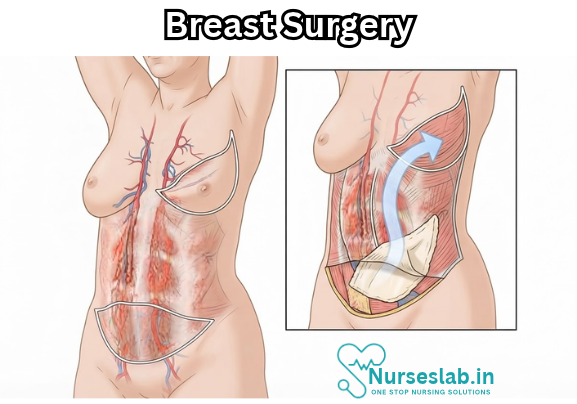
Vascular supply comes from the internal thoracic (internal mammary), lateral thoracic, and thoracoacromial vessels — relevant to flap viability in reconstruction and to haematoma risk.
Classification of breast surgery
Breast operations fall into six broad groups:
- Diagnostic — obtaining tissue for histology
- Therapeutic oncological — removing malignancy
- Axillary staging and clearance — assessing and treating nodal disease
- Reconstructive — restoring form after oncological resection
- Risk-reducing (prophylactic) — removing tissue before cancer develops
- Benign and aesthetic — benign lesion excision, reduction, augmentation, gynaecomastia correction
Diagnostic procedures
Core needle biopsy is the diagnostic standard — it preserves tissue architecture and permits ER, PR, and HER2 receptor testing, which fine needle aspiration cannot reliably do. Usually performed under image guidance with local anaesthetic.
Vacuum-assisted biopsy retrieves larger samples and is used for microcalcifications and architectural distortion.
Excisional biopsy / wide local excision for diagnosis is reserved for non-diagnostic needle biopsy or discordant results.
Image-guided localization. Non-palpable, screen-detected lesions require localization before excision — historically with a wire inserted pre-operatively under imaging, increasingly with radioactive seed, magnetic, or radiofrequency markers placed earlier, which avoids a protruding wire and decouples the radiology appointment from theatre scheduling.
Nursing points for wire localization: the wire is fragile and must not be dislodged. Secure it, avoid pressure over the site, do not allow the patient to adjust it, transfer carefully, and document that the wire is intact on handover to theatre.
Breast-conserving surgery
Also called: lumpectomy, wide local excision, partial mastectomy, segmental mastectomy, quadrantectomy.
The tumour is excised with a rim of normal tissue, preserving the remaining breast. Breast-conserving surgery plus radiation offers survival equivalent to mastectomy in appropriately selected patients — a point worth stating plainly, because many patients assume mastectomy is inherently safer and choose accordingly.
Indications: single tumour of suitable size relative to the breast, clear margins achievable, patient able and willing to receive post-operative radiation.
Margins matter. Current consensus for invasive cancer is “no ink on tumour” — a margin is adequate if no tumour cells reach the cut edge. DCIS conventionally requires a wider margin, commonly around 2 mm. A positive margin means re-excision, which is a significant source of patient distress and worth preparing patients for as a possibility rather than a failure.
Oncoplastic breast surgery combines tumour excision with simultaneous plastic surgical reshaping — local tissue rearrangement, therapeutic mammoplasty, or a reduction-pattern closure — allowing larger excisions while preserving contour, and often with contralateral symmetrizing surgery. It has substantially widened who can be offered conservation.
Mastectomy
| Procedure | What is removed | Typical use |
|---|---|---|
| Total (simple) mastectomy | Breast tissue, nipple-areolar complex, skin | DCIS, risk reduction, when conservation unsuitable |
| Modified radical mastectomy | Breast + axillary nodes; pectoralis major preserved | Invasive cancer with nodal involvement |
| Skin-sparing mastectomy | Breast tissue + NAC; skin envelope preserved | Immediate reconstruction |
| Nipple-sparing mastectomy | Breast tissue; skin and NAC preserved | Selected cases, immediate reconstruction |
| Radical (Halsted) mastectomy | Breast, nodes, pectoral muscles | Historical — rarely performed |
Nipple-sparing approaches require careful case selection — adequate distance from the NAC and negative retroareolar margins — and carry a risk of nipple necrosis, which nurses should know to assess for post-operatively.
Axillary surgery — and the de-escalation story
This is the area of most active change, and the most clinically important thing a nurse can understand about modern breast surgery.
Sentinel lymph node biopsy (SLNB)
The sentinel node is the first node receiving drainage from the tumour. It is identified by injecting radioisotope (technetium-99m), blue dye (methylene blue or patent blue), or a magnetic tracer, then locating and excising the labelled node(s).
The logic: if the sentinel node is negative, the remaining axilla is almost certainly negative, and further dissection is unnecessary. SLNB has largely replaced routine axillary clearance and substantially reduced lymphedema rates.
Nursing points specific to SLNB:
- Blue dye turns the urine green or blue and may discolour the skin for weeks — warn the patient or expect alarm
- Blue dyes can cause transient falsely low pulse oximetry readings
- Rare but real anaphylaxis risk with patent blue dye
- Radioisotope doses are very low; standard precautions suffice, but local radiation safety policy applies
Axillary lymph node dissection (ALND)
Removal of axillary nodal tissue, conventionally levels I and II. Reserved for proven significant nodal disease, bulky adenopathy, inflammatory breast cancer, or recurrence after prior sentinel biopsy.
ALND carries considerably higher morbidity than SLNB: lymphedema, seroma, restricted shoulder movement, and the nerve injuries tabulated earlier.
The current shift: omitting sentinel node surgery altogether
The SOUND and INSEMA trials examined whether sentinel node surgery could be omitted entirely in selected low-risk patients, and practice has moved quickly.
A Mayo Clinic review presented at the American Society of Breast Surgeons 2026 meeting reported that sentinel node surgery in lumpectomy patients fell from 74.5% in 2020 to 49.1% in 2025 — a shift from routine to roughly half of cases in five years. The study also found that omitting sentinel node surgery did not drive escalation of radiation: among patients without it, 51.0% received partial breast irradiation, 27.5% received no radiation, and 21.5% received whole-breast irradiation, with radiation omission higher in women 70 and older (30%) than in those 50–69 (11.1%).
Who this applies to: women aged 50 and over with early-stage (cT1–T2), ER-positive, HER2-negative disease undergoing breast-conserving surgery, with normal axillary nodes on ultrasound or a negative biopsy of any suspicious node — the SOUND and INSEMA entry criteria. Patients receiving neoadjuvant chemotherapy were excluded.
Caveat worth keeping: this particular analysis was a single-institution retrospective review. The direction of travel is clear; the precise thresholds remain institution- and guideline-dependent.
Reconstruction
Timing
- Immediate — at the time of mastectomy; better cosmetic outcome, single anaesthetic, avoids a period without a breast
- Delayed — after adjuvant therapy; preferred where radiation is planned or where decision-making needs time
Implant-based reconstruction. Either a tissue expander inflated progressively over weeks then exchanged for a permanent implant, or direct-to-implant where skin quality allows. Shorter operation, no donor site. Risks include capsular contracture, infection, implant loss, rupture, and poorer outcomes after radiation.
Autologous (flap) reconstruction uses the patient’s own tissue:
| Flap | Donor tissue |
|---|---|
| DIEP | Abdominal skin and fat, sparing rectus muscle |
| TRAM | Abdominal tissue including rectus muscle |
| Latissimus dorsi | Back muscle and skin |
| TUG / PAP | Inner or posterior thigh |
Flap nursing priorities are distinct and time-critical:
- Monitor flap perfusion hourly initially — colour, temperature, capillary refill, turgor, and Doppler signal where used
- Pallor and coolness suggest arterial compromise; duskiness, congestion and swelling suggest venous compromise — both require immediate surgical notification, as salvage is time-dependent
- Avoid pressure on the flap and avoid constrictive dressings or positioning
- Maintain warmth and adequate hydration to support perfusion
- Care for the donor site as a second surgical wound — abdominal flaps require abdominal binder use and attention to wound tension with ambulation
Nipple-areolar reconstruction and tattooing usually follow as later, often outpatient, procedures.
Risk-reducing (prophylactic) surgery
Bilateral risk-reducing mastectomy is offered to selected patients at substantially elevated risk — BRCA1/2 and other high-penetrance mutation carriers, strong family history, or prior chest irradiation. It markedly reduces but does not entirely eliminate risk, since small amounts of breast tissue remain.
Contralateral prophylactic mastectomy is requested frequently after a unilateral diagnosis, and the evidence for survival benefit in average-risk patients is weak. Nurses are often present when this is being considered, and the useful contribution is ensuring the patient has heard the actual risk figures rather than acting on fear alone.
Nursing emphasis: these are irreversible operations on a person who is not ill. Decision-making support, genetic counselling referral, realistic discussion of sensation loss and cosmetic outcome, and unhurried timelines matter more here than anywhere else in breast surgery.
Benign and aesthetic procedures
- Fibroadenoma excision — for large, growing, or symptomatic lesions
- Microdochectomy / duct excision — for pathological nipple discharge
- Incision and drainage of breast abscess, with antibiotics; percutaneous aspiration is often preferred
- Reduction mammoplasty — for symptomatic macromastia
- Augmentation — implant-based
- Gynaecomastia correction — subcutaneous mastectomy, often with liposuction
Nursing Care of the Patient Undergoing Breast Surgery
The surgical episode in breast care is short — often a day case or a one- to two-night stay — and almost everything that goes wrong in it is detected by a nurse rather than a surgeon.
This is a perioperative nursing guide for that episode: assessment, nursing diagnoses with full care plans, phase-by-phase management from the pre-operative visit to discharge, and the documentation that holds it together.
Perioperative nursing assessment
Pre-operative assessment
Procedure-specific
- Exact procedure planned — conservation or mastectomy, unilateral or bilateral, axillary surgery (SLNB, ALND, or none), immediate reconstruction and type
- Whether image-guided localization is required, and whether a wire or marker is already in place
- Expected drains, expected length of stay
Clinical
- Comorbidities, with attention to cardiac and respiratory status and diabetes
- Anticoagulants, antiplatelets, and herbal supplements — bleeding risk
- Smoking status — critical where a flap or nipple-sparing surgery is planned, because of perfusion risk
- Allergies, including latex, contrast, and blue dyes
- Previous anaesthetic history, PONV history
- BMI, nutritional status, skin integrity
Baseline measurements that must be documented before surgery
- Bilateral arm circumference at fixed anatomical points
- Shoulder range of motion, both sides
- Sensation in the arm and chest wall
- Weight and vital signs
Psychosocial
- Understanding of the procedure and expected appearance afterwards
- Body image expectations; reconstruction expectations
- Support at home, caregiving responsibilities, transport for follow-up
- Anxiety level and coping style
- Health literacy and preferred language
Post-operative assessment
- Airway, breathing, circulation; vital signs and trend
- Dressing — and the area beneath the patient
- Drain presence, patency, output volume and character
- Affected limb: colour, warmth, capillary refill, radial pulse, sensation, movement
- Flap (if present): colour, temperature, capillary refill, turgor, Doppler signal
- Nipple-areolar complex (if preserved): colour and viability
- Pain score, site, and character
- Nausea, oral intake, urinary output, mobility
- Emotional response to the altered body
Priority nursing diagnoses — surgical patient
- Risk for Bleeding related to surgical tissue dissection and vascular disruption
- Acute Pain related to incision, tissue trauma, drains, and nerve disruption
- Risk for Infection related to surgical wound, drains, and impaired skin integrity
- Risk for Ineffective Tissue Perfusion (flap/NAC) related to microvascular compromise
- Risk for Peripheral Neurovascular Dysfunction / Lymphedema related to lymph node dissection
- Impaired Physical Mobility related to pain, drains, and tissue tightness
- Impaired Skin Integrity related to surgical incision and drain sites
- Disturbed Body Image related to loss or alteration of the breast
- Deficient Knowledge regarding wound care, drain management, activity limits, and warning signs
- Anxiety related to surgery, histology results, and uncertain prognosis
Phase-by-phase management
Pre-operative day
- Verify informed consent and understanding of the specific procedure
- Confirm the surgical site is marked — critical in a bilateral organ
- Document baseline bilateral arm circumference and shoulder range of motion
- Teach arm exercises, deep breathing, incision splinting, and drain care
- Confirm fasting, allergies, anticoagulant status
- If a localization wire is in place: secure it, avoid pressure, prevent dislodgement, and document that it is intact on handover to theatre
- Discuss fertility preservation where relevant, before treatment begins
- Arrange breast care nurse contact; involve family as the patient wishes
Immediate post-operative (PACU and first hours)
- Airway, breathing, circulation; vital signs per protocol
- Position in semi-Fowler’s with the affected arm elevated on a pillow
- Inspect the dressing and beneath the patient
- Confirm drain patency, suction, and initial output
- Neurovascular assessment of the affected limb
- Flap perfusion check on the prescribed schedule if applicable
- Manage pain and PONV proactively
Ward care, day 0 to discharge
- Scheduled analgesia; pre-medicate before care activities
- Wound and drain site assessment each shift
- Drain output recording each shift
- Begin and progress arm exercises per protocol
- Early ambulation and deep breathing
- Monitor for haematoma, seroma, infection, flap or NAC compromise
- Begin discharge teaching early, not on the day of discharge
- Dietary intake, bowel function, and opioid-related constipation prophylaxis
Blue dye — specific nursing points
Where sentinel node biopsy used blue dye:
- Urine turns green or blue, and skin may remain discoloured for weeks — warn the patient
- Dye can cause transiently falsely low pulse oximetry readings
- Rare anaphylaxis risk with patent blue — monitor during and after
- Document dye use in handover so later readings are interpreted correctly
Drain management
- Maintain compression suction; keep the system below wound level
- Empty, measure, and record output each shift
- Expect serosanguineous drainage progressing to serous
- Teach the patient to strip tubing, empty, measure, and record at home
- Report: sudden cessation, bright red bleeding, foul odour, purulent drainage, or fever
- Removal typically when output falls below the surgeon’s threshold over 24 hours — commonly around 30 mL, though protocols vary
- Reassure that seroma after removal is common and may be aspirated in clinic
Discharge teaching checklist
Wound and drain
- Keep clean and dry per instruction; showering guidance per surgeon
- Drain emptying, measuring, and recording, with a written chart
- Date and arrangements for drain review and removal
Activity
- No heavy lifting, driving, or vigorous overhead activity until cleared
- Daily prescribed arm exercises
- Gradual return to work and routine
Lymphedema precautions — where axillary surgery was performed
- Skin protection, gloves, electric razor, sunscreen, insect repellent
- No constrictive clothing, jewellery, or shoulder bags on that side
- Prompt treatment of any skin break
- Immediate reporting of heaviness, swelling, redness, or warmth
Expected sensations
- Inner-arm numbness, phantom breast sensation, tightness
- Bruising and swelling that settle over weeks
Report urgently
- Fever, chills
- Increasing redness, warmth, or purulent discharge
- Rapidly increasing swelling or firmness
- Sudden cessation of drainage, or bright red drainage
- Calf pain or swelling, or sudden breathlessness
- Flap or nipple colour change to dusky, pale, or black
Follow-up
- Histology and margin results appointment — with re-excision named as a possibility
- Drain review, oncology referral, physiotherapy if indicated
- Prosthesis fitting; reconstruction staging where planned
- Named contact number for questions between appointments
Evaluation criteria
Care is effective when the patient:
- Remains haemodynamically stable with no haematoma
- Reports pain within an acceptable range and participates in recovery activities
- Has a clean, healing wound with no infection
- Maintains a viable flap and NAC, where applicable
- Maintains baseline arm circumference and demonstrates lymphedema precautions
- Achieves the expected shoulder range of motion
- Demonstrates correct drain and wound care using teach-back
- States the red-flag symptoms and has a contact number
- Verbalizes feelings about the body change and engages with support
- Attends the histology results appointment and onward referrals
Documentation essentials
Record: the exact procedure and laterality as per the operation note, including axillary surgery type or its absence; baseline and serial bilateral arm circumference; incision and each drain site appearance; drain output volume and character each shift; pain scores before and after intervention; flap and NAC assessments with timings; neurovascular status of the affected limb; shoulder range of motion achieved; blue dye use; arm restriction alert placement; all teaching delivered with evidence of teach-back; psychosocial assessment and referrals; and the patient’s own stated concerns and goals.
REFERENCES
- Springer Medizin- Current Surgical Standards in the Management of the Axilla — https://www.springermedizin.at/current-surgical-standards-in-the-management-of-the-axilla/52238190
- ASBrS 2026: Sentinel Lymph Node Surgery Omission in Lumpectomy Patients — American Society of Breast Surgeons- https://www.breastsurgeons.org/meeting/2026/docs/ASBrS_2026_Press_Release-Sentinel_Node-Hager.pdf
- American Cancer Society. Surgery for Breast Cancer. https://www.cancer.org/cancer/types/breast-cancer/treatment/surgery-for-breast-cancer.html. Updated 1/11/2023.
- American Society of Plastic Surgeons. Reconstructive Procedures. https://www.plasticsurgery.org/reconstructive-procedures.
- Heidari M, Shahbazi S, Ghodusi M. Evaluation of body esteem and mental health in patients with breast cancer after mastectomy. https://pmc.ncbi.nlm.nih.gov/articles/PMC4743280/. J Midlife Health. 2015 Oct-Dec;6(4):173-7.
Stories are the threads that bind us; through them, we understand each other, grow, and heal.
JOHN NOORD
Connect with “Nurses Lab Editorial Team”
I hope you found this information helpful. Do you have any questions or comments? Kindly write in comments section. Subscribe the Blog with your email so you can stay updated on upcoming events and the latest articles.


