


Last Updated on June 28, 2026 by Nurseslab.in Editorial Team
Epidural Blood Patch for spinal headache relief: learn when it’s needed, how the procedure works, expected recovery, risks, and when to seek medical care.
Introduction
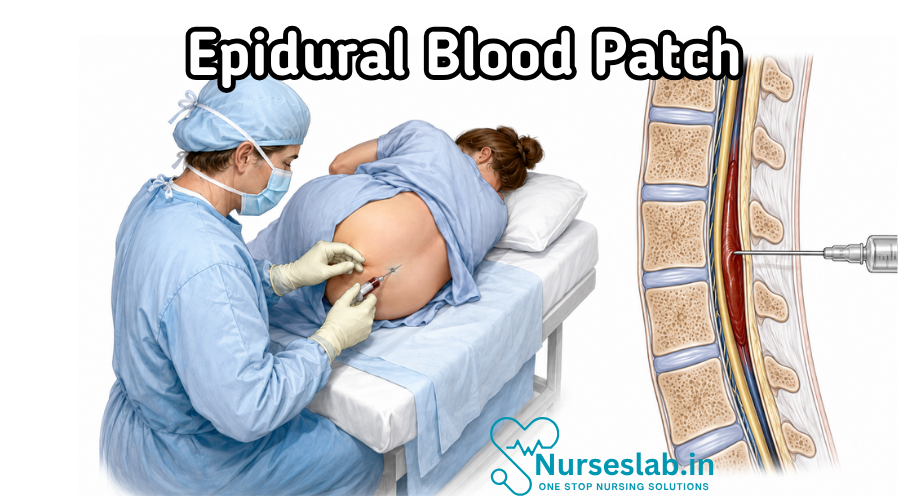
An Epidural Blood Patch (EBP) is a medical procedure used to treat headaches caused by cerebrospinal fluid (CSF) leaks. These leaks can occur after procedures such as lumbar punctures, spinal anesthesia, or spontaneously. An EBP involves injecting a small amount of the patient’s own blood into the epidural space in the spine, which helps seal the leak and restore normal CSF pressure.
Indications
The primary indication for an Epidural Blood Patch is a post-dural puncture headache (PDPH), also known as a spinal headache. This type of headache typically occurs within a few days after a lumbar puncture or spinal anesthesia and is characterized by a severe headache that worsens when the patient is upright and improves when lying down. Other indications for an EBP include spontaneous CSF leaks and leaks resulting from trauma or surgery.
Procedure
Preparation
Before the procedure, the patient is thoroughly evaluated to confirm the presence of a CSF leak. Imaging studies such as MRI or CT myelography may be performed to locate the exact site of the leak. The patient’s medical history and any contraindications to the procedure are also reviewed.
Technique
The EBP procedure is typically performed in a sterile setting, such as an operating room or a specialized procedure suite. The patient is positioned lying on their side or sitting up, depending on the preference of the healthcare provider. The patient’s back is cleaned with an antiseptic solution, and local anesthesia is administered to numb the area.
A needle is then inserted into the epidural space, usually at the same level or one level below the site of the CSF leak. Once the needle is correctly positioned, a small amount of the patient’s blood is drawn from a vein, typically in the arm. This blood is then injected into the epidural space through the needle.
The injected blood forms a clot that helps seal the dural tear and stop the CSF leak. The entire procedure usually takes about 30 minutes to an hour.
Post-Procedure Care
After the EBP procedure, the patient is monitored for a short period to ensure there are no immediate complications. The patient is typically advised to lie flat for one to two hours to help the blood clot form and seal the leak effectively. Pain relief is usually experienced within 24 hours, though some patients may take longer to feel the effects.
Complications and Risks
While the EBP procedure is generally safe, there are potential risks and complications that patients should be aware of. These may include:
- Back pain or discomfort at the injection site
- Temporary increase in headache severity
- Infection
- Bleeding
- Nerve damage
In rare cases, an EBP may not be effective, and a second procedure may be necessary.
Effectiveness
The effectiveness of an Epidural Blood Patch in treating post-dural puncture headaches is well-documented. Studies have shown that the procedure provides significant relief in the majority of patients, with success rates ranging from 70% to 90%. The immediate pain relief following the procedure is often dramatic, allowing patients to return to their normal activities sooner.
Alternatives
In cases where an Epidural Blood Patch is not suitable or effective, other treatment options may be considered. These alternatives include:
- Conservative management: This involves rest, hydration, and caffeine intake to help alleviate headache symptoms.
- Pharmacological treatment: Medications such as pain relievers, anti-inflammatory drugs, and caffeine can be used to manage symptoms.
- Surgical repair: In rare cases, a surgical procedure may be necessary to repair the dural tear and stop the CSF leak.
Nursing Care of a Patient with an Epidural Blood Patch
An Epidural Blood Patch (EBP) is a medical procedure used to treat post-dural puncture headaches, which can occur after a lumbar puncture or spinal anesthesia. The procedure involves injecting a small amount of the patient’s blood into the epidural space to seal the dural tear and stop the cerebrospinal fluid (CSF) leak. Effective nursing care is essential to ensure the patient’s safety, comfort, and recovery.
Pre-procedure Care
Patient Education
- Explain the purpose and procedure of the EBP to the patient and their family.
- Discuss the potential risks and benefits.
- Address any questions or concerns the patient may have.
Preparation
- Ensure the patient has signed the informed consent form.
- Review the patient’s medical history and any allergies.
- Prepare the sterile equipment and supplies needed for the procedure.
Intra-procedure Care
Assistance
- Assist the healthcare provider in positioning the patient, typically in a sitting or side-lying position.
- Maintain a sterile field and hand over the necessary instruments during the procedure.
Monitoring
- Monitor the patient’s vital signs, including blood pressure, heart rate, and oxygen saturation.
- Observe the patient for any signs of discomfort or adverse reactions.
Post-procedure Care
Immediate Care
- Position the patient supine for at least one hour to ensure the blood patch seals effectively.
- Monitor the patient’s vital signs and neurological status.
- Assess the patient for any signs of complications such as bleeding, infection, or nerve damage.
Patient Instructions
- Advise the patient to avoid strenuous activities and heavy lifting for at least 24 hours.
- Encourage the patient to stay hydrated and rest.
- Instruct the patient to report any severe headaches, back pain, or neurological symptoms immediately.
Follow-up Care
- Schedule a follow-up appointment to assess the effectiveness of the EBP and the patient’s recovery.
- Evaluate the need for additional treatment or interventions if symptoms persist.
Effectiveness and Alternatives
The effectiveness of an Epidural Blood Patch in treating post-dural puncture headaches is well-documented. Studies have shown that the procedure provides significant relief in the majority of patients, with success rates ranging from 70% to 90%. The immediate pain relief following the procedure is often dramatic, allowing patients to return to their normal activities sooner.
In cases where an Epidural Blood Patch is not suitable or effective, other treatment options may be considered. These alternatives include:
- Conservative management: This involves rest, hydration, and caffeine intake to help alleviate headache symptoms.
- Pharmacological treatment: Medications such as pain relievers, anti-inflammatory drugs, and caffeine can be used to manage symptoms.
- Surgical repair: In rare cases, a surgical procedure may be necessary to repair the dural tear and stop the CSF leak.
REFERENCES
- Shin HY. Recent update on epidural blood patch. Anesth Pain Med (Seoul). 2022 Jan;17(1):12-23. doi: 10.17085/apm.21113. Epub 2022 Jan 18. PMID: 35038855; PMCID: PMC8841262.
- Heine CL, Furse CM. A Safe Method for Performing an Epidural Blood Patch in a Pediatric Patient Requiring Deep Sedation for Epidural Catheter Placement: A Case Report (https://www.ncbi.nlm.nih.gov/pmc/articles/PMC6819025/). A A Pract. 2019 Nov;13(9):356-357.
- Epidural Blood Patch, Portland Pain carehttps://www.portlandpaincare.com/patient-information/epidural-blood-patch
- Tubben RE, Jain S, Murphy PB. Epidural Blood Patch (https://www.ncbi.nlm.nih.gov/books/NBK482336/). 2023 Jul 3. In: StatPearls [Internet]. Treasure Island (FL): StatPearls Publishing; 2024 Jan.
- Zetlaoui PJ, Buchheit T, Benhamou D. Epidural blood patch: A narrative review (https://pubmed.ncbi.nlm.nih.gov/35952552/). Anaesth Crit Care Pain Med. 2022 Oct;41(5):101138.
Stories are the threads that bind us; through them, we understand each other, grow, and heal.
JOHN NOORD
Connect with “Nurses Lab Editorial Team”
I hope you found this information helpful. Do you have any questions or comments? Kindly write in comments section. Subscribe the Blog with your email so you can stay updated on upcoming events and the latest articles.


