


Last Updated on January 22, 2026 by Nurseslab.in Editorial Team
Introduction
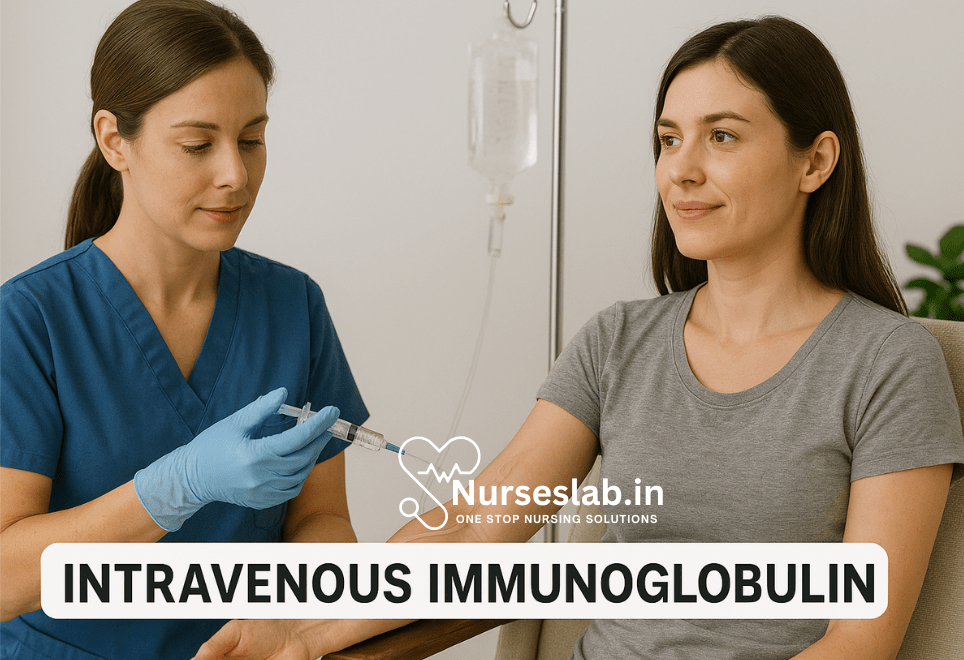
Immunoglobulin therapy is a precautionary measure for patients with low immunity. IVIG therapy can be administered as a replacement therapy via IV infusion in greater, more effective doses without painful side effects, and it can safely be given in outpatient as well as inpatient settings.
Definition
IVIG is a product made up of antibodies that can be given intravenously (through a vein). These antibodies are proteins that help the patient to fight infections.
Purposes
- IVIG is used to treat various autoimmune, infectious, and idiopathic diseases.
- It is also used to increase the levels of immunoglobulins.
Indications
- Autoimmune disorder.
- Immunodeficiency.
- Altered immune response.
- Dermatomyositis.
- Kawasaki’s disease.
- Multiple sclerosis.
- Lupus erythematosus.
- Chronic lymphocytic leukemia.
- Idiopathic thrombocytopenic purpura.
Contraindications
- Renal failure.
- Diabetes.
- Osmotic nephropathy
Articles
| Articles | Purpose |
| IV set with tubing | To administer the drug. |
| Infusion pump | To maintain drop factor. |
| Knife dish | To place the injections. |
| Normal saline flush | To prevent blood clots. |
| Wristwatch | To calculate the flow rate. |
| Notebook with pen | For documentation. |
| Immunoglobulin injection 5 g in 5% solution | To improve immunoglobulin levels. |
| Normal saline 500 mL | For dilution. |
| Inj. Hydrocortisone 50-200 mg (IV) | As a premedication. |
| Inj. Enoxaparin 1 mg/kg | As a premedication. |
| Tab. paracetamol | As a premedication (if needed). |
General Instructions
- Document the brand name, lot number, dose, infusion rate, and side reactions.
- Check baseline data such as renal and liver function tests (LFT, RFT), CBC, hepatitis B and C, and HIV tests.
- The recommended dose of infusion is 400-600 mg/kg for 3-4 weeks.
- Very low dose of IVIG 0.3-0.6 mg/kg once a month should be administered.
- The total time of infusion is 5-6 hours.
- The rate of infusion should be monitored.
- The initiated flow rate will be 0.5-1 mg/kg; after 20 minutes, it can be increased to 1.5-2.5 mg/kg/min.
- The usual maintenance dose is 400-500 mg/kg every 4 weeks.
- The vital signs should be monitored every 30 minutes until the infusion is completed.
- Review every 2 months and monitor CBC and immunoglobulin levels.
- Note adverse reactions such as edema, rashes, and scaly skin.
Recording and Reporting
- Record the type of fluid, amount of IV fluid, and drop rate at which the fluid is infused.
- Verify the prescribed dose to be transfused as per the physician’s order.
- Specify the color changes at the IV infusion site.
- Specify if signs and symptoms of fluid overload or fluid deficit are identified.
- Report any pertinent findings to the nurse-in-charge.
Special Considerations
Pre-Infusion
- Hydration is key to reduce side effects like headache.
- Review medications (e.g., hold nephrotoxic drugs).
- Screen for IgA deficiency (risk of anaphylaxis).
During Infusion
- Start slowly, increase rate gradually.
- Monitor for infusion reactions: headache, chills, fever, nausea.
Post-Infusion
- Watch for delayed side effects: fatigue, aseptic meningitis, renal dysfunction.
- Encourage rest and hydration.
REFERENCES
- Annamma Jacob, Rekha, Jhadav Sonali Tarachand: Clinical Nursing Procedures: The Art of Nursing Practice, 5th Edition, March 2023, Jaypee Publishers, ISBN-13: 978-9356961845 ISBN-10: 9356961840
- Omayalachi CON, Manual of Nursing Procedures and Practice, Vol 1, 3 Edition 2023, Published by Wolters Kluwer’s, ISBN: 978-9393553294
- Sandra Nettina, Lippincott Manual of Nursing Practice, 11th Edition, January 2019, Published by Wolters Kluwers, ISBN-13:978-9388313285
- Adrianne Dill Linton, Medical-Surgical Nursing, 8th Edition, 2023, Elsevier Publications, ISBN: 978-0323826716
- Donna Ignatavicius, Medical-Surgical Nursing: Concepts for Clinical Judgment and Collaborative Care, 11th Edition ,2024, Elsevier Publications, ISBN: 978-0323878265
- Lewis’s Medical-Surgical Nursing, 12th Edition,2024, Elsevier Publications, ISBN: 978-0323789615
- AACN Essentials of Critical Care Nursing, 5th Ed. Sarah. Delgado, 2023, Published by American Association of Critical-Care Nurses ISBN: 978-1264269884
- Ernstmeyer K, Christman E, editors. Nursing Fundamentals [Internet]. 2nd edition. Eau Claire (WI): Chippewa Valley Technical College; 2024. PART IV, NURSING PROCESS. Available from: https://www.ncbi.nlm.nih.gov/books/NBK610818/
Stories are the threads that bind us; through them, we understand each other, grow, and heal.
JOHN NOORD
Connect with “Nurses Lab Editorial Team”
I hope you found this information helpful. Do you have any questions or comments? Kindly write in comments section. Subscribe the Blog with your email so you can stay updated on upcoming events and the latest articles.


