


Last Updated on June 19, 2026 by Nurseslab.in Editorial Team
Explore how healthcare e-learning is transforming nursing education through AI, virtual simulation, mobile learning, personalisation, and flexible professional development.
How digital education is reshaping nursing knowledge, clinical capability, and lifelong professional development
Introduction
Healthcare never stops changing. New evidence, medicines, technologies, pathways, and safety expectations continually reshape nursing practice. Traditional classroom teaching remains valuable, but it cannot carry the entire educational burden of a workforce that works around the clock, spans multiple settings, and needs rapid access to current learning. Healthcare e-learning has therefore moved from a convenient extra to an essential part of workforce development.
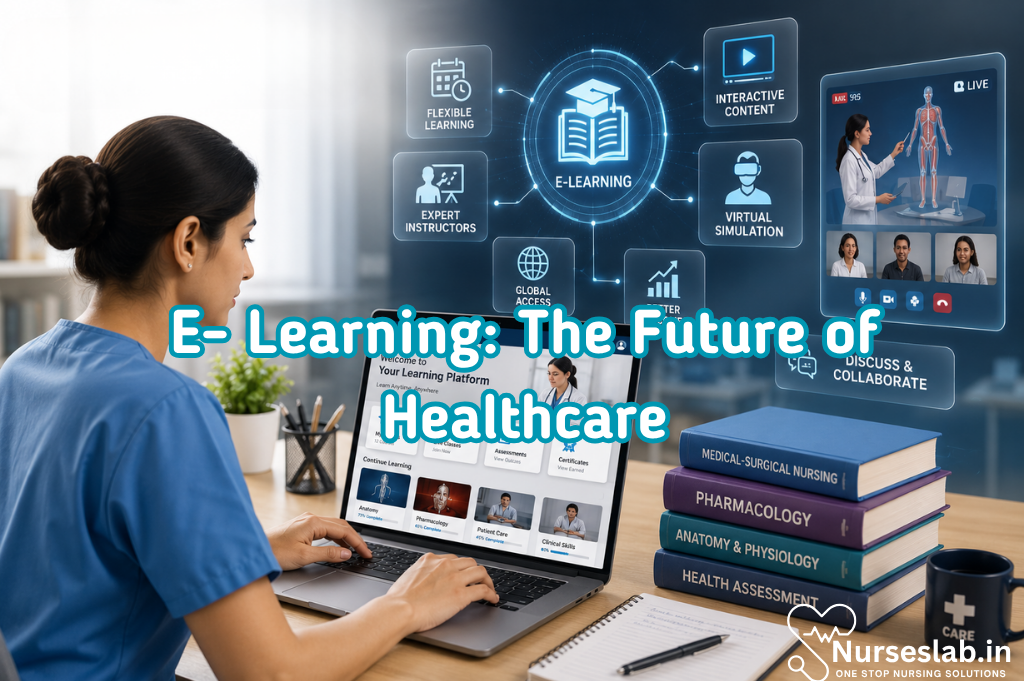
The future is not simply about replacing lectures with videos. It is about creating connected learning ecosystems that combine self-paced modules, virtual patients, simulation, mobile resources, digital assessment, live discussion, workplace coaching, and practice data. For nurses, the promise is significant: learning can become more accessible, personalised, realistic, measurable, and closely connected to patient care. The challenge is equally important: digital education must remain evidence-based, inclusive, secure, human-centred, and linked to demonstrable competence.
What Healthcare E-Learning Means Today
Healthcare e-learning includes any planned education delivered or supported through digital technology. It may be fully online or blended with face-to-face teaching and supervised practice. Formats include interactive modules, webinars, podcasts, online case discussions, mobile apps, virtual classrooms, digital portfolios, virtual reality, augmented reality, serious games, and computer-based simulation.
The most effective question is not, “Is e-learning better than classroom teaching?” It is, “Which learning method best fits this objective, learner, context, and risk?” A short module may be ideal for policy updates. A live virtual workshop may suit ethical debate. A virtual patient can develop clinical reasoning. A physical simulation remains essential for teamwork, equipment use, and psychomotor skills. Blended learning deliberately combines these strengths.
Why the Shift Matters for Nurses
Nurses are the largest professional group in many healthcare systems and work across hospitals, homes, clinics, schools, care facilities, public health, education, research, and leadership. Release for classroom study can be difficult, particularly for shift workers, rural teams, carers, and staff in small services. E-learning can widen access by allowing learning at different times, on different devices, and at an appropriate pace.
It can also standardise essential messages across large organisations. When infection-prevention guidance, medicines policy, documentation requirements, or escalation processes change, a digital resource can be updated and distributed rapidly. Completion data can identify gaps, although completion alone must never be mistaken for competence.
The Technologies Driving the Next Generation of Learning
Artificial Intelligence and Adaptive Learning
Artificial intelligence can support more responsive education. Adaptive platforms may adjust question difficulty, identify weak areas, recommend resources, generate practice cases, or provide immediate feedback. A nurse who consistently struggles with anticoagulant calculations could receive additional exercises, while another learner could move towards more complex scenarios.
AI also introduces risk. Outputs can be inaccurate, biased, outdated, or overconfident. Tools may mishandle confidential information or obscure how a recommendation was produced. Nurses should verify content against trusted clinical sources, avoid entering identifiable patient data into unapproved systems, and follow organisational governance. AI can support reasoning and feedback, but it must not replace accountable educators, clinical supervisors, or professional judgement.
Virtual, Augmented, and Extended Reality
Immersive technologies place learners inside realistic scenarios without exposing patients to avoidable risk. A nurse might assess a deteriorating virtual patient, practise prioritisation during a major incident, identify hazards in a home, or rehearse communication in a mental-health crisis. Augmented reality can overlay instructions or anatomy onto the physical environment, while mixed-reality systems combine real equipment with digital patients.
The educational value does not come from novelty alone. Good simulation requires clear objectives, psychological safety, realistic decisions, pre-briefing, observation, feedback, and debriefing. Immersion should serve learning rather than distract from it. Physical accessibility, motion sensitivity, device hygiene, technical support, and alternative formats must also be planned.
Virtual Patients and Branching Scenarios
Virtual patients allow learners to take a history, interpret observations, request investigations, choose interventions, and experience consequences. Branching scenarios are particularly useful for medication safety, safeguarding, triage, sepsis, consent, leadership, and communication. Unlike a linear slide deck, they require active decisions and make reasoning visible.
Mobile Learning and Microlearning
Microlearning delivers focused content in small units: a five-minute case, a short quiz, a drug-safety update, or a demonstration followed by one application task. Mobile access can help nurses learn between shifts or revisit key information close to practice. Short does not mean superficial. Effective microlearning addresses one clear objective and connects to a larger pathway.
Learning Analytics and Digital Portfolios
Learning analytics can show progress, repeated errors, disengagement, and completion patterns. Digital portfolios can bring together certificates, reflections, supervisor feedback, assessments, and improvement plans. Used ethically, these tools support targeted development. Used carelessly, they can become surveillance systems that reduce learning to clicks, scores, or time online. Learners should know what data are collected, why, who can access them, and how long they are retained.
From Passive Content to Active Learning
Healthcare e-learning fails when it simply places dense text and a multiple-choice test online. Nurses learn more effectively when they retrieve knowledge, make decisions, receive feedback, reflect, and apply learning in context. Effective designs use clinical cases, spaced repetition, questions throughout, deliberate practice, peer discussion, and opportunities to explain reasoning.
Assessment should match the objective. Knowledge may be assessed through questions. Communication may require recorded or observed performance. A psychomotor skill needs demonstration in practice or simulation. Team leadership requires a team context. High-risk competence cannot be signed off solely because a learner passed an online quiz.
Benefits for Nurses, Patients, and Organisations
- Flexible access: learning can accommodate shifts, geography, caring responsibilities, and different pacing needs.
- Scalability: organisations can deliver consistent education to large, dispersed workforces.
- Safe practice: learners can make decisions and learn from errors without harming patients.
- Standardisation: core content, terminology, and assessment can be aligned across teams.
- Personalisation: pathways can respond to role, prior knowledge, performance, and career goals.
- Repeatability: complex or rare scenarios can be revisited until performance improves.
- Rapid updating: digital content can respond quickly to new evidence or policy.
- Data-informed support: educators can identify where learners need additional teaching.
- Global reach: online education can widen access to continuing professional development, including in resource-limited locations.
These benefits are potential, not automatic. Outcomes depend on instructional design, relevance, technology, educator capability, learner support, workplace culture, and whether staff have protected time to participate.
The Digital Divide Cannot Be Ignored
E-learning can increase access while also creating new barriers. Learners may lack reliable internet, a suitable device, private study space, digital confidence, assistive technology, or time during paid work. Platforms may not function well on older phones or low-bandwidth connections. Captions, transcripts, keyboard navigation, screen-reader compatibility, colour contrast, and readable layouts are essential rather than optional.
Equitable design offers alternatives: downloadable versions, audio and text options, accessible assessment, local learning spaces, device-loan schemes, technical support, and protected time. Organisations should test resources with diverse nurses—including internationally educated staff, people with disabilities, rural teams, and those with limited digital experience—before deployment.
Keeping the Human Element
Nursing is relational. No platform can fully reproduce the complexity of comforting a distressed family, negotiating consent, noticing hesitation, or earning trust over time. The future of e-learning should therefore strengthen human connection, not displace it. Facilitated discussion, peer feedback, coaching, mentorship, interdisciplinary learning, and reflective debriefing remain central.
Digital education can prepare nurses for clinical encounters, but learning must transfer to practice. Educators should ask supervisors and patients whether behaviour changed, audit relevant outcomes, and revise content when improvement is not seen.
Quality, Safety, and Governance
Clinical content should be authored and reviewed by appropriately qualified experts, linked to current evidence, dated, version-controlled, and scheduled for review. Conflicts of interest must be transparent. Learners need a route to report errors or accessibility problems. Scenario assumptions should reflect diverse patients and avoid stereotypes.
Data governance matters whenever platforms collect identities, activity, results, reflections, voice, video, or biometric information. Organisations should minimise collection, secure data, define lawful use, assess vendors, manage access, and plan for system failure. Cybersecurity awareness should be part of both platform design and nursing education.
How E-Learning Can Support Clinical Competence
A complete learning pathway might begin with a short online pre-assessment, followed by targeted knowledge modules and a virtual patient. The learner then attends skills practice or team simulation, receives structured debriefing, demonstrates competence under supervision, and records reflection in a portfolio. Follow-up questions several weeks later reinforce retention, while workplace audit checks whether practice changed.
- Knowledge: interactive content, retrieval questions, and spaced review.
- Clinical reasoning: virtual patients, branching cases, and feedback.
- Psychomotor skills: demonstration, deliberate practice, and observed assessment.
- Communication: role-play, recorded consultations, and facilitated feedback.
- Teamwork: synchronous simulation and interdisciplinary debriefing.
- Professional development: coaching, reflection, audit, and digital portfolios.
What the Future May Look Like for a Nurse Learner
A nurse begins a shift and receives a short learning prompt based on a recent safety update. Later, a quiet period allows completion of a five-minute case on early deterioration. Their answers reveal uncertainty about escalation thresholds, so the learning platform recommends a virtual scenario. During the scenario, the nurse must prioritise assessment, communicate using a structured format, and respond as the patient changes.
The following week, the nurse practises the same scenario with colleagues in a simulation centre. A facilitator explores decision-making and human factors during debriefing. A supervisor then observes workplace escalation and signs off the relevant capability. The digital elements do not replace supervised practice; they make it better prepared, more targeted, and easier to revisit.
Practical Steps for Nurses
- Set a clinical goal. Choose learning that addresses a patient-care need, not merely a certificate.
- Check credibility. Review the author, evidence, date, update cycle, accreditation, and relevance to local policy.
- Learn actively. Pause to predict, answer questions without looking, write a short summary, and apply the content to a case.
- Verify high-risk information. Check medicines, procedures, and emergency guidance against approved current sources.
- Protect confidentiality. Never upload identifiable patient information to unapproved platforms or AI tools.
- Connect learning to practice. Discuss it with a supervisor, practise the skill, and seek observed feedback.
- Revisit the topic. Use spaced review rather than one long session followed by silence.
- Record reflection. Document what changed in your understanding and what you will do differently.
Practical Steps for Nurse Educators and Organisations
- Start with a performance or patient-safety need, then define measurable outcomes.
- Choose technology only after identifying the learning objective.
- Co-design with nurses, patients, educators, accessibility specialists, and digital teams.
- Build active practice, feedback, reflection, and transfer into the pathway.
- Offer protected learning time, devices, connectivity, and technical support.
- Separate course completion from clinical competence.
- Train faculty in digital facilitation, assessment, debriefing, and data ethics.
- Evaluate knowledge, behaviour, patient outcomes, equity, and unintended consequences.
- Plan content review, platform downtime, data retention, and vendor exit.
- Scale only after testing usability, accessibility, safety, and educational effect.
Questions Nurses Should Ask Before Enrolling
- Who created and clinically reviewed the course?
- When was the content last updated?
- Does it match my country, role, scope, and local policy?
- How will I practise and demonstrate the skill?
- Is the platform accessible on my device and with any adjustments I use?
- What learner data are collected and how are they used?
- Is meaningful feedback available?
- Will I have protected time and workplace support?
- What evidence shows the learning improves performance?
Common Myths About Healthcare E-Learning
- “Online learning is automatically flexible.” It is only flexible when staff have time, access, and realistic deadlines.
- “Completion proves competence.” Completion proves that a course was completed; competence requires valid assessment and practice.
- “More technology means better learning.” Poor design remains poor design inside a headset or AI platform.
- “Digital education removes the need for educators.” Skilled facilitation, feedback, support, and judgement become more important, not less.
- “Younger nurses are naturally digitally competent.” Familiarity with consumer technology does not guarantee clinical informatics, cybersecurity, or digital-health capability.
- “E-learning is always cheaper.” High-quality content requires design, review, licensing, support, accessibility, governance, and maintenance.
The Role of Nurses in Shaping the Future
Nurses should not be passive recipients of digital education. Their frontline experience is essential when deciding which problems need teaching, whether a scenario feels authentic, where learners struggle, and whether a resource changes care. Nurses can act as subject-matter experts, designers, facilitators, assessors, researchers, accessibility advocates, digital champions, and critical users.
The most important contribution may be asking difficult questions: Does this tool make care safer? Whose perspective is missing? What happens when the algorithm is wrong? Can a busy night nurse realistically use it? Does it improve practice or merely generate data? Innovation becomes valuable when it is accountable to patients, learners, and the realities of care.
How Success Should Be Measured
Course satisfaction and completion rates are useful, but they are not enough. Evaluation should ask whether nurses retain knowledge, demonstrate skills, make better decisions, communicate more effectively, and change practice. Where appropriate, organisations should examine patient-safety indicators, clinical outcomes, time away from care, staff confidence, accessibility, cost, and disparities in participation.
Good evaluation also looks for unintended effects. Did mandatory modules add workload without protected time? Whether the platform exclude some staff? Did learners memorise a quiz rather than improve judgement? Did an AI tutor reinforce an error? Continuous monitoring, learner feedback, and transparent revision are essential.
Conclusion: The Future Is Blended, Intelligent, and Human
The future of healthcare e-learning is already visible: learning platforms available at any time, mobile resources, adaptive pathways, virtual patients, immersive simulation, digital portfolios, and globally accessible professional development. These tools can expand educational capacity, support lifelong learning, and give nurses safer opportunities to practise complex decisions.
Technology alone, however, will not improve nursing. The strongest future is blended: digital learning for access, repetition, personalisation, and simulation; expert educators for judgement and feedback; clinical supervisors for safe application; and patients as partners in defining meaningful care. When evidence, equity, accessibility, privacy, and human connection guide design, e-learning becomes more than a convenient course. It becomes an infrastructure for a capable, confident, and continuously learning nursing workforce.
REFERENCES
- Adobe.com, The Future of Learning: Exploring eLearning in Healthcare, June 9, 2023, https://elearning.adobe.com/2023/06/the-future-of-learning-exploring-elearning-in-healthcare/
- Rohit Kumar, Is eLearning the Future of Training in Healthcare?, 21 Mar, 2025, https://corecompetency.net/insights/is-elearning-the-future-of-training-in-healthcare/
Stories are the threads that bind us; through them, we understand each other, grow, and heal.
JOHN NOORD
Connect with “Nurses Lab Editorial Team”
I hope you found this information helpful. Do you have any questions or comments? Kindly write in comments section. Subscribe the Blog with your email so you can stay updated on upcoming events and the latest articles.


