


Last Updated on January 13, 2026 by Nurseslab.in Editorial Team
Explore the evolution of culture in sociology: a dynamic process where traditions, values, and social norms adapt through innovation, interaction, and historical change. Cultural evolution explains shifts in identity, behavior, and institutions—essential for understanding diversity, globalization, and societal progress.
Introduction
Culture, a fundamental concept within sociology, refers to the shared beliefs, values, norms, symbols, practices, and artefacts that shape the way individuals and groups interact within societies. It is both a product and a process: the outcome of historical development and the ongoing means through which societies define themselves and relate to the world. For sociologists, understanding culture is critical to analysing social behaviour, identity formation, group dynamics, and societal change.
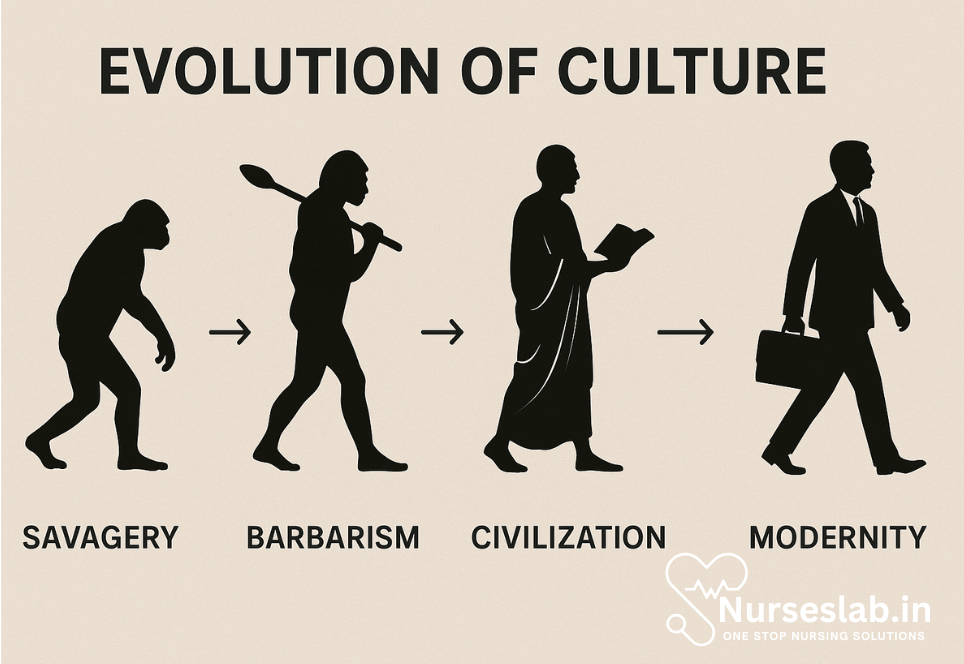
Historical Perspectives
The study of culture as a distinct sociological concept has deep roots in both anthropology and early social theory. In the nineteenth century, anthropologists such as Edward Burnett Tylor and Franz Boas laid the groundwork for understanding culture as a complex whole, encompassing knowledge, belief, art, morals, law, custom, and other capabilities acquired by humans as members of society. Tylor’s definition, articulated in his seminal work Primitive Culture (1871), remains influential for its holistic approach.
Early sociological perspectives, however, often focused more on social structure and institutions than on culture itself. Auguste Comte, considered the father of sociology, emphasised the systematic study of society but did not develop a nuanced concept of culture. Herbert Spencer, similarly, viewed society as an organism but did not focus extensively on cultural analysis.
The anthropological tradition, particularly through Boas’s work, challenged prevailing notions of cultural hierarchy and ethnocentrism, advocating for cultural relativism—the idea that cultures should be understood on their own terms rather than judged against others. This shift enabled sociologists to appreciate the diversity and complexity of cultural forms, laying the foundation for more sophisticated theories.
Classical Sociological Theories: Durkheim, Weber, and Marx
Émile Durkheim: Culture and Social Solidarity
Émile Durkheim, one of the founders of modern sociology, placed culture at the centre of his analysis of social cohesion and integration. In The Elementary Forms of Religious Life (1912), Durkheim examined how collective representations—symbols, rituals, and beliefs—bind individuals together, reinforcing social norms and values. For Durkheim, culture was both a source of social order and a mechanism through which societies maintained solidarity. He argued that cultural phenomena, especially religion, were not mere reflections of individual consciousness but collective forces shaping society’s moral fabric.
Max Weber: Culture, Meaning, and Social Action
Max Weber’s contributions to cultural sociology are profound. He emphasised the importance of meaning in social action, arguing that individuals interpret and construct their realities through cultural symbols and values. In The Protestant Ethic and the Spirit of Capitalism (1905), Weber traced how religious beliefs influenced economic behaviour and the development of capitalist societies. His approach underscored the role of ideas, values, and worldviews in shaping historical change, moving beyond materialist explanations to highlight the subjective dimensions of culture.
Karl Marx: Ideology and Cultural Hegemony
Karl Marx, while primarily focused on material conditions and class relations, also addressed the influence of culture through the concept of ideology. Marx viewed culture as a reflection of the dominant class’s interests, arguing that ruling ideas serve to justify and perpetuate social inequalities. Later Marxist thinkers, notably Antonio Gramsci, developed the concept of cultural hegemony, exploring how power operates not only through economic and political means but also through cultural institutions and practices. This perspective has been instrumental in analysing how culture can both reinforce and challenge existing power structures.
Modern Theories: Structuralism, Functionalism, and Symbolic Interactionism
Structuralism
Structuralism, influenced by linguist Ferdinand de Saussure and anthropologist Claude Lévi-Strauss, approaches culture as a system of underlying structures—rules, codes, and relationships—that shape human behaviour. Lévi-Strauss’s studies of myths and kinship systems revealed recurring patterns across cultures, suggesting that universal cognitive structures underpin cultural expressions. Structuralism’s emphasis on the deep grammar of culture provided a new lens for analysing symbolic forms and the logic of social life.
Functionalism
Functionalist theories, building on Durkheim’s legacy, analyse culture in terms of its role in maintaining social stability and integration. Talcott Parsons, a leading functionalist, argued that cultural values and norms provide the standards for evaluating behaviour, resolving conflicts, and ensuring the continuity of social systems. Functionalism views culture as an adaptive mechanism, helping societies respond to internal and external challenges. Critics, however, have pointed out that functionalism can overlook cultural conflict and change, focusing too narrowly on consensus and equilibrium.
Symbolic Interactionism
Symbolic interactionism, developed by George Herbert Mead and Herbert Blumer, shifts attention to the micro-level processes through which individuals create and negotiate meaning. Culture, from this perspective, emerges through everyday interactions, as people use symbols—language, gestures, objects—to communicate and construct shared realities. This approach highlights the fluid, dynamic nature of culture, emphasising agency, interpretation, and the ongoing production of meaning. It is particularly useful for examining identity formation, role-taking, and the negotiation of social norms.
Mechanisms of Cultural Change: Diffusion, Innovation, Acculturation, and Assimilation
Diffusion
Cultural diffusion refers to the spread of cultural elements—ideas, practices, technologies, artefacts—from one society or group to another. This process can occur through trade, migration, conquest, or media, leading to the adoption of new forms and the transformation of existing ones. Diffusion is a key driver of cultural change, facilitating the exchange and blending of traditions across boundaries.
Innovation
Innovation involves the creation of new cultural forms, practices, or technologies within a society. Innovations may arise from individual creativity, collective experimentation, or responses to changing circumstances. Sociologists study how innovations are accepted, resisted, or adapted, examining the social processes that shape their diffusion and impact. The concept of cultural lag, introduced by William Fielding Ogburn, describes the period during which non-material culture (values, norms) struggles to keep pace with material innovations (technology).
Acculturation and Assimilation
Acculturation describes the process by which individuals or groups adopt elements of a different culture, often as a result of sustained contact. This can lead to the blending, modification, or even loss of cultural traits. Assimilation, by contrast, involves the absorption of minority groups into the dominant culture, often accompanied by the erosion of distinct identities. Both processes are complex, shaped by power relations, social policies, and individual choices. Sociologists analyse the conditions under which acculturation and assimilation occur, as well as their consequences for identity, social cohesion, and cultural diversity.
Globalisation and Cultural Evolution: Technology, Media, and Migration
The contemporary era is characterised by unprecedented global interconnectedness, driven by advances in technology, communication, and transportation. Globalisation has profoundly affected cultural evolution, enabling the rapid exchange of ideas, values, and practices across continents.
Technology and media play a central role in this process. The internet, social media, and digital platforms facilitate the dissemination of cultural content, breaking down geographical barriers and fostering new forms of interaction. Popular culture, music, cinema, and fashion are increasingly global phenomena, shaping tastes and identities worldwide. At the same time, globalisation has intensified debates about cultural homogenisation—the loss of local distinctiveness in favour of global norms—and cultural hybridisation, the creation of new forms through the mixing of traditions.
Migration is another significant factor in cultural evolution. The movement of people across borders brings diverse cultures into contact, challenging established norms and fostering multicultural societies. Migrants often maintain transnational ties, creating hybrid identities and communities that transcend national boundaries. Sociologists study the impact of migration on cultural integration, adaptation, and conflict, as well as the policies that shape these processes.
Contemporary Debates: Multiculturalism, Cultural Homogenisation, and Identity
Multiculturalism
Multiculturalism refers to the coexistence of multiple cultural groups within a society, recognising and valuing diversity as a source of strength and enrichment. It is both a social reality and a political ideal, reflected in policies that promote inclusion, tolerance, and equal rights. Advocates argue that multiculturalism fosters creativity, innovation, and social cohesion by allowing individuals to express their identities freely. Critics, however, contend that it can lead to fragmentation, undermine shared values, and create tensions between groups.
Cultural Homogenisation
Cultural homogenisation describes the process by which local cultures are subsumed by dominant global forms, often as a result of economic and media influences. The spread of Western consumer culture, language, and lifestyles has raised concerns about the erosion of indigenous traditions and the loss of cultural autonomy. Sociologists debate the extent and consequences of homogenisation, examining whether it represents genuine convergence or masks underlying diversity and resistance.
Identity
The question of identity is central to contemporary cultural sociology. In a rapidly changing world, individuals and groups grapple with issues of belonging, recognition, and self-definition. Identity is shaped by cultural narratives, symbols, and practices, as well as by experiences of inclusion and exclusion. Sociologists explore how identities are constructed, negotiated, and contested, paying attention to the role of ethnicity, gender, religion, and other factors. The rise of identity politics reflects the growing importance of cultural claims in social and political life.
Conclusion: Summary and Future Directions in the Study of Culture
The evolution of culture in sociology is marked by a rich interplay of theories, historical developments, and ongoing debates. From its anthropological origins to its central place in classical and modern sociological thought, culture remains a vital lens for understanding social life. Key thinkers such as Durkheim, Weber, and Marx have shaped the field, offering diverse perspectives on the role of culture in social solidarity, meaning, and power.
Contemporary sociological theories continue to expand our understanding, examining culture as both a structure and a process, a source of stability and change. Mechanisms of cultural change—diffusion, innovation, acculturation, and assimilation—highlight the dynamic nature of cultural evolution, while globalisation and migration present new challenges and opportunities for cultural interaction.
Debates about multiculturalism, homogenisation, and identity underscore the complexity of culture in the modern world. As societies become increasingly interconnected, the study of culture in sociology must adapt, embracing new methods, perspectives, and questions. Future research will likely focus on the interplay between local and global forces, the impact of digital technologies, and the ongoing negotiation of identity in diverse societies.
For students, researchers, and educators, a deep understanding of cultural evolution is essential for navigating the complexities of contemporary social life. By tracing the historical and theoretical development of culture in sociology, we gain critical insights into the forces that shape our world, inform our interactions, and define who we are.
REFERENCES
- R Sreevani, Applied Sociology for Nurses, 2nd Edition, 2023, Jaypee Publishers, ISBN: 978-9356962866.
- I. Clement, Sociology for Nurses, 3rd Edition, 2023, Pearson Publishers, ISBN: 978-9357053273.
- Denny, Earle, Hewison, Sociology for Nurses, 3rd Edition, 2016, Wiley Publishers, ISBN: 978-1509505401.
- Hannah Cooke, Sociological Approaches to Health, Healthcare and Nursing, 1st Edition, September 9, 2024, ISBN: 978-0702083143.
- Jacob Anthikad, Sociology for Graduate Nurses, 2nd Edition, 2014, Jaypee Publishers, ISBN: 978-9351520085.
- Tubergen, Frank. March 2020. Introduction to Sociology. ISBN: 978-1351134958. https://www.researchgate.net/publication/339505825_Introduction_to_Sociology
Stories are the threads that bind us; through them, we understand each other, grow, and heal.
JOHN NOORD
Connect with “Nurses Lab Editorial Team”
I hope you found this information helpful. Do you have any questions or comments? Kindly write in comments section. Subscribe the Blog with your email so you can stay updated on upcoming events and the latest articles.


