


Last Updated on January 10, 2026 by Nurseslab.in Editorial Team
The Vampire Facelift is a non-surgical cosmetic procedure that combines platelet-rich plasma (PRP) from the patient’s own blood with hyaluronic acid fillers to rejuvenate facial skin—enhancing volume, texture, and tone while promoting collagen production and natural healing
Introduction to the Vampire Facelift
The pursuit of youthful, radiant skin has inspired countless innovations in cosmetic medicine. Among the most intriguing and buzzworthy of these is the Vampire Facelift, also known as the PRP (Platelet-Rich Plasma) Facelift. This minimally invasive procedure has garnered widespread attention for its promise to rejuvenate the face using the patient’s own blood—an idea that sounds almost like science fiction, yet is firmly rooted in scientific principles.
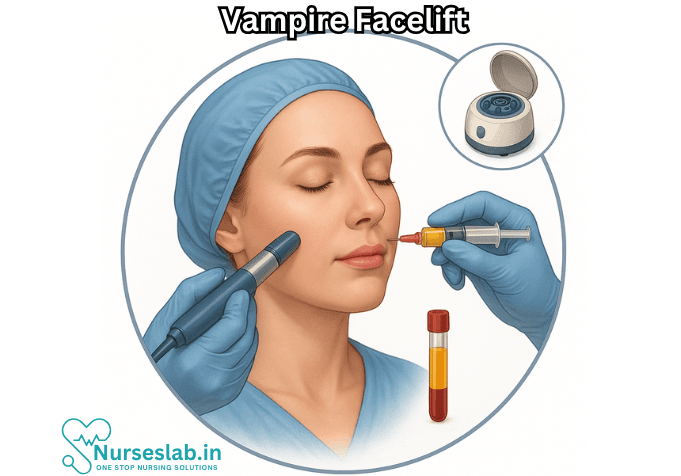
The name “Vampire Facelift” evokes an image of mysterious transformation but refers to a scientifically grounded technique that utilizes growth factors from a patient’s blood to stimulate tissue regeneration, enhance skin volume, and improve complexion. This guide provides a comprehensive look at the Vampire Facelift, including its origins, procedure, benefits, risks, and what patients can expect before, during, and after treatment.
Origins and Evolution of the Vampire Facelift
The concept of using the body’s own regenerative properties to promote healing is not new. Platelet-rich plasma therapy has been used for decades in orthopedic medicine, sports injuries, and dentistry to enhance recovery. In the early 2000s, medical professionals began adapting PRP for aesthetic purposes, particularly for facial rejuvenation.
The term “Vampire Facelift” was popularized by Dr. Charles Runels in 2010. Dr. Runels developed and trademarked the specific method for combining PRP with dermal fillers to enhance facial aesthetics naturally. Since then, the Vampire Facelift has become a sought-after procedure among celebrities and the general public alike, praised for its natural results and minimal downtime.
Understanding Platelet-Rich Plasma (PRP)
Platelet-rich plasma is a concentration of platelets derived from the patient’s own blood. Platelets, best known for their role in clotting, also contain growth factors that facilitate tissue repair and regeneration. By isolating and concentrating these platelets, clinicians can harness their healing properties for cosmetic benefits.
The process involves drawing a small amount of blood from the patient, usually from the arm. This blood is then spun in a centrifuge to separate its components—red blood cells, white blood cells, plasma, and platelets. The platelet-rich fraction is then collected and prepared for injection.
The Procedure: Step-by-Step
The Vampire Facelift is typically performed in an outpatient, clinical setting. Here is an overview of what patients can expect:
- Consultation: The journey begins with a thorough consultation. The provider assesses the patient’s medical history, skin concerns, and aesthetic goals to determine if they are a suitable candidate.
- Blood Draw: A small vial of blood (usually 10–20 milliliters) is drawn from the patient’s arm.
- Preparation of PRP: The blood sample is placed in a centrifuge, which spins rapidly to separate the platelets from other blood components. This process typically takes about 10–15 minutes.
- Dermal Fillers: In many cases, a hyaluronic acid-based filler (such as Juvederm or Restylane) is injected into areas that require volume enhancement, such as the cheeks, under the eyes, or nasolabial folds. This provides immediate lifting and contouring effects.
- PRP Injection: The concentrated PRP is then injected into targeted areas of the face, often using fine needles or a microneedling device. The PRP works by stimulating collagen production, increasing blood flow, and promoting tissue regeneration.
- Post-Procedure Care: Patients may experience mild redness, bruising, or swelling, but these symptoms generally subside within a few days. Special aftercare instructions are given to ensure optimal healing.
The entire procedure usually takes about 60–90 minutes, and patients are free to return to most normal activities shortly afterward.
Benefits of the Vampire Facelift
The Vampire Facelift offers a range of cosmetic benefits, many of which are achieved through the synergistic effects of dermal fillers and PRP. Some of the most notable advantages include:
- Natural Rejuvenation: Since PRP is derived from the patient’s own blood, it reduces the risk of allergic reactions or adverse effects, making it a safe option for most individuals.
- Youthful Volume Restoration: The combination of fillers and PRP helps restore lost volume, smooth out wrinkles, and enhance facial contours without the need for surgery.
- Enhanced Skin Tone and Texture: PRP stimulates collagen and elastin production, leading to improved skin texture, elasticity, and overall radiance.
- Minimally Invasive: The procedure involves no incisions or general anesthesia and requires little to no downtime.
- Long-Lasting Results: While the effects of dermal fillers are immediate, the full benefits of PRP become apparent over several weeks as the skin’s natural healing processes take place.
- Customizable Treatment: The technique can be tailored to address individual concerns, such as fine lines, acne scars, or dullness.
Risks and Considerations
Like all cosmetic procedures, the Vampire Facelift is not without its risks and limitations. Patients should be aware of the following:
- Temporary Side Effects: Common side effects include bruising, redness, swelling, and tenderness at the injection sites. These effects typically resolve within a few days.
- Infection Risk: Although rare, there is a small risk of infection anytime the skin is punctured.
- Uneven Results: Inexperienced providers may cause uneven filler placement or overcorrection, leading to asymmetry or lumps.
- Not a Surgical Facelift: The Vampire Facelift does not offer the dramatic results of a surgical facelift. It is best suited for those with mild to moderate signs of aging.
- Results Vary: Individual results depend on factors such as skin type, age, and overall health.
Patients with certain medical conditions (such as blood disorders, active infections, or specific autoimmune diseases) may not be ideal candidates for PRP treatments. A thorough consultation and honest communication with a qualified practitioner are essential.
Ideal Candidates for the Vampire Facelift
The Vampire Facelift is best suited for individuals who:
- Exhibit mild to moderate facial aging and volume loss
- Desire natural-looking results without surgery
- Are in good general health and non-smokers (smoking can hinder healing)
- Have realistic expectations about the results
- Do not have contraindicated medical conditions
It is important for patients to discuss their medical history, medications, and prior procedures with their provider to ensure the safest and most effective care.
What to Expect: Before, During, and After the Procedure
Before: Patients should avoid blood-thinning medications and supplements (such as aspirin or fish oil) before the procedure to minimize bruising. A pre-procedure consultation will address all concerns and review the treatment plan.
During: A topical numbing cream is often applied for comfort. The blood draw and injections are generally well-tolerated, with most patients reporting only mild discomfort.
After: Recovery is quick, with most redness and swelling resolving within a day or two. Providers may recommend gentle skincare, avoiding direct sun exposure, and refraining from strenuous exercise for 24–48 hours.
Comparing the Vampire Facelift with Other Treatments
The cosmetic market offers a variety of facial rejuvenation options, each with its advantages and limitations. Here’s how the Vampire Facelift compares to alternatives:
- Traditional Facelift: Involves surgical intervention, providing more dramatic and long-lasting results but carries greater risks, longer downtime, and higher costs.
- Dermal Fillers Alone: Fillers offer immediate volume but lack the regenerative benefits of PRP. Combining fillers with PRP yields more comprehensive rejuvenation.
- PRP Facial (Vampire Facial): A PRP facial typically involves microneedling followed by topical application of PRP, focusing more on skin texture than volume.
- Laser and Chemical Peels: These techniques target surface skin irregularities and pigment, often requiring more downtime and carrying a risk of hyperpigmentation, especially in darker skin tones.
Scientific Evidence and Efficacy
A growing body of clinical research supports the safety and efficacy of PRP-based procedures for skin rejuvenation. Studies have demonstrated improvements in skin texture, elasticity, and overall appearance, particularly when PRP is used in conjunction with other modalities such as dermal fillers.
However, results can be variable, and more large-scale, controlled studies are needed to fully establish the long-term benefits of these treatments. Patients should seek reputable providers who follow evidence-based protocols.
Nursing Care of Patients Undergoing Vampire Facelift (PRP Facelift)
As with any cosmetic intervention, meticulous nursing care is fundamental to maximizing outcomes, minimizing complications, and ensuring patient satisfaction.
Pre-Procedure Nursing Care
Patient Assessment
- Obtain detailed medical and surgical history, including allergies, medication use (especially anticoagulants and NSAIDs), previous cosmetic procedures, and history of bleeding disorders.
- Assess for contraindications such as active infection, skin diseases, pregnancy, autoimmune disorders, or recent use of blood thinners.
- Evaluate baseline skin condition and document with photographs as appropriate.
Patient Education and Informed Consent
- Educate the patient on the nature of the procedure, expected outcomes, potential risks, and alternative options.
- Discuss possible side effects, including swelling, bruising, redness, tenderness, infection, or allergic reactions.
- Obtain informed consent, ensuring the patient fully understands the procedure and potential complications.
- Provide instructions regarding discontinuation of certain medications (as directed by the physician), such as aspirin, NSAIDs, or herbal supplements, to minimize bleeding risk.
Pre-Procedure Preparation
- Ensure the patient’s face is clean and free of make-up, creams, or lotions.
- Assist with drawing the patient’s blood for PRP preparation under aseptic conditions.
- Prepare the treatment room with necessary equipment: sterile syringes, centrifuge for PRP processing, local anesthetics, ice packs, and emergency resuscitation equipment.
- Apply topical anesthetic numbing cream as prescribed to enhance comfort.
Intra-Procedure Nursing Care
- Maintain strict aseptic technique to prevent infection.
- Monitor the patient’s vital signs and comfort throughout the procedure.
- Assist the clinician with PRP preparation using the centrifuge.
- Hand over sterile syringes and assist with filler and PRP injections as required, ensuring correct anatomical site and depth.
- Provide emotional support and reassurance to alleviate patient anxiety.
- Be vigilant for adverse reactions such as vaso-vagal episodes, allergic responses, or excessive bleeding.
Post-Procedure Nursing Care
Immediate Post-Procedure
- Monitor the patient for immediate complications, such as bleeding, excessive pain, allergic reactions, or dizziness.
- Apply ice packs intermittently to reduce swelling and discomfort.
- Assess the injection sites for redness, swelling, or signs of infection.
- Document the procedure, including number of injection sites, products used, and patient’s response.
- Ensure patient remains in the clinic for a brief observation period, especially if there is a history of fainting or hypersensitivity.
Patient Education and Home Care Instructions
- Advise the patient to avoid touching or massaging the treated areas for at least 6 hours post-procedure.
- Recommend the use of gentle cleansers and avoidance of harsh skincare products, exfoliants, or makeup for 24–48 hours.
- Instruct the patient to sleep with their head elevated on pillows to minimize swelling.
- Warn against intense physical activity, sun exposure, saunas, or hot tubs for a minimum of 24–48 hours.
- Emphasize the importance of not consuming alcohol or non-prescribed blood-thinning medications immediately after the procedure.
- Teach signs of potential complications, such as increasing redness, swelling, heat, pus, severe pain, or fever, and instruct to report these symptoms promptly.
Pain and Symptom Management
- Mild pain or discomfort is expected and can be managed with cold compresses and acetaminophen if necessary (avoid NSAIDs unless prescribed).
- Monitor for and document the progression of bruising or swelling; most symptoms subside within a few days to a week.
- Reassure the patient that initial redness and tenderness are normal and usually resolve quickly.
Follow-Up Care
- Schedule follow-up visits as per clinic protocol, generally within 1–2 weeks post-procedure to assess outcomes and address patient concerns.
- Evaluate the efficacy of the treatment and document patient satisfaction and any adverse reactions.
- Review ongoing skincare regimens and reinforce sun protection and gentle skincare habits.
Potential Complications and Nursing Interventions
Common Adverse Effects
- Bruising and Swelling: Most common; instruct patients on cold compress use and monitor for unusual changes.
- Redness and Tenderness: Expected to resolve within days; document progression and address concerns promptly.
Less Common but Serious Complications
- Infection: Monitor for increasing redness, warmth, discharge, or fever. Report to the provider immediately. Assist in wound care and administration of prescribed antibiotics if needed.
- Allergic Reactions: Watch for urticaria, itching, or shortness of breath. Be prepared to initiate emergency protocols if anaphylaxis occurs.
- Vascular Compromise: Rare but serious; if there is blanching, severe pain, or skin discoloration, alert the clinician immediately for possible intervention.
- Hematoma Formation: Apply pressure and notify the provider if swelling persists.
- Nerve Injury: Report unusual numbness, tingling, or weakness to the provider for assessment.
Documentation
- Record all observations, interventions, teaching, and patient responses in the medical record.
- Photograph treated areas (with patient consent) for comparison during follow-up visits.
- Report and document any adverse events or complications in accordance with facility protocols.
Psychological and Emotional Support
- Acknowledge the patient’s expectations and concerns regarding cosmetic results.
- Offer reassurance about the healing process and typical recovery timeline.
- Provide realistic guidance regarding the gradual nature of PRP-induced improvements, which may take weeks to become fully apparent.
- Encourage open communication and availability for questions or support during recovery.
Special Considerations
- For patients with a history of anxiety or needle phobia, provide additional support and distraction techniques during the procedure.
- For individuals with sensitive skin or allergies, alert the clinician for possible adjustments to materials or aftercare instructions.
- Adapt patient education materials for language barriers or differing health literacy levels.
REFERENCES
- Alam M, Hughart R, Champlain A, et al. Effect of Platelet-Rich Plasma Injection for Rejuvenation of Photoaged Facial Skin: A Randomized Clinical Trial. https://pubmed.ncbi.nlm.nih.gov/30419125/. JAMA Dermatol. 2018 Dec 1;154(12):1447-1452.
- Alam M, et al. (2018). Effect of platelet-rich plasma injection for rejuvenation of photoaged facial skin. DOI:
https://doi.org/10.1001/jamadermatol.2018.3977 - American Academy of Dermatology Association. Is Platelet-Rich Plasma the Secret to Younger-Looking Skin?https://www.aad.org/public/cosmetic/younger-looking/platelet-rich-plasma-secret-to-younger-ski
- American Academy of Orthopaedic Surgeons. Platelet-Rich Plasma (PRP). https://orthoinfo.aaos.org/en/treatment/platelet-rich-plasma-prp/ Last reviewed 1/2022.
- Buzalaf MAR, Levy FM. Autologous platelet concentrates for facial rejuvenation. https://pubmed.ncbi.nlm.nih.gov/36074433/. J Appl Oral Sci. 2022 Sep;30:e20220020.
- Du R, Lei T. Effects of autologous platelet-rich plasma injections of facial skin rejuvenation. https://www.ncbi.nlm.nih.gov/pmc/articles/PMC7086200/. Exp Ther Med. 2020 Apr;19(4):3024-3030..
- Everts P, Onishi K, Jayaram P, Fábio Lana J, Mautner K. Platelet-Rich Plasma: New Performance Understandings and Therapeutic Considerations in 2020. https://www.ncbi.nlm.nih.gov/pmc/articles/PMC7589810/. Int J Mol Sci. 2020 Oct;21(20):7794.
- Virin Goddard N, Waterhouse N. Regenerative Medicine, Stem Cell Therapies, and Platelet-Rich Plasma: Where Is the Evidence?. https://www.ncbi.nlm.nih.gov/pmc/articles/PMC7086067/ Aesthet Surg J. 2020 Mar;40(4):460-465
Stories are the threads that bind us; through them, we understand each other, grow, and heal.
JOHN NOORD
Connect with “Nurses Lab Editorial Team”
I hope you found this information helpful. Do you have any questions or comments? Kindly write in comments section. Subscribe the Blog with your email so you can stay updated on upcoming events and the latest articles.


