


Last Updated on June 28, 2026 by Nurseslab.in Editorial Team
How to assess responsiveness quickly, recognise deterioration, and take the right action in an emergency
When a person becomes suddenly ill or is injured, one of the first questions a first aider must answer is simple but vital: how responsive are they? A rapid assessment of responsiveness helps you recognise serious illness, decide how urgently help is needed, and communicate clearly with emergency services. AVPU is a straightforward tool that gives first aiders a shared language for describing what they find.
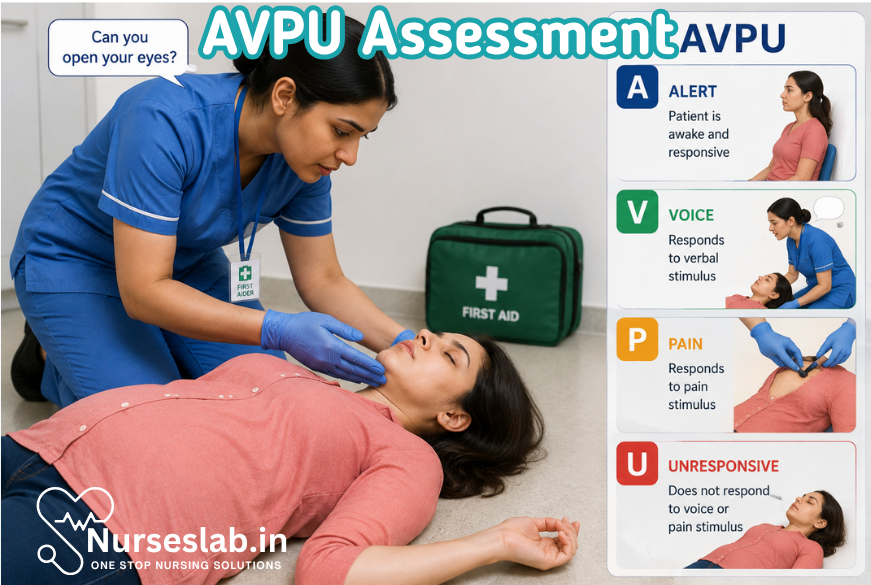
AVPU stands for Alert, Voice, Pain, and Unresponsive. It is not a diagnosis and it does not replace a full first-aid assessment. Instead, it is a quick snapshot of a person’s level of responsiveness at that moment. Any reduction from normal responsiveness should be taken seriously, especially when it is new, unexplained, worsening, or associated with abnormal breathing, a head injury, seizure, poisoning, severe bleeding, stroke symptoms, or collapse.
This guide is designed for general first-aid education. In a real emergency, protect yourself, call the appropriate emergency number, follow the call handler’s instructions, and act within your training.
Why Responsiveness Matters
The brain depends on a continuous supply of oxygen and glucose. A change in responsiveness may signal a problem with the airway, breathing, circulation, blood sugar, body temperature, the brain itself, or exposure to a drug or toxin. It can also follow a seizure, faint, infection, serious allergic reaction, head injury, stroke, or cardiac event. Because the causes range from reversible to immediately life-threatening, first aiders should treat altered responsiveness as a sign requiring prompt assessment rather than trying to diagnose the exact cause.
Responsiveness can also change over time. Someone may initially answer clearly and then become confused, respond only when spoken to, or stop responding altogether. Repeating AVPU allows you to identify this trend. A downward change is clinically important even if the person is still breathing.
What Each Letter Means
A — Alert
An alert person is awake and responds spontaneously. They may look at you, speak, move purposefully, or follow what is happening without needing repeated prompting. However, “alert” does not automatically mean “well.” A person can be awake but confused, disorientated, unusually agitated, unable to remember events, or speaking unclearly. Note what you observe rather than recording only the letter A.
Introduce yourself and ask simple questions: “What is your name?”, “Do you know where you are?”, “What happened?”, and “Do you know what day or time it is?” Do not turn this into an interrogation. The aim is to check whether answers are sensible and whether the person can follow a simple instruction, such as “Open your eyes” or “Squeeze my hand.” Consider their normal communication, language, hearing, learning needs, and any known cognitive condition.
V — Responds to Voice
A person at the Voice level does not respond spontaneously but reacts when you speak. They may open their eyes, make a sound, move, or attempt to follow a command after you call their name or ask loudly, “Can you hear me?” This is an abnormal level of responsiveness and warrants urgent attention. Keep the airway and breathing under close observation, summon help, and look for a reversible cause without delaying emergency care.
Use a normal speaking voice first, then speak more firmly if necessary. If you know the person’s name, use it. Avoid shouting aggressively or repeatedly shaking them. Note the actual response: for example, “opened eyes when name called but did not answer questions” is more helpful than “V” alone.
P — Responds to Pain
A person classified as Pain does not respond to voice but shows a reaction to an appropriate physical stimulus. They may open their eyes, groan, withdraw a limb, or make another purposeful movement. This indicates significantly reduced consciousness and is an emergency. First aiders should not use harmful techniques such as pinching, twisting skin, rubbing the breastbone, pressing on the eyes, or applying force to the fingers.
For a general first aider, a gentle shoulder tap combined with a clear request is usually sufficient for the initial responsiveness check in an adult, provided there is no obvious injury that makes touching unsafe. For a baby, gentle stimulation such as tapping the sole of the foot may be used according to current paediatric first-aid training. The purpose is to assess response, not to cause pain. If there is no response to voice, prioritise airway, breathing, the emergency call, and dispatcher guidance rather than repeatedly applying stronger stimuli.
U — Unresponsive
An unresponsive person does not react to voice or gentle physical stimulation. This is immediately life-threatening until proven otherwise. Shout for help, open the airway, and check for normal breathing for no more than 10 seconds. Occasional gasps, noisy irregular breaths, or infrequent snorting movements are not normal breathing.
If the person is not breathing normally, call emergency services, send someone for an automated external defibrillator if available, and start cardiopulmonary resuscitation. Follow the call handler’s instructions and use the defibrillator as soon as it arrives. If the person is breathing normally but remains unresponsive, place them in the recovery position when appropriate, keep the airway open, call for emergency help, and reassess breathing continuously. If movement is unsafe because of immediate danger, entrapment, or a suspected injury, tell the call handler and follow their instructions.
How to Carry Out an AVPU Assessment
- Check for danger. Look for traffic, electricity, fire, water, violence, falling objects, chemicals, or other hazards. Do not become a second casualty.
- Approach and observe. Look for spontaneous movement, eye opening, speech, obvious bleeding, seizure activity, or breathing difficulty.
- Speak clearly. Introduce yourself, ask whether they are all right, and give a simple instruction.
- Use gentle physical stimulation if appropriate. If there is no response to voice, gently tap the shoulders in an adult while repeating the question, unless injury makes this unsafe.
- Assign the best AVPU description. Record the highest level of response observed, together with what the person actually did.
- Move immediately to airway and breathing. AVPU must never delay life-saving care.
- Call for help early. A response below Alert, sudden confusion, or deterioration requires urgent escalation.
- Repeat the assessment. Recheck after any change, first-aid intervention, seizure, movement, or while waiting for the ambulance.
AVPU Within the Primary Survey
AVPU belongs within a structured primary survey rather than standing alone. Many first-aid courses use a sequence such as Danger, Response, Airway, Breathing, Circulation, and an emergency call. In clinical settings, responsiveness forms part of a broader ABCDE assessment. Whatever recognised framework your training uses, the priorities remain consistent: make the scene safe, identify unresponsiveness, ensure the airway is open, determine whether breathing is normal, control catastrophic bleeding, and get expert help early.
Do not spend several minutes asking orientation questions while a person is struggling to breathe or bleeding heavily. Treat an obvious life-threatening problem as soon as it is recognised, then continue the assessment. Likewise, do not assume that a person who speaks has a fully clear airway or stable condition. Short phrases, noisy breathing, blue or grey colour, severe wheeze, or worsening drowsiness are warning signs.
What Can Cause a Reduced AVPU Level?
- Airway or breathing problems: choking, severe asthma, anaphylaxis, drowning, smoke inhalation, or another cause of low oxygen.
- Circulatory problems: major bleeding, shock, heart attack, abnormal heart rhythm, or cardiac arrest.
- Neurological causes: stroke, head injury, seizure, brain infection, or a sudden severe headache associated with collapse.
- Metabolic causes: low blood sugar, severe dehydration, or organ failure.
- Drugs and toxins: alcohol, opioids, sedatives, carbon monoxide, chemicals, or accidental and intentional overdose.
- Temperature-related illness: heatstroke or severe hypothermia.
- Fainting: usually brief, but persistent or repeated loss of responsiveness demands further assessment.
A first aider does not need to identify the exact diagnosis before acting. Look for clues that change immediate care: a medical-alert item, medicine nearby, a witnessed seizure, facial droop, severe bleeding, a head impact, drug packaging, a carbon-monoxide alarm, or information from relatives. Never delay the emergency call to conduct a lengthy search.
Special Considerations for Children, Older Adults, and Disabled People
In babies and children, assess whether the response is appropriate for age. A baby may normally respond through eye contact, movement, crying, or interaction rather than words. A child who is unusually floppy, silent, difficult to wake, or uninterested in a caregiver may be seriously unwell. Use paediatric life-support techniques taught on a current course; they differ in important details from adult care.
Older adults may have dementia, hearing impairment, speech difficulty, or a naturally reduced level of mobility. Establish what is normal by asking a relative or carer, but do not dismiss a new change as “just age.” Sudden confusion can be an important sign of acute illness. Similarly, a person with a learning disability, autism, aphasia, paralysis, or another communication difference may respond in a way that is easy to misinterpret. Adapt your communication, allow time, use familiar carers when appropriate, and focus on change from baseline.
Calling Emergency Services and Giving a Clear Handover
Call urgently when a person is unresponsive, is not breathing normally, has a reduced or worsening response, or has other red-flag symptoms such as stroke signs, severe breathing difficulty, major bleeding, poisoning, seizure lasting longer than expected, repeated seizures, or a significant head injury. Put the phone on speaker if instructed so you can continue care. State the exact location, what happened, the person’s approximate age, their AVPU level, whether breathing is normal, major injuries or symptoms, and what first aid is being given.
A useful update might be: “Adult found collapsed. Initially responded when spoken to, but now only moves when the shoulder is tapped. They are breathing normally and are in the recovery position. No major bleeding seen. The change occurred at 14:20.” Times are valuable, especially the time last known well, the onset of symptoms, a seizure’s duration, or the moment responsiveness changed.
Common Mistakes to Avoid
- Using AVPU as a diagnosis. It describes responsiveness; it does not explain the cause.
- Delaying the airway and breathing check. A letter is never more important than immediate life-saving action.
- Assuming Alert means safe. An awake person may still have a stroke, serious head injury, shock, poisoning, or respiratory emergency.
- Applying painful or dangerous stimuli. First aiders should avoid forceful techniques and follow current training.
- Testing repeatedly without acting. Once reduced consciousness is identified, summon help and manage airway and breathing.
- Failing to reassess. A single AVPU score can miss deterioration.
- Leaving an unresponsive breathing person alone. Their airway or breathing may worsen suddenly.
- Offering food or drink. A drowsy person may choke, and urgent treatment or anaesthesia may be needed.
- Restraining a seizure. Protect the person from nearby hazards, cushion the head if possible, time the seizure, and do not put anything in the mouth.
Three Practical Scenarios
Scenario 1: The Dizzy Colleague
A colleague sits down suddenly and looks pale. They answer questions clearly and follow instructions, so they are Alert, but they report chest pressure and sweating. AVPU does not make this low risk. Keep them at rest, call emergency services because of the concerning symptoms, monitor responsiveness and breathing, and be ready to act if they deteriorate.
Scenario 2: The Head Injury
A cyclist falls and initially talks normally. Ten minutes later, they open their eyes only when their name is called and give confused answers. The change from Alert to Voice is a red flag. Call emergency services, minimise unnecessary movement, maintain the airway, monitor breathing, control bleeding, and report the timeline clearly.
Scenario 3: Found Unresponsive
You find a person lying still. After checking for danger, you speak and gently tap their shoulders, but there is no response: U. You open the airway and check breathing for no more than 10 seconds. If breathing is abnormal or absent, you call for an ambulance, begin CPR, and use an AED as soon as possible. If breathing is normal, you use the recovery position when appropriate and continue to monitor them until help arrives.
A Simple First-Aider’s AVPU Checklist
- Make sure the scene is safe.
- Look for spontaneous eye opening, speech, and purposeful movement.
- Speak clearly and give one simple instruction.
- Use only gentle, appropriate physical stimulation if there is no voice response.
- Classify the response as A, V, P, or U and describe what you observed.
- Open the airway and check for normal breathing without delay.
- Call emergency services early for reduced or worsening responsiveness.
- Start CPR and use an AED if the person is not breathing normally.
- Use the recovery position for an unresponsive person who is breathing normally when appropriate.
- Keep monitoring and record important times and changes.
Frequently Asked Questions
Is AVPU the same as the Glasgow Coma Scale?
No. AVPU is a rapid four-level assessment suitable for an initial check and repeated monitoring. The Glasgow Coma Scale is more detailed and is generally used by trained healthcare professionals. First aiders should not allow scoring systems to distract from airway, breathing, CPR, bleeding control, and the emergency call.
What if the person is asleep?
A sleeping person should wake or respond appropriately to voice and gentle stimulation. If they are unexpectedly difficult to wake, snoring unusually after an injury or substance exposure, or not responding normally, treat this as reduced consciousness and check airway and breathing.
Should I check a pulse?
General first aiders are usually directed to assess responsiveness and normal breathing rather than spend time searching for a pulse. Follow your current training and the emergency call handler’s instructions. If the person is unresponsive and not breathing normally, start CPR.
Can someone improve from P or V back to A?
Yes, but improvement does not necessarily remove the need for medical help. Continue monitoring, identify what happened, and follow emergency advice. A temporary recovery after a seizure, faint, low blood sugar episode, poisoning, or head injury may be followed by further deterioration.
Final Thoughts
AVPU gives first aiders a fast, memorable way to describe responsiveness: Alert, responds to Voice, responds to an appropriate physical stimulus, or Unresponsive. Its value lies in speed, simplicity, and repeatability. Used well, it helps identify deterioration, supports a concise emergency handover, and prompts the rescuer to move rapidly to airway and breathing.
The most important lesson is that AVPU is a starting point, not an endpoint. Protect yourself, assess the response, open the airway, decide whether breathing is normal, call for help, and reassess. Confidence comes from practical training, so refresh your skills regularly and practise realistic scenarios. In an actual emergency, clear priorities and early action matter more than a perfectly phrased score.
REFERENCES
- AVPU Responsiveness Scale, Robert Buttner and James Hayes
Jun 12, 2025, https://litfl.com/avpu-responsiveness-scale/ - Optimal first Aid, What is AVPU or ACVPU?, https://www.optimalfirstaid.co.uk/acvpu-scale/
- What Is the AVPU Scale? A Simple Guide to Using It in First Aid, Last Updated January 28, 2026, https://primarycarefirstaid.ca/what-is-avpu-scale-first-aid/
Stories are the threads that bind us; through them, we understand each other, grow, and heal.
JOHN NOORD
Connect with “Nurses Lab Editorial Team”
I hope you found this information helpful. Do you have any questions or comments? Kindly write in comments section. Subscribe the Blog with your email so you can stay updated on upcoming events and the latest articles.


