


Last Updated on August 28, 2026 by Nurseslab.in Editorial Team
AI Documentation beyond the promise of “less charting”: a practical look at attention, workflow, accountability, and care at the bedside
Introduction
If you work in an inpatient unit at a large health system, there’s a reasonable chance ambient AI documentation is already on your unit, arriving next quarter, or being piloted two floors up. The technology moved from physician exam rooms to nursing workflows fast — Abridge made its nursing product available to all its health system clients nationwide in May 2026, Ambience launched an inpatient nursing suite in June, Microsoft extended Dragon Copilot into nursing workflows and integrated it with Epic’s Rover app, and Mayo Clinic has been building a nurse-designed ambient documentation tool it’s now presenting at national conferences.
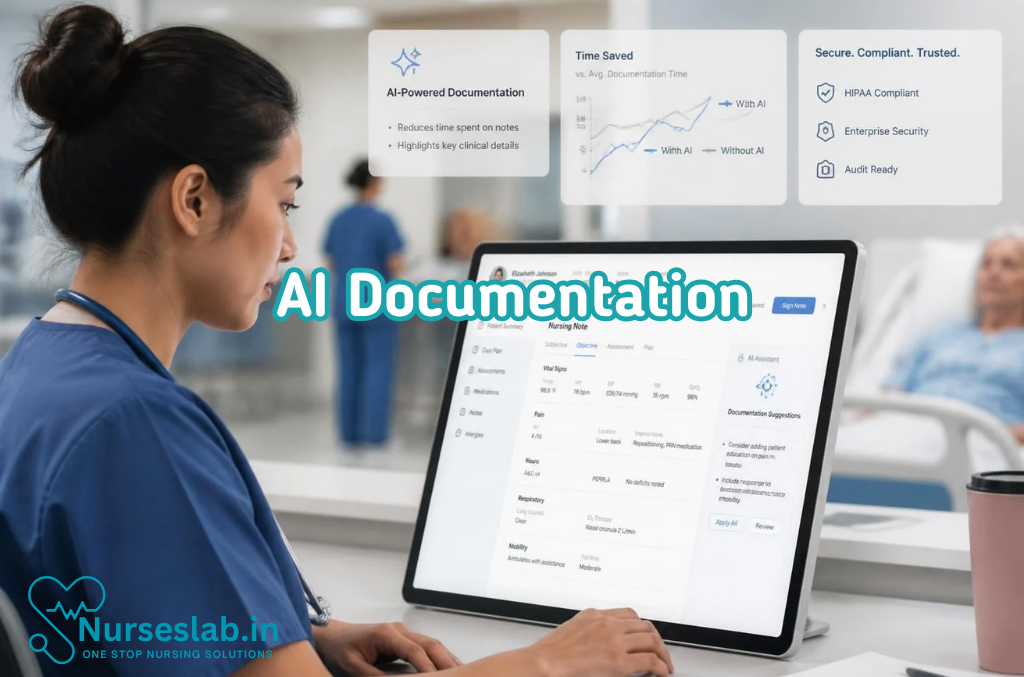
The marketing language around all of this is consistent and largely interchangeable: less time charting, more time at the bedside. That’s not wrong, but it’s not the whole picture either, and it isn’t specific enough to help you plan your shift.
So here’s the more useful version. What actually changes when ambient AI documentation lands on your unit, what stubbornly doesn’t, and what you should do differently on the floor.
First: what “ambient documentation for nursing” actually means
Ambient AI documentation uses automated speech recognition plus a large language model to listen to your conversation with a patient and draft documentation from it. On the physician side, the output is a narrative note. On the nursing side, the more valuable output is different: discrete, structured values that populate flowsheet fields.
That distinction matters more than it sounds. Nursing documentation isn’t a shorter version of physician documentation — it’s a different animal entirely. Physicians produce a handful of narrative notes per day. Nurses produce hundreds of discrete data points: vitals, pain scores, intake and output, skin assessments, fall risk, Braden scores, mobility, lines and drains, education delivered, response to intervention. A 2025 study in JMIR Nursing found nurses spend roughly 31% of a 12-hour shift on flowsheet documentation alone — before narrative notes, before handoff, before the charting that spills past the end of the shift.
A tool that writes you a beautiful paragraph doesn’t help much when what you need is 40 fields filled correctly. The nursing-specific tools now shipping are built around that: you talk through your assessment naturally, and the system files structured values into the right fields with a link back to the source transcript so you can verify each one.
That’s the product. Here’s what it does to an actual shift.
What genuinely changes
1. Assessment documentation collapses into the assessment itself
This is the real shift. Today, most nurses assess a patient, hold six or eight findings in working memory, walk to a workstation, and reconstruct the assessment from memory into fields. Ambient documentation removes the reconstruction step. You narrate what you’re finding as you find it — “left lower leg, 2+ pitting edema, no redness, pedal pulse palpable” — and the values get drafted.
The time saving is real, if not dramatic. Nursing leaders at Bon Secours Mercy Health reported about 20.6 minutes saved per nurse across a 12-hour shift, with an average assignment of 4.5 patients, in a case study published in Nurse Leader in April 2026. Anecdotal reports run higher — one Mercy nurse using Dragon Copilot described saving roughly two hours of charting in a 12-hour shift — but treat individual reports as individual reports.
Twenty minutes is not nothing. It’s also not the transformation the vendor deck promises. Set expectations accordingly.
2. The end-of-shift tail gets shorter
The most consistently reported benefit across the ambient AI literature — mostly from the physician side, but early nursing reports echo it — is a reduction in after-hours documentation. The charting you’d otherwise finish after handoff, or clock out and come back to, shrinks.
If you’re the nurse who routinely leaves 30 to 45 minutes late finishing notes, this is the change you’ll feel first, and it’s the one most likely to affect whether you’re still in this job in three years.
3. Where you chart moves
Ambient tools push documentation back into the patient room and off the hallway workstation. That’s a meaningful change to the physical shape of a shift. It also means the patient hears everything you’re documenting — which cuts both ways. Some nurses find it improves the encounter, because the patient hears their findings narrated and can correct or add to them in real time. Others find it awkward, particularly around skin assessments, weights, substance use history, or anything the patient may not want stated out loud with a roommate six feet away.
You will develop judgment about when to step out and chart the old way. That judgment is part of the skill now.
4. Handoff and shift-summary tools arrive alongside it
The newer platforms don’t stop at charting. Ambience’s inpatient suite pairs ambient flowsheet documentation with a nursing summary product aimed at pre-shift preparation and shift-transition anxiety. Microsoft, HCA, and Google have all announced work on AI-assisted handoff.
The pitch is that you walk into your shift with a synthesized picture of each patient rather than assembling one from scratch across six tabs. It’s promising and it’s early. Handoff is where a lot of harm originates, so this deserves more scrutiny than assessment charting does, not less.
5. Use is becoming an expectation, not a preference
This is the change nurses tend to be least prepared for. The Bon Secours Mercy Health team was explicit about it: they implemented ambient documentation with the expectation of consistent use during every patient interaction, comparing it to virtual nursing models that are standard components of care delivery rather than opt-in workflows. Their finding was that adoption succeeded when that expectation was clearly communicated and supported with training and coaching — and that the gap between high-performing units and everyone else was a leadership and adoption problem, not a product problem.
Their authors also noted the friction extended well beyond technology, because ambient documentation challenged ingrained habits, role expectations, and assumptions about how nursing work should be performed. That’s a candid description of what it feels like on a unit in month two.
Where adoption has gone well, voluntary use has been high. Advocate Health reported that 65% of nurses using their tool activate it six or more times per shift, with more than 80% reporting meaningful time savings — unusually strong engagement for clinical software.
What doesn’t change
1. You are still legally responsible for every word
AI-generated documentation requires nurse review, verification, and signature before it enters the legal medical record. Your signature carries the same weight it always did. The tool has no license. It cannot be named in a board complaint. You can.
This is the single most important thing to internalize, because the failure mode is predictable: the drafted note reads fluently, it’s 1830, you have two admissions pending, and you sign it. Fluency is not accuracy.
2. The error rate is real, and the dangerous errors are the invisible ones
A 2025 review published in the Journal of Medical Internet Research examined notes generated by ambient AI scribes and found that roughly 70% contained at least one error. Reported hallucination rates for LLM-augmented ambient systems in the clinical literature span a wide band, from about 3% to 28%, depending on the tool and the setting. ECRI ranked AI as the number one health technology hazard for 2025, ahead of every device and drug-delivery risk on the list.
The errors sort into two categories:
Omissions — the tool drops something you said. A reported symptom, a medication change, a patient statement. These are relatively easy to catch, because you remember saying it.
Fabrications — the tool adds something you never said. An assessment finding, a normal exam element, a plausible-sounding detail. These are much harder to catch, precisely because they read like documentation you would have written. Nothing about a fabricated “denies chest pain” looks wrong on the screen.
There’s also an equity dimension. Analyses of AI transcription and scribing tools have found degraded performance for some patient populations, including Black patients, which means error rates are not evenly distributed across your assignment.
Vendors are responding — Microsoft says Dragon Copilot includes safeguards to flag hallucinations and omissions, validate clinical codes, and provide citations back to the source. Those are the right features to build. They are also vendor claims about vendor products, not independently verified outcomes, and they should be read that way.
3. Typing burden becomes verification burden
This is the trade that doesn’t appear in the ROI slide. You are no longer composing documentation, but you are now auditing it — reading 40 drafted fields and confirming each against what you actually found. Done properly, verification is genuine cognitive work. Done improperly, it’s a click.
The gap between those two is where patient safety lives, and it’s almost entirely invisible to your manager’s dashboard. A unit can post excellent time-savings numbers and terrible verification discipline at the same time.
4. Large parts of nursing documentation are untouched
Ambient tools capture what’s said out loud in a conversation. That excludes:
- Medication administration and barcode scanning
- Pump programming and titration records
- Anything sourced from a device rather than your voice
- Restraint documentation, and most regulated time-bound assessments
- Care plans, care coordination notes, and much discharge documentation
- Incident reports and variance documentation
Some of these will get automated by other means. They’re not being solved by ambient listening.
5. Assessment itself is not automated
The tool records your assessment. It does not perform one. It has no hands, does not see the patient’s color change, doesn’t register that something is subtly off in a way you can’t yet name. Clinical judgment — noticing, interpreting, escalating — remains entirely yours, and it’s the part of nursing that no ambient product on the market claims to touch.
The related risk that’s beginning to surface in the literature is “cognitive debt”: the concern that clinicians who stop composing their own documentation gradually lose some of the synthesis that composing it produced. Writing an assessment forces you to organize it. Nobody knows yet what happens to that skill over years of not doing it. It’s a genuine open question, not a reason to reject the tool.
6. Your ratio, your acuity, and your break
Twenty minutes back does not change your assignment, your patient acuity, your admission volume, or whether anyone covers you for lunch. Time returned by a documentation tool can be reinvested in patient care, absorbed by additional patients, or quietly disappear into the general density of a shift.
Which of those happens is a staffing and management decision, not a technology outcome. If your organization deploys ambient documentation and simultaneously increases assignments, the tool did not fail — it did exactly what it was designed to do, and the organization made a separate choice about the proceeds. Worth naming clearly, because these two things get conflated constantly.
What the evidence actually supports right now
Be careful with the numbers you’ll see quoted, because most of the strong data is physician data.
The well-known findings — Mass General Brigham’s 21.2% reduction in burnout prevalence after 84 days of ambient documentation use, roughly 13 to 16 minutes per day in reduced EHR and documentation time across five academic medical centers, a multi-site study of 263 physicians and APPs showing ambulatory burnout dropping from 51.9% to 38.8% after 30 days — come from physician and advanced practice populations.
Nursing-specific outcome data is thinner and mostly comes from health system self-reports and vendor-adjacent case studies. KLAS’s April 2026 first look at Abridge’s nursing product surveyed nine health system leaders: eight reported being highly satisfied, one satisfied. Two saw outcomes immediately, four within six months, one between six and twelve months, and two hadn’t yet seen outcomes. That’s encouraging directionally — and it’s nine executives, not a controlled trial, and executives are not the people doing the charting.
More rigorous work is underway. The University of Wisconsin–Madison began a stepped-wedge pragmatic trial in May 2026 measuring whether ambient AI reduces flowsheet documentation time and improves nurse wellbeing among RNs and nursing assistants. Results are expected around the end of 2026. That’s the kind of evidence the field currently lacks.
How to work with it well
Narrate deliberately. Say findings in complete, unambiguous phrases. “Sacrum, stage two, three by two centimeters, no drainage” documents cleanly. “Looks about the same as yesterday” does not.
Verify against memory, not against plausibility. Read each drafted field and ask whether you actually found that — not whether it seems reasonable. Fabrications survive plausibility checks by design.
Give the high-liability fields a second pass. Fall risk, skin, suicide screening, restraints, pain reassessment, and anything with a regulatory clock. These are where an error costs the most and where auto-population is most dangerous.
Tell the patient. Say plainly that a documentation tool is listening and what it does. Consent expectations vary by organization and state; know yours. Ambient systems capture incidental conversation as well as clinical content, which is a live privacy question, not a hypothetical one.
Know how to turn it off, and use that. Sensitive disclosures, family conflict, code situations, anything the patient asks stay off the record.
Report errors every time. Vendor and informatics teams tune these systems on reported failures. An unreported hallucination is one that recurs on someone else’s patient.
Questions worth asking your leadership
- What is the measured error rate for our tool, on our units, with our patient population?
- Are any fields auto-populating without explicit nurse review? Which ones?
- What’s the audit trail for who reviewed and approved AI-drafted content?
- Does the tool surface confidence indicators or flag low-confidence output?
- What’s the policy if AI-drafted documentation contributes to a patient harm event? Who is named?
- Is use mandatory or optional, and was that decided with nursing input?
- Is any of the time saved being reinvested in staffing, or is the assignment unchanged?
That last one is not a hostile question. It’s the one that determines whether this technology reads as relief or as speedup on your unit — and nurse leaders who’ve done this well have generally been willing to answer it directly.
The bottom line
Ambient AI documentation is a real improvement to a real problem, and it is smaller than the marketing suggests. It moves work back into the patient room. It does not touch medication administration, device data, care planning, clinical judgment, staffing ratios, or acuity — and it transfers a portion of your workload from typing into verification, which is less visible and, done carelessly, more dangerous.
The nurses who’ll do best with it are the ones who treat it as a competent, fast, occasionally wrong assistant whose work they are professionally accountable for. Which, as it happens, is roughly how experienced nurses have always handled everything that arrives on the unit promising to make the job easier.
Have you worked with ambient documentation on your unit? What surprised you — and what did nobody warn you about?
REFERENCES
- SOAPNoteAI Editorial Team, AI Documentation for Nurses in 2026: What Actually Works,Updated May 2026, https://soapnoteai.com/soap-note-guides-and-example/nursing-ai-documentation-2026/
- SullyAI, AI Scribe for Nurses and What Shift Documentation Actually Needs, Aug 6, 2026, https://www.sully.ai/blog/ai-scribe-for-nurses-and-what-shift-documentation-actually-needs
- TheAIPlaybook , AI for Nurses: The Documentation Shortcuts That Actually Work, https://www.theaiplaybook.pro/resources/ai-for-nurses
Stories are the threads that bind us; through them, we understand each other, grow, and heal.
JOHN NOORD
Connect with “Nurses Lab Editorial Team”
I hope you found this information helpful. Do you have any questions or comments? Kindly write in comments section. Subscribe the Blog with your email so you can stay updated on upcoming events and the latest articles.


