


Last Updated on October 21, 2026 by Nurseslab.in Editorial Team
Breast pathology is a vital domain within nursing, encompassing a range of conditions from benign inflammatory processes to complex neoplastic diseases. For nurses, understanding systemic pathology and genetics of the breast is crucial for effective patient care, early detection, education, and psychosocial support.
Introduction
Breast diseases represent a significant health concern worldwide, with implications for morbidity, mortality, and quality of life. Nurses are at the forefront of patient care, playing key roles in detection, management, and support for individuals affected by breast conditions. Systemic pathology describes how diseases affect the body as a whole, while genetics investigates hereditary factors influencing disease occurrence and progression. A robust understanding of these areas enhances nursing care, enabling informed clinical decisions and compassionate patient engagement.
Section 1: Anatomy and Physiology of the Breast
Structure of the Breast
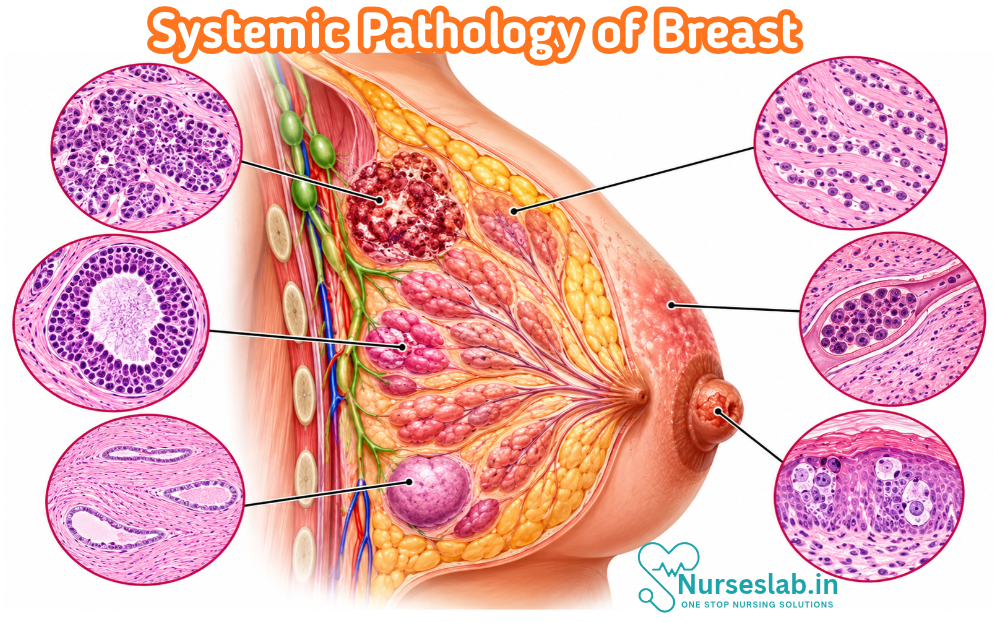
The female breast comprises glandular, fibrous, and adipose tissues. The glandular component consists of 15–20 lobes, each containing lobules made up of alveoli lined by epithelial cells, responsible for milk production. These lobes drain into lactiferous ducts, converging at the nipple. Surrounding the glandular tissue is stroma, comprising connective tissue and fat, which determines breast size and contour.
Function of the Breast
The primary function of the breast is lactation, providing nutrition to infants. Hormones such as oestrogen, progesterone, and prolactin regulate breast development and milk production. The breast also plays a role in sexual identity and psychosocial wellbeing.
Relevance to Pathology
Understanding breast anatomy is essential for identifying pathological changes. Many diseases originate in specific components—mastitis affects the ducts and lobules, while carcinomas may arise from epithelial cells lining ducts or lobules. Anatomical knowledge aids in accurate diagnosis and management.
Section 2: Mastitis
Definition
Mastitis is inflammation of the breast tissue, commonly occurring in lactating women but can affect non-lactating individuals as well. It is categorised as acute or chronic, each with distinct features.
Types of Mastitis
- Acute Mastitis: Typically occurs during breastfeeding, resulting from milk stasis and bacterial infection (most often Staphylococcus aureus).
- Chronic Mastitis: A rare, persistent inflammation not related to lactation, often seen in older women.
Etiology and Pathogenesis
Acute mastitis arises from milk stasis due to incomplete emptying of the breast, creating a medium for bacterial growth. Entry of pathogens occurs through nipple cracks or erosions. Chronic mastitis may be associated with autoimmune reactions or duct ectasia.
Clinical Features
- Pain, swelling, warmth, and redness of the breast
- Fever and malaise
- Purulent nipple discharge (occasionally)
- Abscess formation in severe cases
Diagnosis
Diagnosis is clinical, supported by history and examination. Ultrasound may be used to detect abscesses. Laboratory tests include culture of discharge or aspirated pus.
Management
- Antibiotic therapy (e.g. flucloxacillin, amoxicillin-clavulanate)
- Supportive care: analgesics, continued breastfeeding, warm compresses
- Incision and drainage for abscess
Complications
- Abscess formation
- Sepsis (rare)
- Chronic inflammation and scarring
Section 3: Phyllodes Tumour
Definition
Phyllodes tumour is a rare fibroepithelial neoplasm of the breast, characterised by leaf-like (phyllodes) projections seen histologically. It can range from benign to highly malignant.
Classification
- Benign Phyllodes Tumour: Well-circumscribed, slow-growing, minimal cellular atypia
- Borderline Phyllodes Tumour: Intermediate features, increased mitoses, some atypia
- Malignant Phyllodes Tumour: Rapid growth, marked cellular atypia, high mitotic rate, potential for metastasis
Pathology
Microscopically, phyllodes tumours show a biphasic pattern—epithelial and stromal components. The stromal element demonstrates increased cellularity and may exhibit atypia and mitotic activity, especially in borderline and malignant tumours. Leaf-like architecture is typical.
Clinical Presentation
- Painless, rapidly enlarging breast mass
- Overlying skin may be stretched, but rarely ulcerated
- Axillary lymphadenopathy is uncommon
Diagnosis
- Clinical examination and imaging (ultrasound, mammography)
- Core needle biopsy for histological confirmation
Treatment
- Wide local excision with clear margins
- Simple mastectomy for large or recurrent tumours
- Axillary lymph node dissection is not routine, as nodal involvement is rare
Prognosis
Benign phyllodes tumours have an excellent prognosis after excision. Borderline and malignant tumours carry risks of recurrence and, in rare cases, distant metastasis, necessitating close follow-up.
Section 4: Carcinoma of the Breast
Epidemiology
Breast carcinoma is the most common cancer among women in India and worldwide. Incidence rises with age, peaking between 45–65 years. Early detection and advances in treatment have improved survival rates.
Risk Factors
- Female gender and increasing age
- Family history of breast or ovarian cancer
- Genetic mutations (BRCA1, BRCA2)
- Early menarche, late menopause
- Nulliparity or late first pregnancy
- Prolonged oestrogen exposure (hormone replacement therapy)
- Lifestyle factors: obesity, alcohol intake, sedentary habits
Genetic Predisposition
Approximately 5–10% of breast cancers are hereditary, primarily linked to mutations in the BRCA1 and BRCA2 genes. Other genetic syndromes include Li-Fraumeni syndrome (TP53 mutation), Cowden syndrome (PTEN mutation), and hereditary diffuse gastric cancer syndrome (CDH1 mutation). Genetic counselling is recommended for individuals with strong family histories.
Pathogenesis
Breast carcinogenesis involves multiple genetic and environmental factors. Mutations in tumour suppressor genes and oncogenes disrupt normal cell cycle regulation, leading to uncontrolled proliferation. Hormonal influences and chronic inflammation contribute to malignant transformation.
Classification of Breast Carcinoma
- Invasive Ductal Carcinoma (IDC): Most common type (70–80%), arises from ductal epithelium, forms hard irregular masses.
- Invasive Lobular Carcinoma (ILC): Originates from lobular epithelium, often multicentric and bilateral, shows single-file cell infiltration histologically.
- Medullary Carcinoma: Soft, well-circumscribed mass, prominent lymphoplasmacytic infiltrate, better prognosis.
- Mucinous (Colloid) Carcinoma: Abundant extracellular mucin, slow-growing, occurs in older women.
- Tubular Carcinoma: Well-differentiated, small tubule formation, favourable outcome.
- Inflammatory Carcinoma: Aggressive, presents with erythema and oedema (peau d’orange), poor prognosis.
- Paget’s Disease of the Nipple: Malignant cells infiltrate epidermis of nipple, associated with underlying carcinoma.
- Other Types: Papillary, metaplastic, and adenoid cystic carcinomas.
Histopathology
- IDC: Nests and cords of malignant epithelial cells, desmoplastic stroma.
- ILC: Small, uniform cells infiltrating in single files.
- Medullary: Syncytial sheets of tumour cells, lymphoid stroma.
- Mucinous: Tumour cells floating in mucin pools.
- Paget’s Disease: Large, pale-staining malignant cells in epidermis.
Clinical Features
- Painless lump in the breast
- Change in breast shape or contour
- Nipple retraction or discharge
- Skin changes: dimpling, thickening, ulceration
- Axillary lymphadenopathy
- Systemic symptoms in advanced disease
Diagnosis
- Clinical examination
- Imaging: mammography, ultrasound, MRI
- Biopsy: fine needle aspiration cytology (FNAC), core needle biopsy, excisional biopsy
- Laboratory tests: hormone receptor status (ER, PR), HER2/neu testing
Staging and Grading
- Staging (TNM): Assesses tumour size (T), nodal involvement (N), metastasis (M)
- Grading: Based on histological differentiation, mitotic activity, nuclear pleomorphism
Management
- Hormonal therapy: tamoxifen, aromatase inhibitors
- Surgery: lumpectomy, mastectomy, axillary dissection
- Radiotherapy
- Chemotherapy
- Targeted therapy: trastuzumab for HER2-positive cases
- Palliative care for advanced disease
Prognosis
Prognosis depends on tumour type, stage, grade, hormone receptor status, and genetic factors. Early-stage, hormone receptor-positive tumours have better outcomes. HER2-positive and triple-negative cancers require aggressive management.
Section 5: Genetic Aspects of Breast Pathology
Inherited Syndromes
- BRCA1/BRCA2 Mutation: High lifetime risk for breast and ovarian cancer, autosomal dominant inheritance
- Li-Fraumeni Syndrome: TP53 mutation, predisposes to multiple cancers including breast
- Cowden Syndrome: PTEN mutation, increased risk for breast, thyroid, and endometrial cancers
- Hereditary Diffuse Gastric Cancer Syndrome: CDH1 mutation, associated with lobular breast carcinoma
Genetic Counseling
Genetic counselling provides risk assessment, education, and emotional support for individuals with familial predisposition. Nurses play a vital role in facilitating referrals, supporting patients during decision-making, and interpreting test results.
Molecular Markers
- Hormone receptors: oestrogen (ER), progesterone (PR)
- HER2/neu status
- Ki-67 proliferation index
- Gene expression profiling (e.g. Oncotype DX)
Implications for Nursing Care
- Identifying high-risk individuals
- Educating patients about genetic risks and testing
- Coordinating multidisciplinary care
- Providing psychosocial support
Section 6: Diagnostic Approaches in Breast Pathology
Imaging Techniques
- Mammography: Screening and diagnostic tool, detects microcalcifications and masses
- Ultrasound: Differentiates solid from cystic lesions, guides biopsies
- Magnetic Resonance Imaging (MRI): High sensitivity for multifocal and multicentric disease
Biopsy Methods
- Fine needle aspiration cytology (FNAC)
- Core needle biopsy
- Excisional biopsy
Laboratory Tests
- Hormone receptor analysis
- HER2/neu testing
- Genetic testing for familial syndromes
Role of Nurses in Diagnosis
- Assisting in imaging procedures and biopsies
- Ensuring patient comfort and informed consent
- Educating patients about procedures and results
- Facilitating communication between patients and multidisciplinary teams
Section 7: Nursing Considerations in Breast Pathology
Patient Education
- Teaching breast self-examination techniques
- Providing information about risk factors and prevention
- Explaining diagnostic procedures and treatment options
Psychosocial Support
- Addressing anxiety, fear, and emotional distress
- Supporting body image and self-esteem
- Facilitating support groups and counselling services
Care Planning
- Individualising care based on patient needs
- Monitoring for treatment side effects and complications
- Promoting recovery and rehabilitation
- Coordinating with physiotherapists, dieticians, and social workers
Multidisciplinary Approach
- Collaborating with surgeons, oncologists, radiologists, pathologists, and genetic counsellors
- Ensuring holistic care and continuity
- Advocating for patient-centred care
Conclusion
The systemic pathology and genetics of breast diseases are integral to nursing practice. A thorough understanding of anatomy, pathogenesis, genetic predisposition, diagnostic modalities, and multidisciplinary management empowers nurses to deliver high-quality, compassionate care. Staying updated with advances in breast pathology and genetics enhances patient outcomes and supports effective education and advocacy.
REFERENCES
- Ramadas Nayak, Textbook of Pathology and Genetics for Nurses, 2nd Edition,2024, Jaypee Publishers, ISBN: 978-93-5270-031-8.
- Suresh Sharma, Textbook of Pharmacology, Pathology & Genetics for Nurses II, 2nd Edition, 31 August 2022, Jaypee Publishers, ISBN: 978-9354655692.
- Kumar, V., Abbas, A.K., & Aster, J.C. (2020). Robbins and Cotran Pathologic Basis of Disease. 10th Edition. Elsevier.
- McCance, K.L., & Huether, S.E. (2018). Pathophysiology: The Biologic Basis for Disease in Adults and Children. 8th Edition. Elsevier.https://www.britishjournalofnursing.com/content/clinical-new-series/pathophysiology-applied-to-nursing-the-basis-for-disease-and-illness
Stories are the threads that bind us; through them, we understand each other, grow, and heal.
JOHN NOORD
Connect with “Nurses Lab Editorial Team”
I hope you found this information helpful. Do you have any questions or comments? Kindly write in comments section. Subscribe the Blog with your email so you can stay updated on upcoming events and the latest articles.


