


Last Updated on July 10, 2026 by Nurseslab.in Editorial Team
Ovarian reserve testing measures hormone levels and follicle count to assess a woman’s egg supply, fertility potential, and reproductive planning options.
Introduction
Ovarian reserve refers to the quantity and quality of a woman’s remaining eggs and is a central concept in reproductive medicine. As the number and viability of oocytes naturally decline with age, understanding ovarian reserve has become crucial for fertility assessment, family planning, and assisted reproductive technologies (ART). Ovarian reserve testing encompasses a range of diagnostic tools designed to estimate a woman’s reproductive potential.
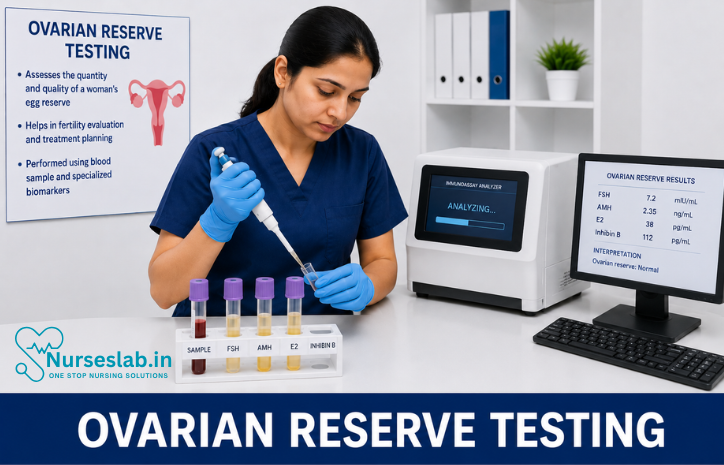
Understanding Ovarian Reserve
Physiology of Ovarian Reserve
Ovarian reserve is determined by the pool of primordial follicles present in the ovaries from birth. This finite reservoir declines progressively due to a natural process known as follicular atresia. By puberty, only about 3-4 lakh oocytes remain from the original 1-2 million present at birth. With each menstrual cycle, a cohort of follicles is recruited, but only one typically matures and ovulates, while the rest undergo atresia. The rate of loss accelerates in the mid-30s, leading to a marked reduction in fertility and ultimately culminating in menopause.
Factors Affecting Ovarian Reserve
While chronological age is the primary determinant of ovarian reserve, several other factors can influence it:
- Genetic factors: Family history of early menopause or certain genetic conditions may predispose to diminished reserve.
- Medical treatments: Chemotherapy, pelvic radiation, and pelvic surgeries can reduce ovarian reserve.
- Lifestyle factors: Smoking, low body mass index, and environmental toxins may hasten follicular depletion.
- Gynaecological conditions: Endometriosis, ovarian cysts, or autoimmune disorders can impact ovarian health.
Thus, assessment of ovarian reserve is a nuanced process, requiring consideration of individual risk factors alongside age.
Importance of Ovarian Reserve Testing
Ovarian reserve testing plays a pivotal role in modern fertility care and reproductive medicine. Its importance lies in the following areas:
- Fertility Assessment: Helps identify women at risk of diminished ovarian reserve (DOR) or premature ovarian insufficiency (POI), enabling timely intervention or family planning decisions.
- ART Planning: Guides the choice and dose of ovarian stimulation protocols in in vitro fertilisation (IVF) or other ART procedures, aiming to optimise outcomes and reduce risks like ovarian hyperstimulation syndrome (OHSS).
- Predicting Menopause: Offers insights into the timing of menopause, which may inform broader health planning.
- Patient Counselling: Provides objective data to support discussions about fertility potential, prognosis, and reproductive options.
For patients, especially those delaying childbearing or at risk of reduced fertility, ovarian reserve testing provides valuable information to make informed choices.
Types of Ovarian Reserve Tests
A variety of tests are available to assess ovarian reserve, each with unique strengths and limitations. The most commonly used and researched tests include:
Antral Follicle Count (AFC)
AFC is a transvaginal ultrasound assessment of the number of small (2-10 mm) antral follicles in both ovaries, typically performed in the early follicular phase (days 2-5 of the menstrual cycle). The number of antral follicles correlates with the remaining follicular pool and is a reliable predictor of ovarian response to stimulation. AFC is non-invasive and provides immediate results, but is subject to inter-observer variability and may be influenced by technical factors and underlying ovarian pathology.
Anti-Müllerian Hormone (AMH)
AMH is a glycoprotein hormone secreted by granulosa cells of pre-antral and small antral follicles. Serum AMH levels reflect the size of the growing follicle pool and, by extension, the ovarian reserve. Unlike FSH and estradiol, AMH levels are relatively stable throughout the menstrual cycle, making it a convenient and reproducible marker. Low AMH indicates reduced ovarian reserve, while high levels may suggest polycystic ovarian syndrome (PCOS) or increased ovarian response.
Follicle-Stimulating Hormone (FSH)
FSH is produced by the anterior pituitary and stimulates follicular growth. In women with declining ovarian reserve, the feedback inhibition by ovarian hormones diminishes, leading to elevated baseline FSH levels, especially in the early follicular phase. Measurement of FSH, typically on day 2-5 of the cycle, is a traditional test for ovarian reserve. However, FSH levels can fluctuate from cycle to cycle and may only rise after significant decline in reserve.
Estradiol
Baseline estradiol, measured alongside FSH in the early follicular phase, can provide additional information. Elevated estradiol may suppress FSH, potentially masking underlying ovarian insufficiency. Therefore, interpretation of FSH must consider concurrent estradiol values for accuracy.
Other Emerging Tests
Several other markers and tests are under investigation or used in specific contexts:
- Inhibin B: Produced by granulosa cells, inhibin B levels decline with ovarian ageing but show significant variability.
- Ovarian volume: Measured by ultrasound, reduced ovarian size is associated with diminished reserve but is less sensitive than AFC or AMH.
- Dynamic tests: Clomiphene citrate challenge test and exogenous FSH stimulation tests assess ovarian responsiveness but are less commonly used due to complexity and limited predictive value.
- Genetic markers: Research is ongoing into genetic predictors of ovarian ageing and reserve, but these are not yet routinely available.
Interpretation of Test Results
Interpreting ovarian reserve test results requires a nuanced understanding of normal ranges, age-related changes, and clinical context.
Normal and Abnormal Values
- AFC:
- Normal: 8-15 antral follicles (combined both ovaries)
- Low reserve: <5-7 follicles
- High reserve (often seen in PCOS): >20 follicles
AMH:
Normal (age-dependent): 1.5-4.0 ng/mL (10.7-28.6 pmol/L)
Low reserve: <1.0 ng/mL (7.14 pmol/L)
High reserve: >5.0 ng/mL (35.7 pmol/L)
FSH (Day 2-5):
Normal: <10 IU/L
Borderline: 10-15 IU/L
High: >15 IU/L (suggests diminished reserve)
Estradiol (Day 2-5):
Normal: <60-80 pg/mL
High: >80 pg/mL (may indicate early follicular recruitment or ovarian insufficiency)
It is important to note that reference ranges may vary between laboratories and populations, and should always be interpreted within the clinical context.
Age-Related Changes
Ovarian reserve markers decline with age, but the rate and timing of decline are highly individual. For example, a 35-year-old woman with an AMH of 0.8 ng/mL may have a lower-than-expected reserve, while a 40-year-old with the same value may be within the expected range for her age. Therefore, age-specific reference values and longitudinal assessment may provide more meaningful insights than single measurements.
Clinical Scenarios
Interpretation of test results must consider the clinical context:
- Infertility evaluation: Low AMH and AFC suggest reduced prognosis for ART but do not preclude natural conception.
- PCOS: High AMH and AFC are typical but may not correlate with oocyte quality.
- Oncology patients: Ovarian reserve testing before and after chemotherapy assists in fertility preservation planning.
Clinical Applications
Ovarian reserve testing informs a wide range of clinical decisions in reproductive medicine:
- Infertility Workup: Identifies women with reduced reserve who may benefit from expedited ART or alternative strategies.
- ART Protocol Selection: Guides the choice of stimulation protocols, drug dosages, and cycle expectations in IVF and related procedures.
- Fertility Preservation: Assists in counselling women considering oocyte or embryo freezing due to medical or social reasons.
- Predicting Menopause: While not a precise tool, reserve testing offers some predictive value regarding the timing of menopause.
- Patient Counselling: Provides an objective basis for discussing realistic fertility expectations and family planning options.
- Oncofertility: Supports decision-making for patients undergoing gonadotoxic therapies.
Ultimately, ovarian reserve testing enables personalised medicine, allowing clinicians to tailor recommendations to individual reproductive potential and goals.
Limitations and Challenges
Despite its utility, ovarian reserve testing has several limitations:
- Variability: AFC and FSH can fluctuate between cycles; AMH assays may vary between laboratories.
- Predictive Value: Tests are better at predicting poor ovarian response to stimulation than actual fertility or pregnancy outcomes.
- Interpretation Complexity: High AMH or AFC in PCOS does not guarantee high oocyte quality or successful pregnancy.
- Non-Ovarian Factors: Uterine, tubal, and male factors also contribute to infertility but are not assessed by these tests.
- Psychological Impact: Results may cause unnecessary anxiety or false reassurance if not interpreted and communicated appropriately.
It is essential for clinicians to interpret results in conjunction with clinical history, age, and other fertility factors, and to communicate findings sensitively to patients.
Nursing Care of Patients Undergoing Ovarian Reserve Testing
A Comprehensive Guide for Clinical Practice
Introduction
Ovarian reserve testing is a critical diagnostic procedure in reproductive medicine, particularly for women experiencing infertility, planning delayed childbearing, or considering assisted reproductive technologies (ART) such as in vitro fertilisation (IVF). The tests evaluate the quantity and quality of a woman’s remaining eggs and help in predicting the likelihood of conception. Nurses play a pivotal role in the care and support of patients undergoing these assessments, ensuring not only the smooth execution of procedures but also providing emotional, educational, and psychological support.
Overview of Ovarian Reserve Testing
Ovarian reserve tests commonly performed include serum follicle-stimulating hormone (FSH) levels, anti-Müllerian hormone (AMH) levels, antral follicle count (AFC) via transvaginal ultrasound, and less frequently, clomiphene citrate challenge tests. These tests may be conducted individually or in combination, depending on the patient’s clinical scenario.
Pre-Test Nursing Responsibilities
Patient Education and Counselling
One of the foremost responsibilities of a nurse is to ensure the patient understands the purpose, nature, and implications of ovarian reserve testing. This involves explaining the reasons for testing and what the results may indicate regarding fertility potential. Nurses should use simple language, avoiding medical jargon, and encourage patients to ask questions, thereby alleviating anxiety and dispelling myths associated with infertility investigations. The nurse should provide written materials or reliable online resources for further reading, and clarify any doubts regarding the procedures.
In the Indian context, it is important to address cultural sensitivities and familial concerns, as fertility and childbearing are often intertwined with social expectations. Nurses should show empathy and respect for the patient’s emotional state, and ensure privacy and confidentiality throughout the counselling process. Where appropriate, partners or family members may be included in discussions, with the patient’s consent, to foster a supportive environment.
Preparation for Testing
Prior to the tests, nurses must verify the timing of the procedures. For example, FSH and estradiol levels are typically measured on day 2 or 3 of the menstrual cycle, while AMH can be tested at any time. The nurse should instruct the patient to note the start of her menstrual period and communicate promptly for scheduling. For transvaginal ultrasound, the nurse should explain the nature of the procedure, address concerns regarding discomfort, and advise on appropriate attire or preparation, such as emptying the bladder before the scan.
The nurse should review the patient’s medical and reproductive history, allergies, and current medications to identify any contraindications or factors that may influence test results. In some cases, fasting or abstaining from certain medications may be necessary; clear instructions should be provided in advance.
During the Testing Procedure
Providing Comfort and Support
During specimen collection for serum tests, the nurse ensures proper identification, labelling, and handling of samples to maintain accuracy and safety. For ultrasound procedures, the nurse assists the patient with positioning, offers reassurance, and maintains privacy by using appropriate drapes and limiting exposure. It is crucial to create a calm and respectful atmosphere, as patients may feel vulnerable during intimate examinations.
Nurses should monitor for any signs of distress or discomfort, and intervene promptly. Gentle communication and a caring approach can help reduce anxiety and encourage cooperation. In case of pain or adverse reactions, immediate support and appropriate referrals must be provided.
Infection Control and Safety
Strict adherence to infection control protocols is necessary. This includes hand hygiene, use of sterile equipment, and proper disposal of sharps and biological waste. The nurse should ensure that the ultrasound probe is sterilised between uses, and that gloves are worn during all procedures involving contact with bodily fluids.
Post-Test Nursing Care
Immediate Aftercare
After the procedures, nurses should check for any complications, such as bleeding at the venipuncture site or discomfort following the ultrasound. The patient should be advised to report any unusual symptoms, such as pain, fever, or persistent bleeding.
The nurse should provide information about when and how results will be communicated. In most cases, laboratory results may take a few days; ultrasound findings are often available immediately. The nurse should ensure that the patient has a follow-up appointment scheduled to discuss the results with the physician.
Emotional and Psychological Support
Ovarian reserve testing can be emotionally taxing, especially for women facing infertility or uncertain reproductive futures. Nurses play a key role in recognising signs of emotional distress, such as anxiety, depression, or withdrawal, and providing timely support. This may involve active listening, validation of feelings, and, where necessary, referral to counselling services or support groups.
In India, where social stigma may be associated with infertility, nurses must be particularly sensitive to the psychological impact of test results. Encouraging open communication and fostering a non-judgemental environment can help patients cope with stress and make informed decisions regarding further management.
Patient Education after Testing
Nurses should ensure that patients understand the significance of their test results, and the next steps in their care plan. For example, low ovarian reserve may necessitate early intervention or consideration of ART; normal results may reassure the patient but do not guarantee conception. It is essential to clarify that these tests are only one aspect of fertility assessment, and other factors such as male partner health, tubal patency, and overall reproductive health also play vital roles.
Educational materials should be provided in languages and formats accessible to the patient. Where possible, nurses should offer information about lifestyle modifications that may improve reproductive outcomes, such as maintaining a healthy weight, avoiding tobacco and excessive alcohol use, managing stress, and following a balanced diet.
Documentation and Communication
Accurate documentation of all nursing actions, patient responses, and test results is essential for continuity of care. Nurses should record the timing of procedures, any complications, patient education provided, and emotional support rendered. Effective communication with the multidisciplinary team, including physicians, laboratory staff, and counsellors, ensures coordinated care and optimal outcomes.
Cultural and Ethical Considerations
Nursing care in ovarian reserve testing must be guided by ethical principles of autonomy, beneficence, and confidentiality. Nurses should respect the patient’s right to make informed choices and provide unbiased information about all available options. In culturally diverse settings like India, sensitivity to religious beliefs, family dynamics, and social norms is paramount. Nurses should avoid making assumptions about the patient’s values or preferences and should seek to understand and accommodate individual needs.
Role of Nurses in Assisted Reproductive Technologies
For patients proceeding to ART such as IVF, nurses continue to play a vital role throughout the treatment journey. This includes ongoing education, medication administration, monitoring for complications, and providing emotional support during the often stressful process. Nurses act as advocates for the patient, helping to navigate complex procedures and decisions, and ensuring that care remains patient-centred and compassionate.
Challenges Faced by Nurses
Nurses may encounter challenges such as limited resources, high patient volumes, and varying levels of health literacy. Addressing these requires adaptability, continuous education, and effective time management. Building rapport and trust with patients is essential, as is advocating for improved reproductive health services and awareness within the community.
REFERENCES
- American College of Obstetricians & Gynecologists. Female Age-Related Fertility Decline (https://www.acog.org/clinical/clinical-guidance/committee-opinion/articles/2014/03/female-age-related-fertility-decline).
- Committee opinion no. 605: primary ovarian insufficiency in adolescents and young women (https://pubmed.ncbi.nlm.nih.gov/24945456/). Obstet Gynecol. 2014 Jul;124(1):193-197.
- Jirge PR. Ovarian reserve tests. J Hum Reprod Sci. 2011;4(3):108-113.
- Parry JP, Koch CA. Ovarian Reserve Testing (https://www.ncbi.nlm.nih.gov/books/NBK279058/). [Updated 2019 Nov 2]. In: Feingold KR, Anawalt B, Boyce A, et al., eds. Endotext [Internet]. South Dartmouth (MA): MDText.com, Inc.; 2000-.
- Practice Committee of the American Society for Reproductive Medicine. Testing and interpreting measures of ovarian reserve: a committee opinion (https://pubmed.ncbi.nlm.nih.gov/33280722/). Fertil Steril. 2020 Dec;114(6):1151-1157.
- Ramalho de Carvalho B, Gomes Sobrinho DB, Vieira AD, et al. Ovarian reserve assessment for infertility investigation (https://www.ncbi.nlm.nih.gov/pmc/articles/PMC3302183/). ISRN Obstet Gynecol. 2012;2012:576385.
Stories are the threads that bind us; through them, we understand each other, grow, and heal.
JOHN NOORD
Connect with “Nurses Lab Editorial Team”
I hope you found this information helpful. Do you have any questions or comments? Kindly write in comments section. Subscribe the Blog with your email so you can stay updated on upcoming events and the latest articles.


