


Last Updated on May 27, 2026 by Nurseslab.in Editorial Team
Swan Ganz catheterization, or pulmonary artery catheterization, provides real‑time measurements of pulmonary artery pressures, cardiac output, and hemodynamic status. It helps diagnose shock, heart failure, and complex cardiac conditions, guiding advanced critical‑care management.
Introduction
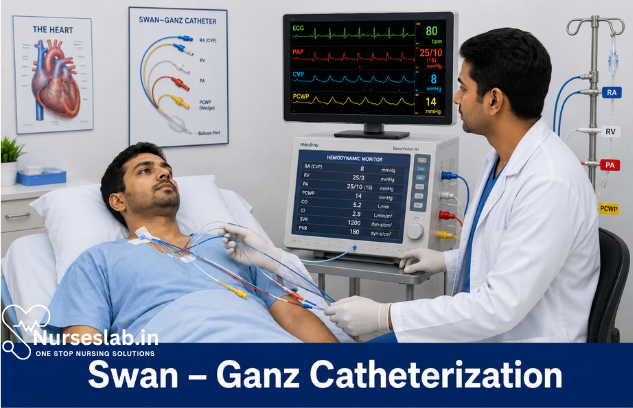
Swan-Ganz catheterization, also known as pulmonary artery catheterization, is a specialised diagnostic procedure employed in cardiology and critical care to assess and monitor haemodynamic parameters. Since its inception in the early 1970s by Drs. Jeremy Swan and William Ganz, this technique has revolutionised the management of complex cardiac and pulmonary conditions by enabling direct measurement of intracardiac pressures and cardiac output. Over the decades, Swan-Ganz catheterization has become an invaluable tool in intensive care units (ICUs), operating theatres, and cardiac catheterisation laboratories, providing real-time data that guide therapeutic decisions and patient management.
Historical Background
Prior to the development of the Swan-Ganz catheter, clinicians relied on indirect clinical signs and invasive surgical procedures to estimate cardiac function and pulmonary pressures. The introduction of the balloon-tipped, flow-directed catheter allowed for safer, bedside access to the pulmonary artery, facilitating continuous monitoring and enhancing the understanding of cardiovascular physiology in critically ill patients. This innovation has led to improved outcomes in the diagnosis and treatment of heart failure, shock, and other complex medical conditions.
Purpose and Clinical Indications
The primary purpose of Swan-Ganz catheterization is to obtain accurate, real-time haemodynamic measurements that inform the diagnosis, management, and prognostication of various cardiac and pulmonary disorders. The catheter enables direct measurement of right atrial pressure (RAP), right ventricular pressure (RVP), pulmonary artery pressure (PAP), and pulmonary capillary wedge pressure (PCWP), as well as cardiac output and mixed venous oxygen saturation (SvO2).
Clinical Indications:
- Assessment of shock (cardiogenic, septic, hypovolaemic, and mixed shock states)
- Diagnosis and management of heart failure (especially advanced or refractory cases)
- Evaluation of pulmonary hypertension and differentiation of its various aetiologies
- Guidance during complex cardiac surgeries, including transplantation and valve replacement
- Monitoring of critically ill patients with multi-organ dysfunction
- Assessment of fluid status and response to therapy in ICU settings
- Evaluation of congenital heart disease and intracardiac shunts
It is crucial to note that the use of Swan-Ganz catheterization should be reserved for situations where information gained will significantly impact clinical management, as the procedure carries inherent risks.
Preparation
Patient Preparation
Proper patient preparation is essential to minimise complications and ensure the accuracy of haemodynamic measurements. The following steps should be undertaken:
- Informed Consent: Explain the procedure, its benefits, risks, and alternatives to the patient (or their legal representative), and obtain written consent.
- Pre-procedural Assessment: Review the patient’s medical history, allergies, current medications (especially anticoagulants), and relevant laboratory results (e.g., coagulation profile, renal function).
- Physical Preparation: Ensure the patient is fasting if sedation is planned. Remove jewellery and ensure the venous access site (usually the internal jugular, subclavian, or femoral vein) is clean and free from infection.
- Monitoring: Attach standard monitors (ECG, pulse oximetry, blood pressure) and establish intravenous access for administration of fluids and medications.
Equipment Preparation
The following equipment is required for Swan-Ganz catheterization:
- Sterile Swan-Ganz catheter (available in various lengths and lumen configurations)
- Sterile drapes, gloves, and gowns
- Local anaesthetic (e.g., lignocaine)
- Introducer sheath suitable for the chosen venous access site
- Pressure transducers, monitors, and flush systems
- Ultrasound machine (for guided venous access)
- Heparinised saline for catheter patency
- Sutures and dressings for securing the catheter
Step-by-Step Procedure
Swan-Ganz catheterization is a technically demanding procedure that requires meticulous attention to detail. The following steps outline the standard technique:
1. Venous Access
The procedure typically begins with the selection of a suitable central vein—most commonly the internal jugular, subclavian, or femoral vein. Ultrasound guidance is increasingly recommended to minimise complications such as arterial puncture and haematoma formation.
- Preparation: Clean the site with antiseptic solution and drape the area.
- Local Anaesthesia: Infiltrate the skin and subcutaneous tissue with lignocaine.
- Venous Puncture: Using a sterile needle, puncture the vein and confirm venous blood return.
- Guidewire Insertion: Advance a guidewire into the vein.
- Introducer Placement: Pass an introducer sheath over the guidewire and remove the wire.
2. Catheter Insertion and Advancement
- Balloon Inflation: Inflate the balloon at the tip of the Swan-Ganz catheter with air or saline as per manufacturer’s instructions.
- Catheter Advancement: Advance the catheter through the introducer sheath into the central venous system. The flow-directed nature of the catheter allows it to follow the bloodstream towards the right atrium.
- Monitoring: Continuously monitor pressure waveforms and ECG to identify the catheter’s location as it traverses the right atrium, right ventricle, and pulmonary artery.
- Pulmonary Artery Positioning: Once characteristic pulmonary artery pressure waveforms are observed, the catheter is in position. Further advancement with the balloon inflated may allow for wedging in a small pulmonary artery branch to obtain PCWP.
3. Haemodynamic Measurements
The following parameters are measured:
- Right Atrial Pressure (RAP): Reflects central venous pressure
- Right Ventricular Pressure (RVP): Systolic and diastolic pressures in the right ventricle
- Pulmonary Artery Pressure (PAP): Systolic, diastolic, and mean pressures in the pulmonary artery
- Pulmonary Capillary Wedge Pressure (PCWP): Estimates left atrial pressure
- Cardiac Output: Measured by thermodilution or other techniques
- Mixed Venous Oxygen Saturation (SvO2): Indicates global tissue oxygenation
4. Catheter Securement and Monitoring
Once the catheter is correctly positioned, it is secured to the skin with sutures and covered with a sterile dressing. The catheter is then connected to pressure transducers for continuous monitoring. Serial measurements can be taken as clinically indicated.
5. Removal
When haemodynamic monitoring is no longer required, the catheter should be carefully withdrawn, and the site should be monitored for bleeding or infection.
Interpretation of Results
The data obtained from Swan-Ganz catheterization must be interpreted in the context of the patient’s clinical status. Key measurements and their clinical relevance include:
- Right Atrial Pressure (RAP): Elevated in right heart failure, volume overload, or pulmonary hypertension; low in hypovolaemia.
- Right Ventricular Pressure (RVP): Assesses right ventricular function; abnormal waveforms may indicate right ventricular infarction or overload.
- Pulmonary Artery Pressure (PAP): High values suggest pulmonary hypertension, left heart failure, or pulmonary embolism.
- Pulmonary Capillary Wedge Pressure (PCWP): Estimates left ventricular end-diastolic pressure; elevated in left heart failure, mitral valve disease, or fluid overload. Low values may indicate hypovolaemia.
- Cardiac Output: Essential for assessing shock states and guiding fluid and inotropic therapy.
- Mixed Venous Oxygen Saturation (SvO2): Low values indicate inadequate tissue oxygenation or increased oxygen extraction; high values may be seen in sepsis or shunting.
It is important to integrate haemodynamic data with clinical findings, laboratory results, and imaging studies to arrive at an accurate diagnosis and management plan.
Risks and Complications
Swan-Ganz catheterization is an invasive procedure and carries several risks. Complications can be categorised as common or rare, and may arise during insertion, maintenance, or removal.
Common Complications
- Arrhythmias: Catheter manipulation within the right heart can precipitate atrial or ventricular arrhythmias.
- Infection: Central line-associated bloodstream infections (CLABSI) are a risk with prolonged catheterisation.
- Bleeding and Haematoma: Venous puncture may cause bleeding, especially in patients with coagulopathy.
- Thrombosis: Catheter presence may promote thrombosis at the insertion site or within the central veins.
- Pulmonary Artery Rupture: Overinflation of the balloon or excessive advancement may cause vessel injury, a rare but life-threatening complication.
- Catheter Malposition: Misplacement may result in inaccurate measurements or increased risk of complications.
Rare Complications
- Air Embolism: Entry of air during insertion or removal can cause embolic events.
- Valvular Injury: Catheter passage may damage tricuspid or pulmonary valves.
- Endocarditis: Infection of the cardiac endothelium, though rare, is a serious complication.
- Pulmonary Infarction: Prolonged wedging of the catheter may obstruct blood flow, leading to infarction.
Management of Complications
Immediate recognition and management of complications are vital. Strategies include:
- Arrhythmias: Withdraw the catheter to a safer position; administer antiarrhythmic drugs if needed.
- Infection: Adhere to strict aseptic technique; remove catheter if infection is suspected; initiate antibiotics.
- Bleeding: Apply pressure, correct coagulopathy, and monitor haemoglobin levels.
- Pulmonary Artery Rupture: Immediate cessation of procedure, reversal of anticoagulation, and surgical intervention if necessary.
Prevention is achieved by following best practices, including ultrasound-guided venous access, strict aseptic technique, minimising catheter dwell time, and regular monitoring for complications.
Clinical Significance
Swan-Ganz catheterization has greatly enhanced the ability of clinicians to diagnose and manage complex haemodynamic states. Its utility is most pronounced in the following scenarios:
- Guiding Therapy in Shock: Differentiates between various types of shock and guides targeted intervention, such as fluids, vasopressors, or inotropes.
- Advanced Heart Failure: Facilitates optimal titration of medications and devices, and informs decisions regarding mechanical circulatory support or transplantation.
- Pulmonary Hypertension: Provides definitive diagnosis and allows monitoring of response to therapy.
- Complex Surgical Cases: Assists in perioperative management and risk stratification.
- Congenital Heart Disease: Essential for anatomical and physiological assessment prior to corrective procedures.
Despite its benefits, the routine use of Swan-Ganz catheterization has declined in recent years due to concerns about invasiveness, complications, and the advent of less invasive monitoring technologies. Nevertheless, it remains indispensable in selected patient populations where precise haemodynamic data are critical for management.
Nursing Care for Patients Undergoing Swan-Ganz Catheterization
Swan-Ganz catheter plays a pivotal role in the management of complex cardiac and pulmonary conditions, including heart failure, shock, and pulmonary hypertension. The procedure requires meticulous nursing care to ensure patient safety, accurate data collection, and prevention of complications.
Pre-Procedure Nursing Care
Patient Assessment
Thorough patient assessment is the cornerstone of safe Swan-Ganz catheterization. Nurses must review the patient’s medical history, current diagnoses, medication regimen, allergies (particularly latex and contrast agents), and previous responses to invasive procedures. Baseline vital signs, oxygen saturation, cardiac rhythm, and laboratory values—including coagulation profile and renal function—should be documented prior to the procedure. Assessment of peripheral and central venous access sites is also essential to anticipate technical challenges.
Informed Consent
Ensuring that the patient (or legal representative) provides informed consent is a critical nursing responsibility. Nurses should verify that the physician has explained the procedure, its purpose, potential risks, benefits, and alternatives. The nurse reinforces this information, answering questions and confirming understanding. Documentation of the consent process in the patient’s medical record is required.
Preparation and Education
Preparation involves both physical and psychological readiness. The nurse should:
- Explain the procedure in clear, non-technical language, emphasizing what the patient may experience (e.g., sensations during catheter insertion, possible discomfort).
- Discuss the importance of remaining still and following instructions to prevent complications.
- Address anxiety and provide emotional support, using therapeutic communication to reduce fear.
- Ensure appropriate pre-procedure fasting if sedation is anticipated.
- Remove any jewelry or objects that could interfere with the procedure.
- Establish intravenous access for medication administration.
- Assist with skin preparation, including antiseptic cleansing of the insertion site (usually the internal jugular, subclavian, or femoral vein).
- Verify the availability of all necessary equipment and supplies.
Intra-Procedure Nursing Responsibilities
Monitoring Vital Signs
Continuous monitoring during Swan-Ganz catheterization is essential for early detection of adverse events. Nurses should:
- Monitor and record heart rate, blood pressure, respiratory rate, and oxygen saturation at frequent intervals.
- Observe cardiac rhythm via electrocardiogram (ECG) for arrhythmias, especially during catheter advancement.
- Assess for signs of hemodynamic instability, such as hypotension, tachycardia, or hypoxemia.
Assisting with the Procedure
Nurses play a pivotal role in supporting the proceduralist and ensuring patient safety:
- Maintain strict aseptic technique to minimize the risk of infection.
- Provide sterile equipment and assist with donning sterile gloves and gowns.
- Monitor the patient’s comfort and communicate any changes in status to the procedural team.
- Administer sedatives or analgesics as ordered, monitoring for adverse reactions.
- Document the time, site of insertion, catheter size, and any procedural events.
Post-Procedure Nursing Management
Monitoring for Complications
Vigilant post-procedure monitoring is crucial for early identification and management of complications:
- Assess vital signs and cardiac rhythm at regular intervals.
- Inspect the insertion site for bleeding, hematoma, swelling, or signs of infection.
- Monitor for respiratory distress, chest pain, or changes in mental status, which may indicate serious complications such as pulmonary embolism, cardiac tamponade, or catheter migration.
- Evaluate hemodynamic parameters provided by the catheter, ensuring proper waveform interpretation and prompt reporting of abnormal findings.
Catheter Care and Maintenance
Proper catheter care minimizes infection and mechanical complications:
- Maintain sterile dressings at the insertion site; change per institutional protocol or if soiled.
- Secure the catheter to prevent accidental dislodgment.
- Flush the catheter lumens as ordered, using sterile technique to prevent occlusion and infection.
- Monitor for signs of catheter malfunction, such as inability to obtain waveforms or resistance during flushing.
Documentation and Patient Comfort
Accurate documentation supports continuity of care and legal protection:
- Record vital signs, catheter data, insertion site assessments, and any nursing interventions.
- Document patient responses and any complications encountered.
- Ensure the patient is comfortable, adjusting positioning and providing analgesia as needed.
- Encourage verbalization of concerns and offer reassurance.
Patient Education
Comprehensive education empowers patients and families to participate in care and recognize potential problems:
- Explain the purpose and expected outcomes of Swan-Ganz catheterization.
- Describe the recovery process, including activity restrictions and the importance of keeping the insertion site clean and dry.
- Review signs and symptoms of complications, such as fever, chills, redness, swelling, bleeding, chest pain, or palpitations, and instruct the patient to report these immediately.
- Discuss catheter removal, emphasizing the need to remain still during the procedure and monitoring afterwards.
Complications and Nursing Interventions
Potential Complications
Swan-Ganz catheterization, while invaluable, carries risks that require prompt nursing intervention:
- Infection: Strict aseptic technique, regular dressing changes, and vigilant monitoring are essential to prevent local and systemic infections.
- Arrhythmias: Catheter manipulation may trigger cardiac arrhythmias. Continuous ECG monitoring and readiness to intervene with medications or resuscitation are critical.
- Bleeding and Hematoma: Careful site assessment and gentle catheter handling reduce the risk of vessel injury and bleeding. Immediate pressure application and notification of the provider are required for significant bleeding.
- Pulmonary Artery Rupture: Although rare, this complication is life-threatening. Signs include sudden hemoptysis and respiratory distress; emergency interventions include airway management, oxygen administration, and rapid escalation to advanced care.
- Thrombosis and Embolism: Regular flushing of the catheter and monitoring for signs of embolic events (e.g., sudden dyspnea, chest pain) are necessary.
- Catheter Malposition or Migration: Regular waveform analysis and prompt reporting of abnormal readings help detect malposition. Imaging may be required for confirmation.
Nursing Interventions
Effective nursing interventions depend on rapid recognition and response to complications:
- Initiate infection control measures at the first sign of local or systemic infection.
- Respond to arrhythmias with appropriate medication or advanced cardiac life support (ACLS) protocols.
- Apply direct pressure for bleeding, elevate the affected limb, and notify the provider.
- Implement emergency protocols for pulmonary artery rupture, including airway and circulatory support.
- Collaborate with the interdisciplinary team for management of complex complications.
Best Practices
Nursing care for patients undergoing Swan-Ganz catheterization is multifaceted, requiring clinical expertise, vigilance, and compassionate communication. Best practices include:
- Adhering to strict aseptic technique throughout all phases of care.
- Ensuring thorough patient assessment and education to foster understanding and cooperation.
- Maintaining continuous monitoring and rapid intervention for complications.
- Providing holistic support, including emotional reassurance and comfort measures.
- Documenting all assessments, interventions, and patient responses accurately.
REFERENCES
- Chokkalingam Mani B, Chaudhari SS. Right Heart Cardiac Catheterization (https://pubmed.ncbi.nlm.nih.gov/32491336/). 2022 May 9. In: StatPearls [Internet]. Treasure Island (FL): StatPearls Publishing; 2022 Jan-.
- (2013). Obituary: Pulmonary artery catheter 1970-2013. Annals of intensive care. 3. 38. 10.1186/2110-5820-3-38.
- L’Acqua C, Suriano P, Gregu S, Mazzanti V. Troubles After Swan-Ganz Catheter Placement in Cardiac Surgery https://pubmed.ncbi.nlm.nih.gov/28758561/). Semin Cardiothorac Vasc Anesth. 2017 Sep;21(3):262-265.
- Merck Manual — Consumer Version. Pulmonary Artery Catheterization https://www.merckmanuals.com/home/heart-and-blood-vessel-disorders/diagnosis-of-heart-and-blood-vessel-disorders/pulmonary-artery-catheterization.
- Rodriguez Ziccardi M, Khalid N. Pulmonary Artery Catheterization (https://www.ncbi.nlm.nih.gov/books/NBK482170/). [Updated 2022 Aug 29]. In: StatPearls [Internet]. Treasure Island (FL): StatPearls Publishing; 2022 Jan-.
Stories are the threads that bind us; through them, we understand each other, grow, and heal.
JOHN NOORD
Connect with “Nurses Lab Editorial Team”
I hope you found this information helpful. Do you have any questions or comments? Kindly write in comments section. Subscribe the Blog with your email so you can stay updated on upcoming events and the latest articles.


